Tag Archives: thermal energy

First Law of Thermodynamics

Image
Image
Image
Image

Introduction

The First Law of Thermodynamics is one of the fundamental principles of physics and thermodynamics that describes the conservation of energy in thermodynamic systems. It states that energy cannot be created or destroyed; instead, it can only be transferred or transformed from one form to another.

This law provides the foundation for understanding how energy moves between systems and their surroundings in the form of heat and work. It explains many natural phenomena such as heating, cooling, mechanical work, engine operation, and chemical reactions.

Thermodynamics studies the relationship between heat, work, temperature, and energy. The first law specifically deals with the energy balance of a system and shows how energy changes during physical and chemical processes.

Historically, the concept evolved during the 19th century when scientists such as James Prescott Joule, Julius Robert Mayer, and Hermann von Helmholtz demonstrated experimentally that mechanical work and heat are interchangeable forms of energy.

The First Law of Thermodynamics is widely used in many fields, including:

  • Physics
  • Chemistry
  • Mechanical engineering
  • Chemical engineering
  • Environmental science
  • Aerospace engineering
  • Energy systems

Understanding this law allows scientists and engineers to design machines, engines, refrigerators, and power plants.


Basic Concepts of Thermodynamics
Image
Image
Image
Image

Before understanding the first law, several important thermodynamic concepts must be understood.

System

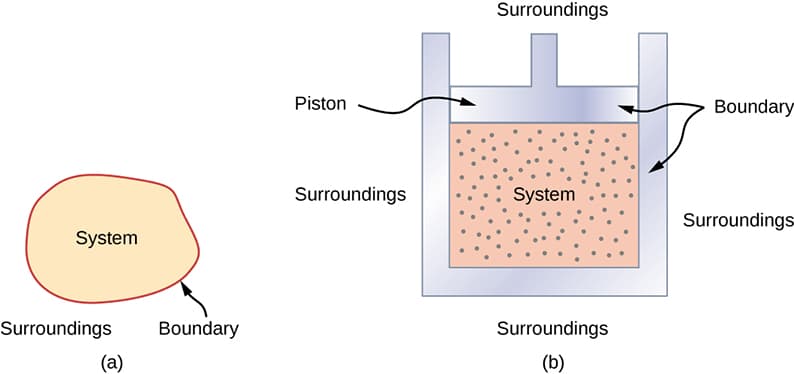
A thermodynamic system is a specific portion of the universe chosen for study.

Examples include:

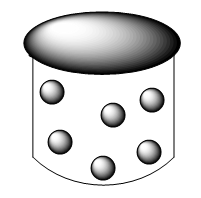
  • Gas inside a cylinder
  • Water inside a boiler
  • A chemical reaction mixture
  • The Earth’s atmosphere

Everything outside the system is called the surroundings.

Types of Systems

Open System

An open system exchanges both energy and matter with the surroundings.

Examples:

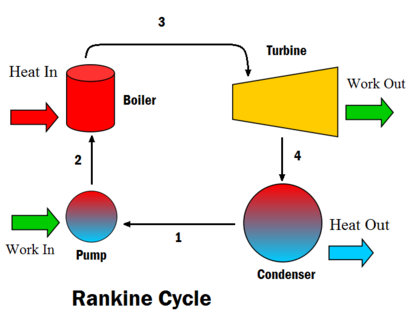
  • Steam turbine
  • Human body
  • Flowing river

Closed System

A closed system exchanges energy but not matter with surroundings.

Example:

  • Gas inside a sealed piston-cylinder device.

Isolated System

An isolated system exchanges neither energy nor matter.

Example:

  • The universe (considered an isolated system).

Boundary

The boundary separates the system from the surroundings. It may be real or imaginary.


Energy in Thermodynamics

Image
Image
Image
Image

Energy is the capacity to do work.

In thermodynamics, energy appears in different forms:

Kinetic Energy

Energy due to motion.

Example:

Moving gas molecules.

Potential Energy

Energy stored due to position or configuration.

Example:

Water stored in a dam.

Thermal Energy

Energy associated with temperature.

Chemical Energy

Energy stored in chemical bonds.

Electrical Energy

Energy due to electric charges.

Nuclear Energy

Energy stored in atomic nuclei.

All these forms of energy can transform into each other.


Internal Energy

Image
Image
Image
Image

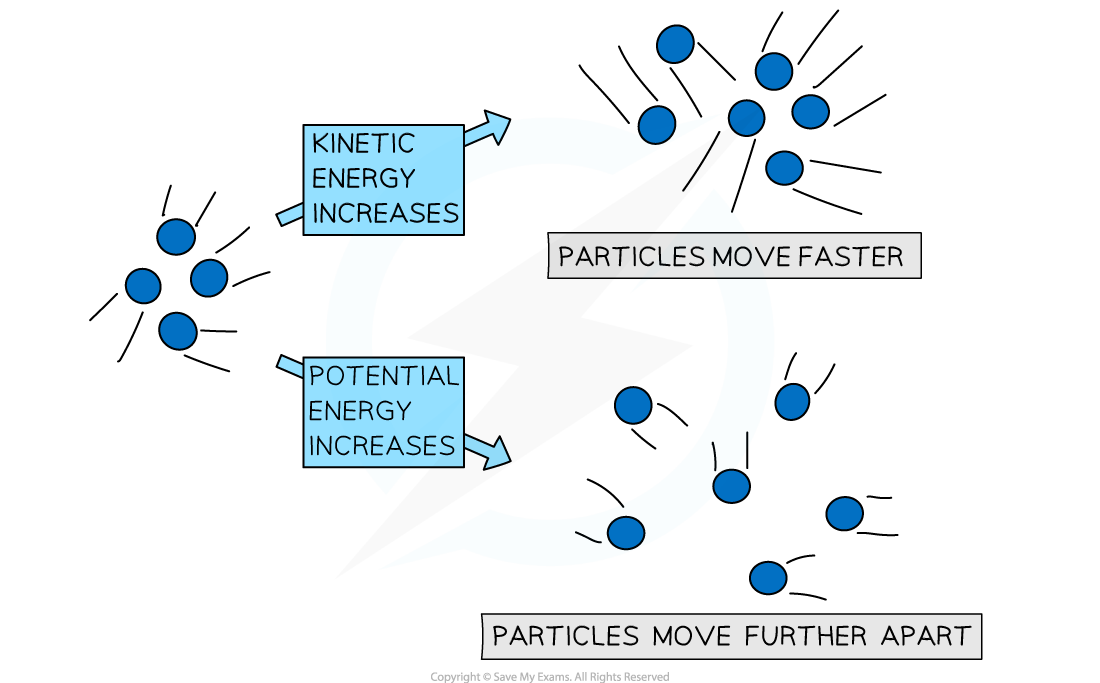
Internal energy (U) is the total microscopic energy contained within a system.

It includes:

  • Kinetic energy of molecules
  • Potential energy between molecules
  • Rotational and vibrational energies

Internal energy depends mainly on temperature and state of the system.

Important points:

  • Internal energy is a state function.
  • It depends only on the current state of the system, not on the path taken to reach that state.

Heat and Work
Image
Image
Image
Image

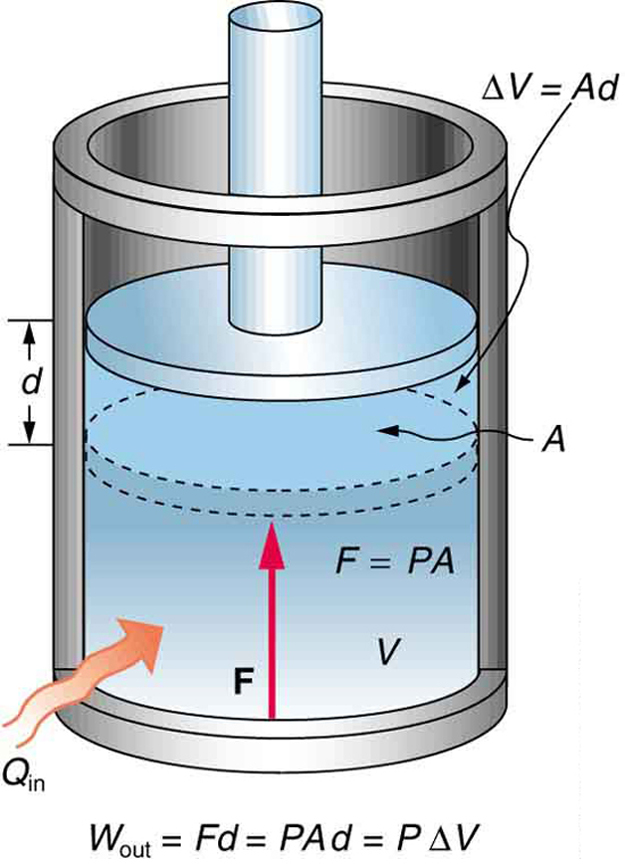
Energy can cross the system boundary in two ways:

Heat (Q)

Heat is energy transferred due to temperature difference between system and surroundings.

Examples:

  • Heating water on a stove
  • Sun warming the Earth
  • Heat transfer in engines

Characteristics of Heat

  • Flows from high temperature to low temperature
  • Measured in joules (J) or calories

Work (W)

Work is energy transferred when a force causes displacement.

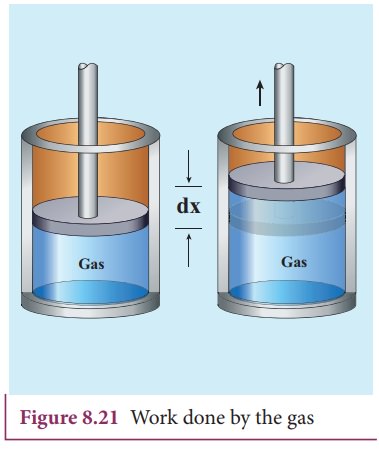
In thermodynamics, work commonly occurs when gas expands or compresses inside a piston.

Examples:

  • Steam pushing a piston
  • Air expanding in engines

Statement of the First Law of Thermodynamics

Image
Image
Image
Image

The First Law of Thermodynamics states:

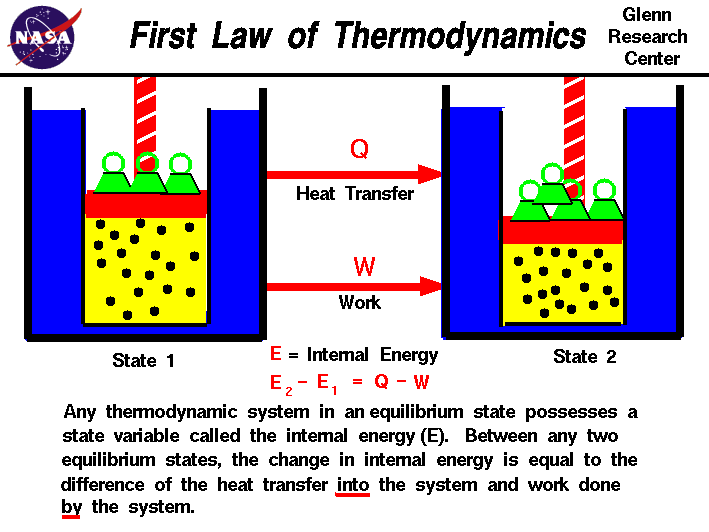
The change in internal energy of a system equals the heat added to the system minus the work done by the system.

Mathematical Form

[
\Delta U = Q – W
]

Where:

  • ( \Delta U ) = Change in internal energy
  • ( Q ) = Heat supplied to the system
  • ( W ) = Work done by the system

Interpretation

  • If heat enters the system → internal energy increases
  • If the system performs work → internal energy decreases

Sign Conventions

Understanding sign conventions is important in thermodynamics.

QuantitySignMeaning
Heat added to systemPositiveEnergy enters system
Heat removedNegativeEnergy leaves system
Work done by systemPositiveSystem uses energy
Work done on systemNegativeEnergy added to system

First Law for Different Thermodynamic Processes

Isothermal Process
Image
Image
Image
Image

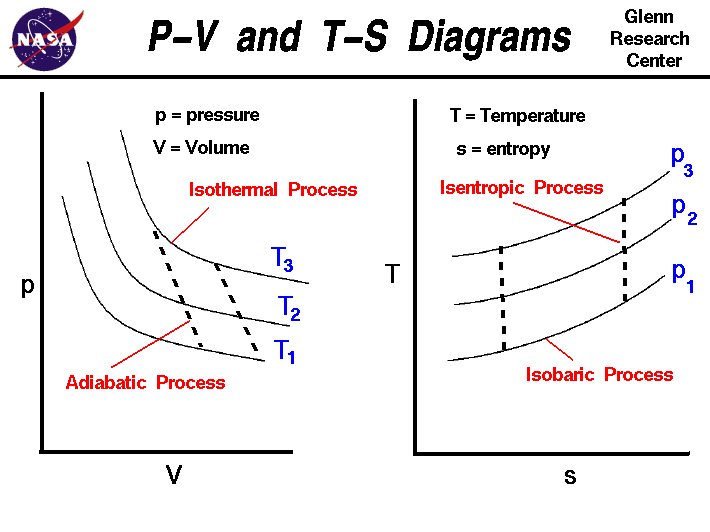
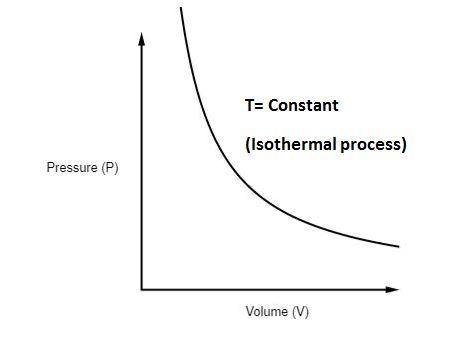
An isothermal process occurs at constant temperature.

Since internal energy depends on temperature:

[
\Delta U = 0
]

Thus,

[
Q = W
]

Meaning heat added to the system is completely converted into work.

Example:

Slow expansion of gas in a piston while temperature remains constant.


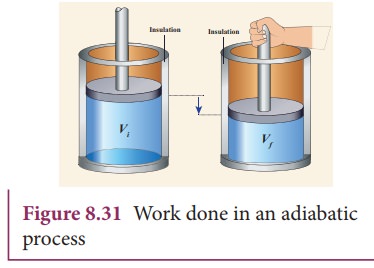
Adiabatic Process
Image
Image
Image
Image

In an adiabatic process, no heat is exchanged with surroundings.

[
Q = 0
]

Thus:

[
\Delta U = -W
]

Internal energy changes due to work done.

Examples:

  • Rapid compression of gas
  • Atmospheric processes
  • Diesel engine compression

Isochoric Process

Image
Image
Image
Image

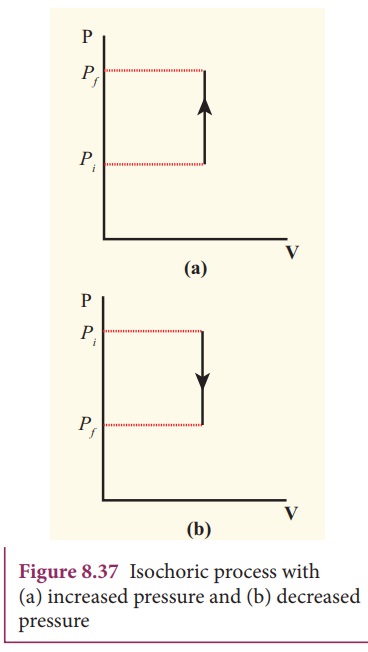
In an isochoric process, volume remains constant.

[
W = 0
]

Therefore:

[
\Delta U = Q
]

Heat added directly changes internal energy.

Example:

Heating gas in a rigid container.


Isobaric Process

Image
Image
Image
Image

In an isobaric process, pressure remains constant.

Work done:

[
W = P(V_2 – V_1)
]

The heat added is partly used for:

  • Increasing internal energy
  • Doing work

Applications of the First Law of Thermodynamics

Image
Image
Image
Image

The First Law has many practical applications.

Heat Engines

Heat engines convert thermal energy into mechanical work.

Examples:

  • Steam engines
  • Car engines
  • Gas turbines

Refrigerators

Refrigerators use work to transfer heat from cold regions to warm surroundings.

Power Plants

Thermal power plants convert heat from fuel into electricity.

Biological Systems

Human metabolism follows energy conservation principles.


Limitations of the First Law

The First Law has some limitations.

It does not explain:

  • Direction of heat flow
  • Why heat flows from hot to cold
  • Efficiency limits of engines

These questions are addressed by the Second Law of Thermodynamics.


Importance of the First Law

The First Law is one of the most important scientific principles because it:

  • Establishes energy conservation
  • Connects mechanical and thermal energy
  • Forms the basis of thermodynamic analysis
  • Helps design engines, turbines, and refrigerators
  • Explains chemical energy transformations

Conclusion

The First Law of Thermodynamics expresses the fundamental principle of energy conservation in thermodynamic systems. It states that energy can neither be created nor destroyed but can only be transformed between different forms such as heat, work, and internal energy.

The law provides a mathematical relationship that allows scientists and engineers to analyze energy changes in physical and chemical processes. By understanding how heat and work influence internal energy, we can design machines, engines, power plants, and refrigeration systems that operate efficiently.

Although the First Law does not explain the direction of energy flow or the efficiency limits of energy conversion, it remains the foundation of thermodynamics and energy science.


Tags

Temperature and Heat

Image
Image
Image
Image

1. Introduction to Temperature and Heat

Temperature and heat are two closely related concepts in physics that describe the thermal state of matter and the transfer of thermal energy between objects. These concepts are fundamental to the study of thermodynamics, which examines the relationships between heat, energy, work, and temperature.

Although the terms temperature and heat are often used interchangeably in everyday language, they represent different physical quantities. Temperature is a measure of the average kinetic energy of the particles in a substance, while heat refers to the energy that is transferred from one object to another because of a temperature difference.

Understanding temperature and heat is essential for explaining many natural phenomena and technological processes. For example, weather patterns, engine operation, refrigeration systems, cooking, and even biological processes all involve heat transfer and temperature changes.

In physics, heat energy flows from a region of higher temperature to a region of lower temperature until thermal equilibrium is reached. This flow of energy can occur through various mechanisms such as conduction, convection, and radiation.

The study of temperature and heat has played an important role in the development of science and engineering. It has led to the creation of thermometers, heat engines, refrigeration systems, and many other technologies that are vital to modern life.


2. Concept of Temperature

Temperature is a physical quantity that indicates how hot or cold an object is relative to other objects. It provides a measure of the thermal condition of matter and determines the direction of heat flow between objects.

Definition

Temperature can be defined as:

Temperature is the measure of the average kinetic energy of the particles in a substance.

When the particles in a substance move faster, their kinetic energy increases, and the temperature rises. When the particles move slower, the temperature decreases.

Temperature determines the direction of heat flow. Heat always flows from an object with higher temperature to one with lower temperature until both objects reach the same temperature.

Temperature Scales

Several temperature scales are used in science and everyday life.

Celsius Scale

The Celsius scale is widely used around the world. In this scale:

  • Water freezes at 0°C
  • Water boils at 100°C

This scale is based on the properties of water under standard atmospheric pressure.

Fahrenheit Scale

The Fahrenheit scale is mainly used in the United States.

  • Water freezes at 32°F
  • Water boils at 212°F

Kelvin Scale

The Kelvin scale is the SI unit of temperature used in scientific measurements.

  • Absolute zero: 0 K
  • Water freezes: 273 K
  • Water boils: 373 K

Kelvin scale is important in thermodynamics because it begins at absolute zero, the point where molecular motion theoretically stops.


3. Concept of Heat

Heat is a form of energy that flows from one body to another due to a temperature difference.

Definition

Heat can be defined as:

Heat is the energy transferred between objects because of a difference in temperature.

Heat is not something contained within an object. Instead, it refers to the energy in transit from one object to another.

Unit of Heat

The SI unit of heat energy is the joule (J).

Historically, heat was also measured in calories.

1 calorie = 4.186 joules

A calorie is defined as the amount of heat required to raise the temperature of 1 gram of water by 1°C.


4. Difference Between Heat and Temperature

Although heat and temperature are related, they represent different physical concepts.

Temperature measures the thermal state of a system, while heat represents energy transfer.

Temperature depends on the average kinetic energy of particles, while heat depends on both temperature and the amount of substance.

For example, a large container of warm water may contain more heat energy than a small cup of boiling water, even though the cup has higher temperature.

Thus, temperature indicates intensity of thermal energy, while heat indicates the total energy transferred.


5. Heat Transfer

Image
Image
Image
Image

Heat can be transferred from one place to another through three main processes.

Conduction

Conduction is the transfer of heat through direct contact between particles.

In conduction:

  • Heat flows from hot regions to cold regions.
  • Energy transfer occurs through collisions between molecules.

Example:

A metal spoon placed in hot tea becomes hot because heat travels through the metal by conduction.

Metals are good conductors because their electrons transfer energy efficiently.


Convection

Convection occurs in fluids such as liquids and gases.

In convection:

  • Heat transfer occurs through the movement of fluid.
  • Warmer fluid rises while cooler fluid sinks.

Example:

When water is heated in a pot, hot water rises and cooler water sinks, forming convection currents.

Convection plays an important role in atmospheric circulation and ocean currents.


Radiation

Radiation is the transfer of heat through electromagnetic waves.

Radiation does not require a medium.

Example:

Heat from the Sun reaches Earth through radiation.

All objects emit thermal radiation depending on their temperature.


6. Thermal Expansion

Image
Image
Image
Image

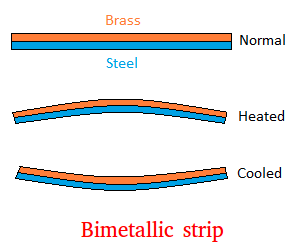
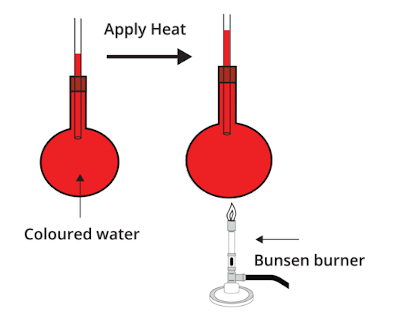
When materials are heated, they usually expand. This phenomenon is called thermal expansion.

As temperature increases, particles move more vigorously and occupy more space.

Types of Thermal Expansion

Linear Expansion

Expansion in one dimension such as length.

Example: expansion of railway tracks in hot weather.

Area Expansion

Expansion in two dimensions.

Example: expansion of metal plates.

Volume Expansion

Expansion in three dimensions.

Example: expansion of liquids and gases when heated.

Thermal expansion is important in engineering design to prevent structural damage.


7. Specific Heat Capacity

Specific heat capacity describes how much heat energy is required to raise the temperature of a substance.

Definition

Specific heat capacity is the amount of heat required to raise the temperature of one unit mass of a substance by one degree Celsius.

Formula:

Q = mcΔT

Where:

Q = heat energy
m = mass
c = specific heat capacity
ΔT = change in temperature

Different substances have different specific heat capacities.

Water has a high specific heat capacity, meaning it requires a large amount of heat to change its temperature.

This property plays an important role in regulating Earth’s climate.


8. Latent Heat

When a substance changes its state, heat energy is absorbed or released without changing temperature.

This heat is called latent heat.

Latent Heat of Fusion

Heat required to change solid into liquid.

Example:

Melting of ice.

Latent Heat of Vaporization

Heat required to change liquid into gas.

Example:

Boiling water turning into steam.

Latent heat explains why temperature remains constant during phase changes.


9. Thermodynamics and Heat

Thermodynamics is the branch of physics that studies heat and energy transformations.

It is governed by several important laws.

First Law of Thermodynamics

Energy cannot be created or destroyed.

It can only change from one form to another.

Example:

Heat energy converted into mechanical work in engines.


Second Law of Thermodynamics

Heat naturally flows from hotter objects to colder objects.

This law introduces the concept of entropy.


Third Law of Thermodynamics

As temperature approaches absolute zero, the entropy of a perfect crystal approaches zero.

These laws govern the behavior of thermal systems.


10. Applications of Heat and Temperature

Temperature and heat have numerous practical applications.

Cooking

Cooking uses heat transfer to change the chemical structure of food.

Refrigeration

Refrigerators remove heat from inside compartments to keep food cold.

Power Plants

Steam engines and turbines use heat to generate electricity.

Climate and Weather

Temperature differences drive atmospheric circulation and weather patterns.

Medical Applications

Thermometers measure body temperature to diagnose illness.


11. Heat in Nature

Heat plays an important role in many natural processes.

Examples include:

  • Solar heating of Earth’s atmosphere
  • Formation of ocean currents
  • Melting of glaciers
  • Volcanic heat from Earth’s interior

The Sun is the primary source of heat energy for Earth.

Solar radiation drives climate systems and supports life on the planet.


12. Measurement of Temperature

Temperature is measured using devices called thermometers.

Different types include:

  • Mercury thermometers
  • Alcohol thermometers
  • Digital thermometers
  • Infrared thermometers

Thermometers work based on properties that change with temperature, such as expansion of liquids or electrical resistance.


13. Importance of Temperature and Heat

Temperature and heat are fundamental to understanding energy transfer in physical systems.

They help explain:

  • Phase changes of matter
  • Climate and weather patterns
  • Operation of engines
  • Biological metabolism
  • Industrial processes

Without understanding heat and temperature, many modern technologies would not exist.


Conclusion

Temperature and heat are fundamental concepts in physics that describe the thermal state of matter and the transfer of energy due to temperature differences. Temperature measures the average kinetic energy of particles, while heat refers to energy transferred between objects.

Heat transfer occurs through conduction, convection, and radiation, allowing energy to move between systems. Thermal expansion, specific heat capacity, and latent heat explain how materials respond to temperature changes.

The study of temperature and heat forms the foundation of thermodynamics, which governs energy transformations in nature and technology. These concepts are essential for understanding processes such as climate dynamics, industrial heating, refrigeration, power generation, and biological functions.

By studying heat and temperature, scientists and engineers have developed technologies that improve daily life and deepen our understanding of natural phenomena.


Tags: