Category Archives: Chemistry

Chemical Kinetics

Image
Image
Image
Image

1. Introduction to Chemical Kinetics

Chemical kinetics is the branch of physical chemistry that deals with the study of reaction rates and the mechanisms by which chemical reactions occur. While thermodynamics tells us whether a reaction is possible or spontaneous, chemical kinetics explains how fast a reaction proceeds and through what pathway it occurs.

A chemical reaction involves the transformation of reactants into products. However, different reactions occur at vastly different speeds. Some reactions, such as explosions or combustion, occur in fractions of a second, whereas others, like rusting of iron or geological transformations, may take years or centuries.

Chemical kinetics seeks to answer several important questions:

  • How fast does a chemical reaction occur?
  • What factors influence the speed of a reaction?
  • What steps occur during the reaction process?
  • What molecular events lead to product formation?

Understanding chemical kinetics is extremely important in many fields including:

  • Industrial chemical production
  • Pharmaceutical drug development
  • Environmental chemistry
  • Biochemistry and enzymatic reactions
  • Materials science
  • Atmospheric chemistry

Through kinetic studies, scientists can design efficient chemical processes, control reaction speeds, and optimize conditions for maximum yield.


2. Rate of Chemical Reaction

Definition of Reaction Rate

The rate of a chemical reaction is defined as the change in concentration of reactants or products per unit time.

Mathematically, the rate can be expressed as:

[
\text{Rate} = \frac{\text{Change in concentration}}{\text{Time}}
]

For a reaction:

[
A \rightarrow B
]

Rate can be written as:

[
\text{Rate} = -\frac{d[A]}{dt} = \frac{d[B]}{dt}
]

The negative sign indicates the decrease in reactant concentration.


Units of Reaction Rate

Common units include:

  • mol L⁻¹ s⁻¹
  • M s⁻¹
  • mol dm⁻³ s⁻¹

Where:

  • mol = amount of substance
  • L = litre
  • s = seconds

Average Rate vs Instantaneous Rate

Average Rate

Average rate is measured over a time interval.

[
\text{Average rate} = \frac{\Delta [A]}{\Delta t}
]

Instantaneous Rate

Instantaneous rate is the rate at a specific moment in time and is determined using derivatives.

[
\text{Instantaneous rate} = \frac{d[A]}{dt}
]


3. Rate Laws

The rate law expresses the relationship between the reaction rate and the concentration of reactants.

For a reaction:

[
aA + bB \rightarrow Products
]

The rate law is:

[
Rate = k[A]^m[B]^n
]

Where:

  • k = rate constant
  • [A], [B] = concentrations
  • m, n = reaction orders

Order of Reaction

The order of a reaction indicates the power to which the concentration of a reactant is raised.

Types of Reaction Orders

  1. Zero-order reaction
  2. First-order reaction
  3. Second-order reaction
  4. Fractional order reaction
  5. Mixed-order reaction

Total order:

[
\text{Order} = m + n
]


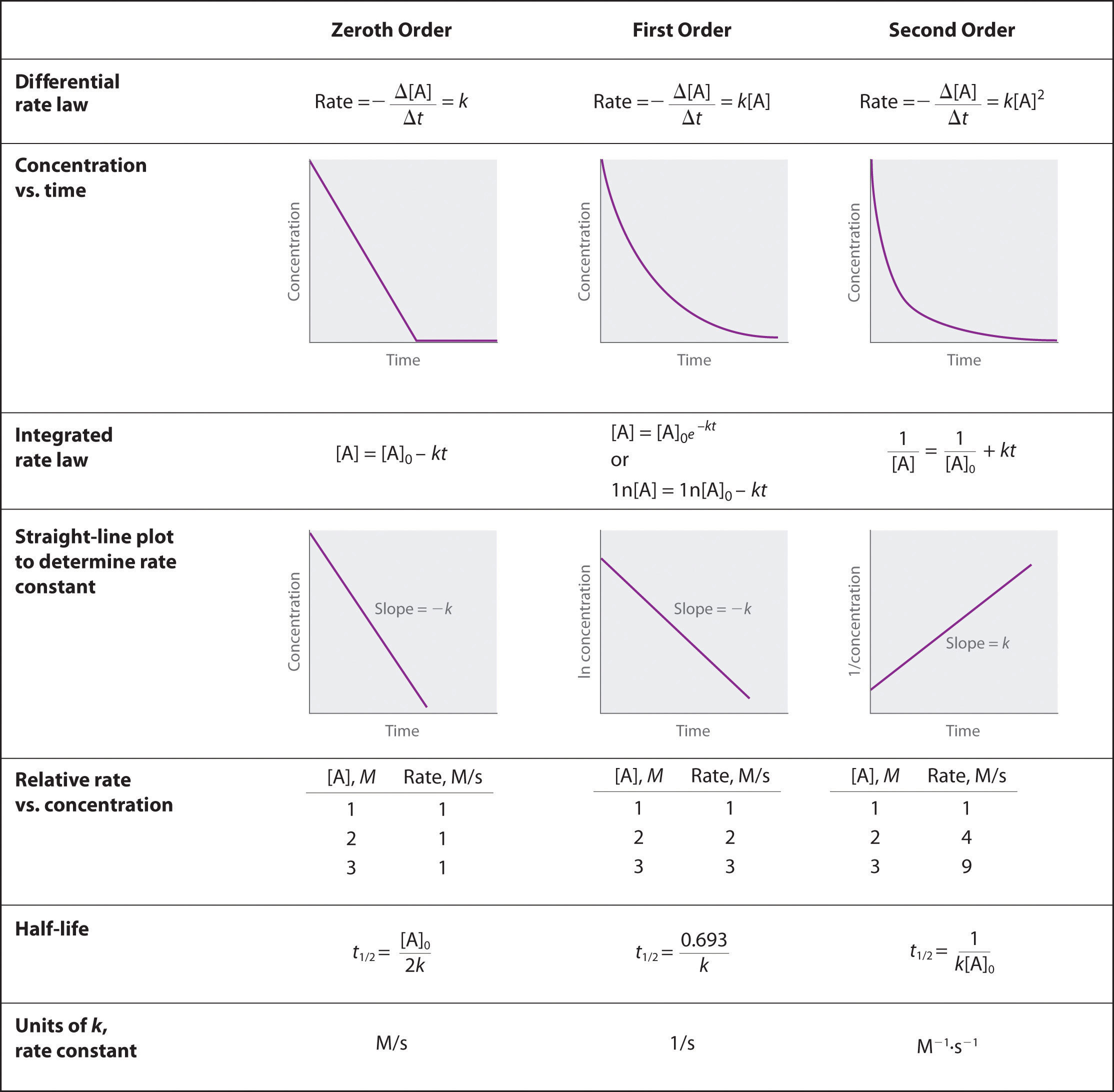
4. Zero-Order Reactions
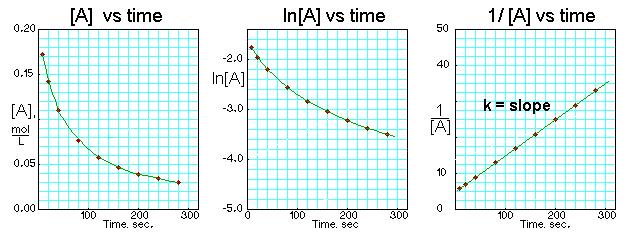
Image
Image
Image

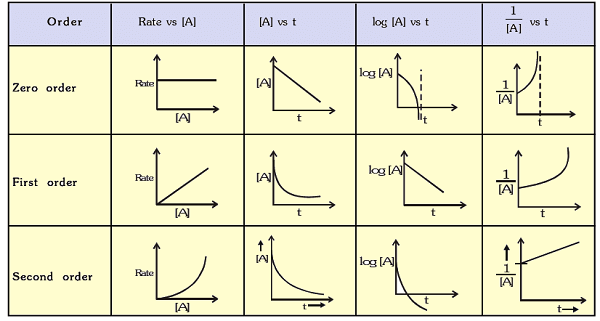
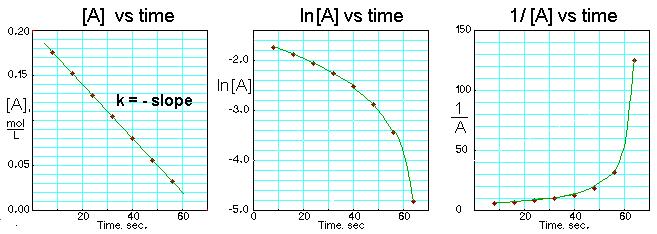
In zero-order reactions, the rate is independent of reactant concentration.

Rate law:

[
Rate = k
]

Integrated form:

[
[A] = [A]_0 – kt
]

Where:

  • ([A]_0) = initial concentration
  • (k) = rate constant
  • (t) = time

Characteristics

  • Rate is constant.
  • Graph of concentration vs time is linear.
  • Half-life depends on initial concentration.

Half-life:

[
t_{1/2} = \frac{[A]_0}{2k}
]

Examples

  • Photochemical reactions
  • Surface catalyzed reactions
  • Decomposition on metal surfaces

5. First-Order Reactions
Image
Image
Image
Image

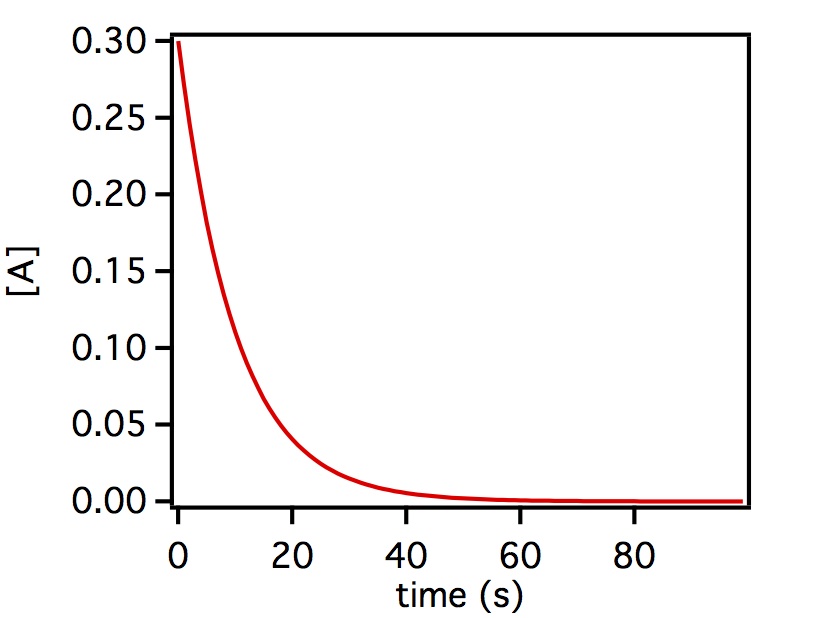
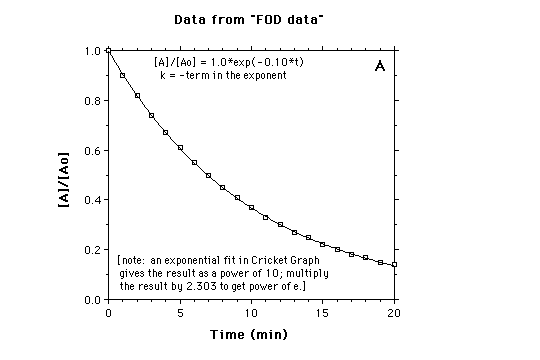
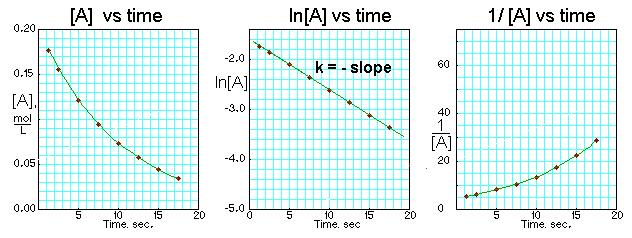
In first-order reactions, the rate is proportional to the concentration of one reactant.

Rate law:

[
Rate = k[A]
]

Integrated equation:

[
\ln[A] = \ln[A]_0 – kt
]

Alternate form:

[
[A] = [A]_0 e^{-kt}
]

Half-life

[
t_{1/2} = \frac{0.693}{k}
]

Key feature: Half-life is independent of initial concentration.

Examples

  • Radioactive decay
  • Decomposition of hydrogen peroxide
  • Conversion of N₂O₅ to NO₂ and O₂

6. Second-Order Reactions

Image
Image
Image
Image

Rate law:

[
Rate = k[A]^2
]

Integrated equation:

[
\frac{1}{[A]} = \frac{1}{[A]_0} + kt
]

Half-life

[
t_{1/2} = \frac{1}{k[A]_0}
]

Characteristics

  • Half-life depends on initial concentration.
  • Graph of (1/[A]) vs time is linear.

Examples

  • Dimerization reactions
  • Certain bimolecular reactions

7. Factors Affecting Reaction Rate
Image
Image
Image
Image

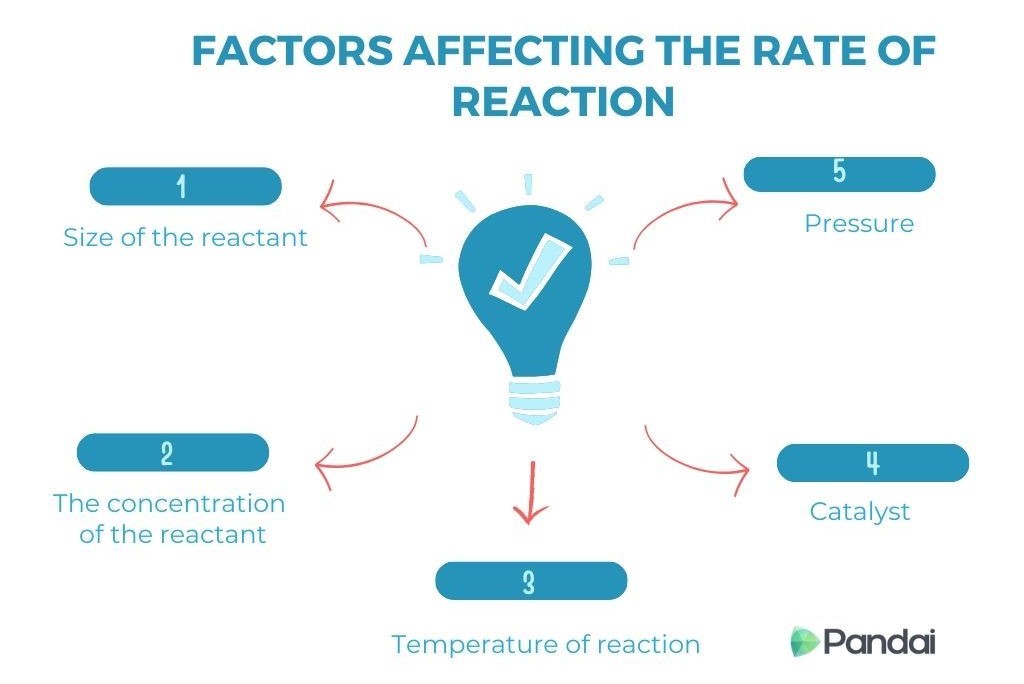
Several factors influence reaction rates.

1. Concentration

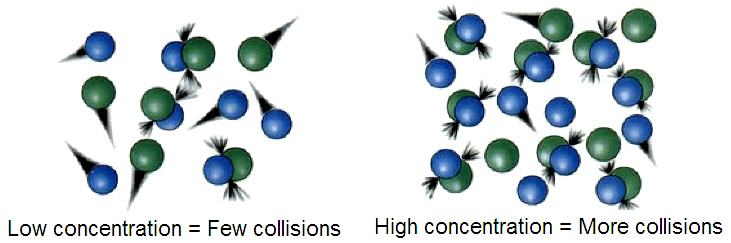
Increasing reactant concentration increases collision frequency, which increases reaction rate.

2. Temperature

Higher temperature increases molecular kinetic energy, resulting in more effective collisions.

Typically:

Rate doubles for every 10°C increase.


3. Catalysts

Catalysts increase reaction rate by lowering activation energy.

Characteristics:

  • Not consumed in reaction
  • Provide alternative reaction pathway
  • Increase efficiency

Examples:

  • Platinum in hydrogenation
  • Enzymes in biological reactions

4. Surface Area

In heterogeneous reactions, larger surface area increases reaction rate.

Example:

Powdered calcium carbonate reacts faster than solid marble.


5. Pressure

Important in gaseous reactions.

Increasing pressure increases concentration of gases.


6. Nature of Reactants

Some substances react faster than others depending on bond strength and molecular structure.


8. Collision Theory
Image
Image
Image
Image

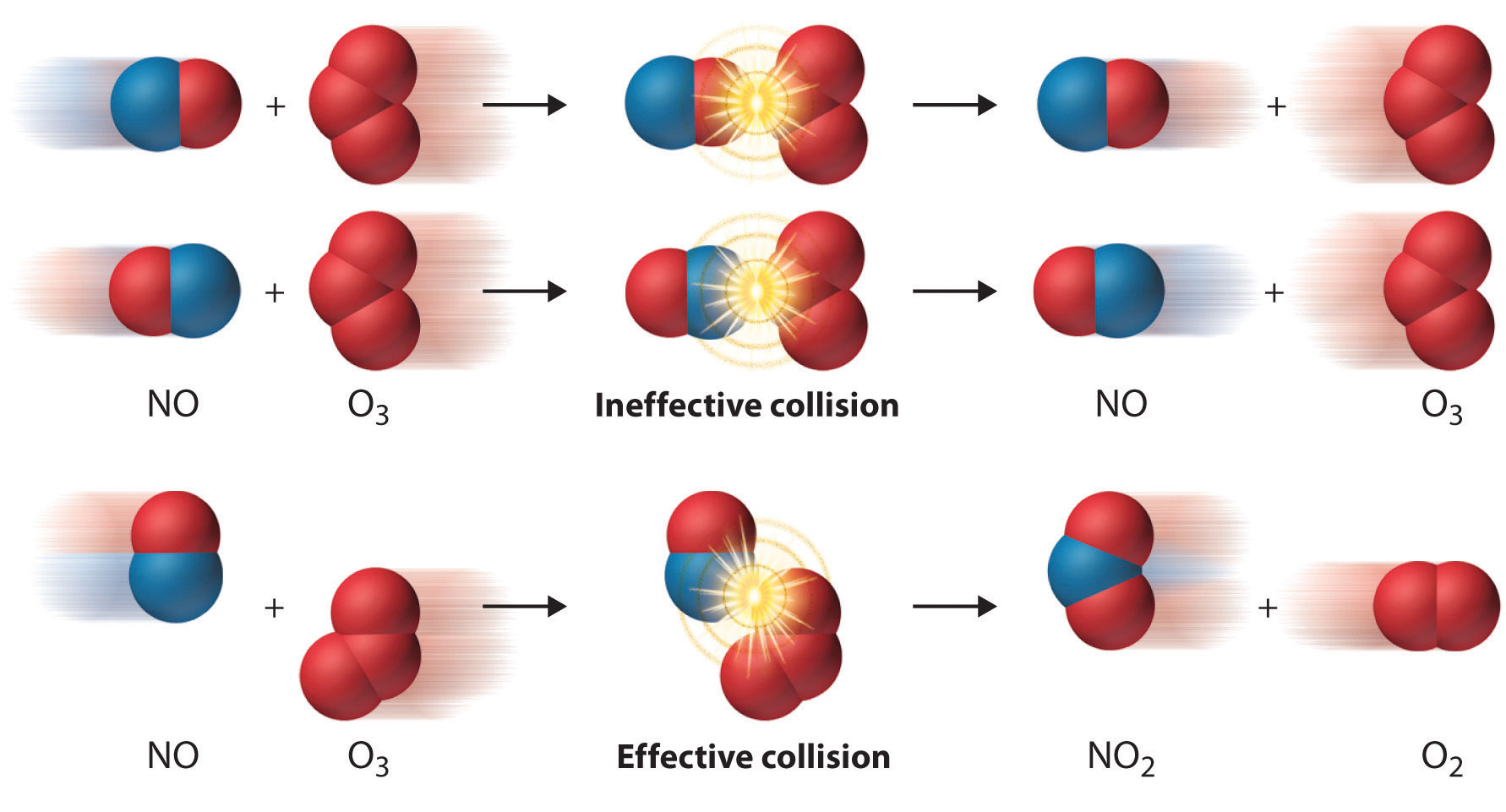
Collision theory explains how chemical reactions occur.

According to this theory:

  1. Molecules must collide to react.
  2. Collisions must have sufficient energy.
  3. Molecules must have correct orientation.

Effective Collisions

Only collisions meeting these conditions produce reactions.


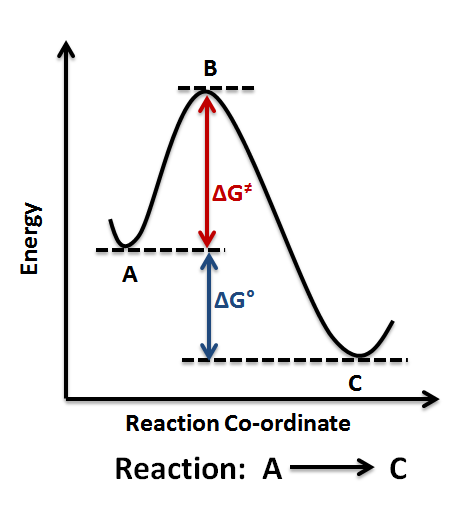
9. Activation Energy

Activation energy is the minimum energy required for a reaction to occur.

Energy profile diagram:

  • Reactants
  • Transition state
  • Products

Catalysts reduce activation energy.


10. Arrhenius Equation

The Arrhenius equation relates temperature and reaction rate.

[
k = Ae^{-E_a/RT}
]

Where:

  • (k) = rate constant
  • (A) = frequency factor
  • (E_a) = activation energy
  • (R) = gas constant
  • (T) = temperature

Linear form:

[
\ln k = \ln A – \frac{E_a}{RT}
]

Arrhenius plots help determine activation energy.


11. Reaction Mechanisms

A reaction mechanism describes the step-by-step sequence of elementary reactions.

Example mechanism:

Step 1: Slow step
Step 2: Fast step

The slow step is called the rate-determining step.


12. Intermediate Species

Intermediates are species formed in one step and consumed in another.

Examples:

  • Free radicals
  • Carbocations
  • Carbanions

They are unstable and short-lived.


13. Catalysis

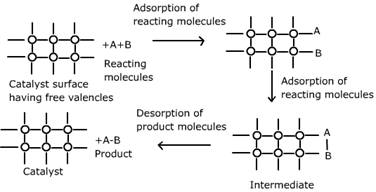
Image
Image
Image
Image

Catalysis is the acceleration of a chemical reaction using a catalyst.

Types:

Homogeneous Catalysis

Catalyst and reactants in same phase.

Example:
Acid-catalyzed ester hydrolysis.

Heterogeneous Catalysis

Catalyst in different phase.

Example:
Hydrogenation using metal catalysts.

Enzyme Catalysis

Biological catalysts.

Example:
Digestive enzymes.


14. Enzyme Kinetics

Enzymes are biological catalysts.

Reaction scheme:

[
E + S \rightarrow ES \rightarrow E + P
]

Where:

  • E = enzyme
  • S = substrate
  • ES = enzyme-substrate complex
  • P = product

Michaelis-Menten equation:

[
v = \frac{V_{max}[S]}{K_m + [S]}
]


15. Photochemical Reactions

These reactions occur due to absorption of light energy.

Example:

Photosynthesis
Ozone formation

Characteristics:

  • Initiated by photons
  • Often involve radicals

16. Chain Reactions

Chain reactions involve several repeating steps.

Steps:

  1. Initiation
  2. Propagation
  3. Termination

Example:

Chlorination of methane.


17. Steady State Approximation

Used for complex reactions.

Assumes concentration of intermediates remains constant.


18. Chemical Kinetics in Industry

Chemical kinetics is essential in industrial processes:

Examples:

  • Haber process
  • Petroleum refining
  • Polymer manufacturing
  • Pharmaceutical synthesis

Optimizing reaction rate improves:

  • Production efficiency
  • Energy use
  • Product yield

19. Applications of Chemical Kinetics

Applications include:

  1. Drug development
  2. Environmental pollution control
  3. Food preservation
  4. Material synthesis
  5. Battery technology
  6. Atmospheric chemistry

20. Importance of Chemical Kinetics

Chemical kinetics helps scientists:

  • Understand reaction mechanisms
  • Predict reaction behavior
  • Design catalysts
  • Control industrial processes
  • Develop sustainable chemical technologies

Conclusion

Chemical kinetics is a fundamental branch of chemistry that explains how and why chemical reactions occur at particular speeds. By studying reaction rates, rate laws, mechanisms, and energy changes, chemists gain insight into the microscopic processes that govern chemical transformations. From industrial production to biological systems, the principles of chemical kinetics play a vital role in modern science and technology.

Tags

Gibbs Free Energy

Image
Image
Image
Image

Introduction

Gibbs Free Energy is one of the most important concepts in thermodynamics and physical chemistry. It is used to determine whether a chemical reaction or physical process will occur spontaneously under constant temperature and pressure. Named after the American scientist Josiah Willard Gibbs, this thermodynamic potential combines the effects of enthalpy (heat content) and entropy (degree of disorder) to predict the direction of chemical reactions.

In many natural and industrial processes, systems tend to move toward states that minimize free energy. Gibbs Free Energy provides a quantitative way to understand this tendency and to predict the feasibility of reactions.

The concept of Gibbs Free Energy is widely used in many areas of science, including:

  • Chemistry
  • Biology
  • Materials science
  • Environmental science
  • Chemical engineering

It is particularly important in understanding chemical equilibrium, biochemical reactions, and energy transformations in living organisms.


1. Definition of Gibbs Free Energy

Gibbs Free Energy represents the maximum amount of useful work that can be obtained from a thermodynamic system at constant temperature and pressure.

It is defined mathematically as:

G = H – TS

Where:

G = Gibbs Free Energy
H = Enthalpy
T = Absolute temperature (Kelvin)
S = Entropy

This equation shows that free energy depends on both the heat content of the system and the disorder within the system.


2. Change in Gibbs Free Energy

The change in Gibbs Free Energy during a chemical reaction is expressed as:

\Delta G = \Delta H – T\Delta S

Where:

ΔG = change in Gibbs Free Energy
ΔH = change in enthalpy
T = absolute temperature
ΔS = change in entropy

This equation is fundamental in predicting whether a reaction will occur spontaneously.


3. Interpretation of Gibbs Free Energy

The sign of ΔG determines the spontaneity of a process.

Negative ΔG

If ΔG is negative:

  • The process is spontaneous
  • The reaction can occur without external energy input

Examples include combustion reactions and many biochemical reactions.


Positive ΔG

If ΔG is positive:

  • The reaction is non-spontaneous
  • External energy is required for the reaction to occur

An example is photosynthesis, which requires energy from sunlight.


ΔG Equal to Zero

If ΔG equals zero:

  • The system is in equilibrium
  • The forward and reverse reactions occur at the same rate

At equilibrium, no net change occurs in the system.


4. Relationship Between Enthalpy, Entropy, and Gibbs Free Energy

Image
Image
Image
Image

The Gibbs Free Energy equation shows how enthalpy and entropy influence reaction spontaneity.

There are four possible combinations of enthalpy and entropy changes.


Case 1: ΔH Negative, ΔS Positive

  • Reaction releases heat
  • Disorder increases

These reactions are always spontaneous.

Example:

Combustion reactions.


Case 2: ΔH Positive, ΔS Negative

  • Heat absorbed
  • Disorder decreases

These reactions are never spontaneous.


Case 3: ΔH Negative, ΔS Negative

Reaction may be spontaneous at low temperatures.


Case 4: ΔH Positive, ΔS Positive

Reaction may be spontaneous at high temperatures.


5. Free Energy and Chemical Equilibrium

Gibbs Free Energy is closely related to chemical equilibrium.

At equilibrium:

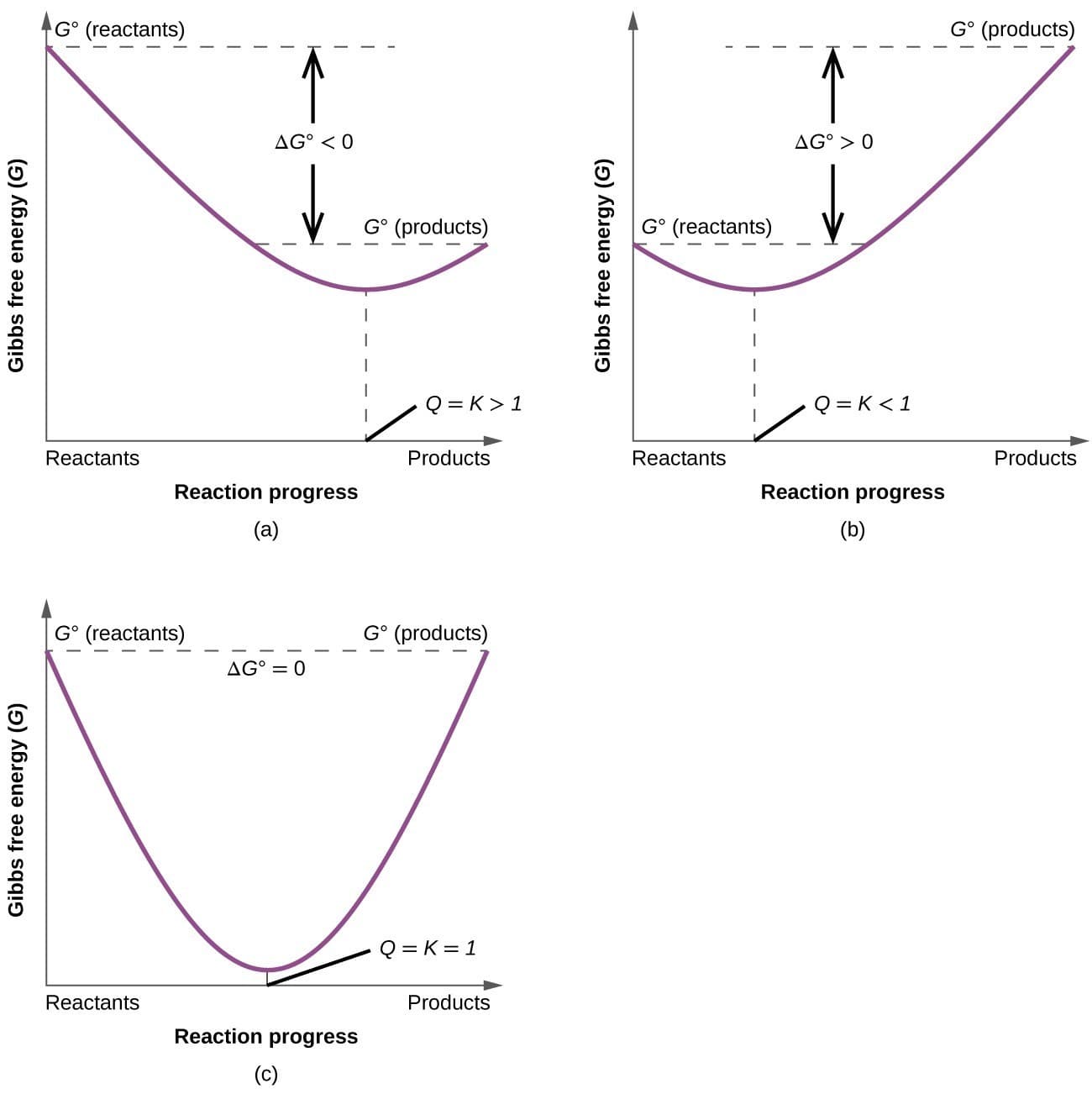
ΔG = 0

The relationship between free energy and the equilibrium constant is given by:

\Delta G^{\circ} = -RT \ln K

Where:

ΔG° = standard free energy change
R = gas constant
T = temperature in Kelvin
K = equilibrium constant


Interpretation

If K > 1 → reaction favors products
If K < 1 → reaction favors reactants

This relationship allows chemists to predict equilibrium conditions.


6. Standard Gibbs Free Energy

Standard Gibbs Free Energy refers to free energy change measured under standard conditions.

Standard conditions include:

  • Temperature = 298 K
  • Pressure = 1 atm
  • Concentration = 1 mol/L

Standard values are used for comparing reactions and calculating thermodynamic properties.


7. Gibbs Free Energy in Chemical Reactions

Image
Image
Image
Image

Chemical reactions can be classified based on free energy changes.


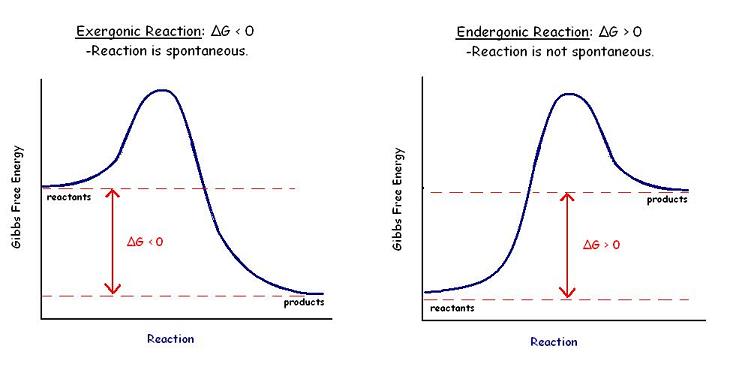
Exergonic Reactions

Exergonic reactions release free energy.

Characteristics:

  • ΔG is negative
  • Reaction occurs spontaneously

Example:

Cellular respiration.


Endergonic Reactions

Endergonic reactions require energy input.

Characteristics:

  • ΔG is positive
  • Reaction does not occur spontaneously

Example:

Photosynthesis.


8. Temperature Dependence of Gibbs Free Energy

Temperature plays a significant role in determining reaction spontaneity.

From the equation:

ΔG = ΔH − TΔS

Increasing temperature increases the influence of entropy.

Some reactions become spontaneous only at high temperatures.

Example:

Melting of ice occurs when temperature rises above 0°C.


9. Gibbs Free Energy in Biological Systems

Gibbs Free Energy is essential in understanding biochemical reactions.

Living organisms rely on energy transformations to sustain life.


ATP and Free Energy

The molecule ATP (adenosine triphosphate) stores and releases energy for cellular processes.

Hydrolysis of ATP releases free energy used in:

  • Muscle contraction
  • Protein synthesis
  • Active transport

Metabolism

Metabolic pathways involve sequences of reactions that either release or consume free energy.

Cells maintain energy balance through these processes.


10. Gibbs Free Energy and Phase Transitions

Gibbs Free Energy also explains phase changes such as melting, freezing, and vaporization.

At equilibrium between two phases:

Gsolid = Gliquid

or

Gliquid = Ggas

Phase transitions occur when free energy of one phase becomes lower than another.


11. Applications of Gibbs Free Energy

Gibbs Free Energy is widely used across many scientific and engineering disciplines.


Chemical Engineering

Engineers use free energy calculations to design chemical reactors and optimize industrial processes.


Electrochemistry

Free energy changes determine electrical energy produced by batteries and fuel cells.


Environmental Science

Free energy helps explain chemical reactions occurring in the atmosphere and oceans.


Materials Science

Free energy analysis helps determine the stability of materials and phase transformations.


12. Importance of Gibbs Free Energy

Gibbs Free Energy is a powerful concept that integrates multiple thermodynamic principles into a single framework. By combining enthalpy and entropy, it allows scientists to predict the direction and feasibility of reactions.

The concept helps explain why some reactions occur naturally while others require energy input. It also provides insights into equilibrium conditions, reaction mechanisms, and energy efficiency.

Understanding Gibbs Free Energy is essential for studying chemical reactions, biological systems, and energy transformations.


Conclusion

Gibbs Free Energy is one of the most important thermodynamic quantities used to determine whether chemical reactions and physical processes occur spontaneously. It combines the effects of enthalpy and entropy into a single equation that describes the usable energy available in a system.

A negative change in Gibbs Free Energy indicates a spontaneous process, while a positive change indicates that energy must be supplied. When free energy change is zero, the system is at equilibrium.

The Gibbs Free Energy equation also reveals how temperature influences reaction spontaneity and how energy transformations occur in chemical and biological systems.

From predicting chemical equilibrium to understanding metabolic reactions in living organisms, Gibbs Free Energy plays a critical role in modern science and technology. Its applications extend across chemistry, biology, engineering, and environmental science, making it one of the most fundamental concepts in thermodynamics.


Entropy

Image
Image
Image
Image

Introduction

Entropy is a fundamental concept in thermodynamics, physics, chemistry, and information theory. It describes the degree of disorder, randomness, or energy dispersal within a system. The concept of entropy plays a central role in understanding natural processes, chemical reactions, and the direction in which physical systems evolve over time.

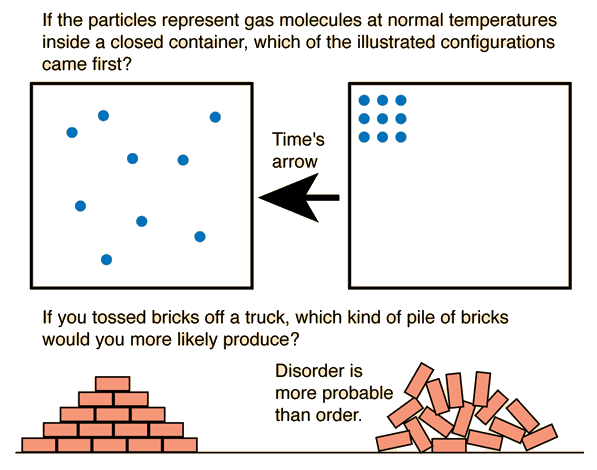
In simple terms, entropy measures how spread out or disorganized the energy in a system is. Systems naturally evolve toward states with greater disorder and higher entropy. This principle explains many everyday phenomena, such as why ice melts, gases expand, and heat flows from hot objects to cold objects.

Entropy was first introduced in the 19th century by the German physicist Rudolf Clausius while studying heat engines and thermodynamic processes. Later, scientists such as Ludwig Boltzmann connected entropy with molecular motion and probability, giving the concept a deeper statistical interpretation.

Entropy is closely related to the Second Law of Thermodynamics, which states that the total entropy of an isolated system always increases over time. This law explains why certain processes occur spontaneously while others do not.

Entropy has become one of the most important ideas in modern science. It helps scientists understand processes ranging from molecular reactions and phase transitions to cosmology and information processing.


1. Definition of Entropy

Entropy is a thermodynamic property that measures the degree of disorder or randomness in a system.

In thermodynamics, entropy is symbolized by S.

Entropy can also be described as the measure of energy dispersal within a system.

For example:

  • A perfectly ordered crystal has very low entropy.
  • A gas with freely moving molecules has high entropy.

As systems become more disordered, their entropy increases.


2. Mathematical Expression of Entropy

The change in entropy during a thermodynamic process is defined by the relationship:

\Delta S = \frac{Q_{rev}}{T}

Where:

ΔS = change in entropy
Qrev = heat absorbed in a reversible process
T = absolute temperature (Kelvin)

This equation shows that entropy change depends on the amount of heat transferred and the temperature at which the transfer occurs.


3. Statistical Interpretation of Entropy

The Austrian physicist Ludwig Boltzmann connected entropy with molecular behavior.

His famous equation is:

S = k \ln W

Where:

S = entropy
k = Boltzmann constant
W = number of possible microscopic arrangements (microstates)

This equation means that entropy increases when the number of possible molecular arrangements increases.

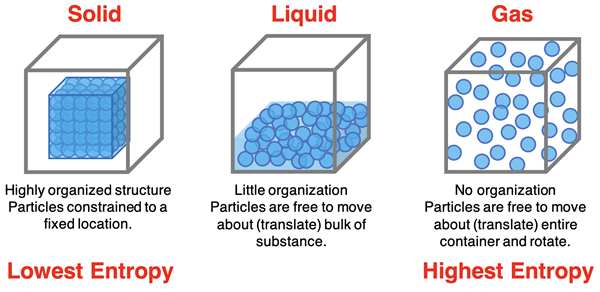
For example:

  • A crystal has very few possible arrangements.
  • A gas has many possible arrangements.

Therefore, gases have much higher entropy than solids.


4. Entropy and Disorder

Image
Image
Image
Image

Entropy is often associated with disorder.

Low Entropy

Systems with high order have low entropy.

Examples include:

  • Crystalline solids
  • Highly organized molecular structures

High Entropy

Systems with greater randomness have higher entropy.

Examples include:

  • Gases
  • Mixed substances
  • Random particle arrangements

Entropy in Different States of Matter

Entropy increases when matter changes from more ordered states to less ordered states.

Typical order of entropy:

Solid < Liquid < Gas

This means gases have the highest entropy because their molecules move freely and randomly.


5. The Second Law of Thermodynamics

The Second Law of Thermodynamics states that the total entropy of an isolated system always increases over time.

This law explains the natural direction of processes in the universe.

In simpler terms:

Natural processes tend to move toward greater disorder.


Examples of the Second Law

Many everyday phenomena illustrate the second law.

Heat Transfer

Heat flows naturally from hot objects to cold objects.

It does not spontaneously flow in the opposite direction.


Mixing of Gases

When two gases mix, they do not spontaneously separate again.

The mixing process increases entropy.


Ice Melting

Ice melts at room temperature because the liquid state has higher entropy than the solid state.


6. Entropy and Spontaneity

Entropy plays a major role in determining whether a process occurs spontaneously.

A spontaneous process is one that occurs naturally without external intervention.

Examples include:

  • Gas expansion
  • Dissolution of salt in water
  • Heat transfer from hot to cold bodies

Processes that increase entropy tend to occur spontaneously.

However, entropy alone does not fully determine spontaneity. Other factors such as enthalpy also play a role.


7. Entropy Changes in Physical Processes

Image
Image
Image
Image

Entropy changes occur during phase transitions.


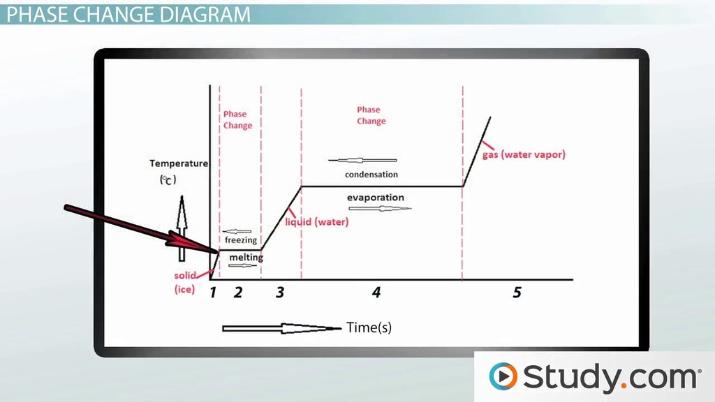
Melting

When a solid melts into a liquid, entropy increases because particles gain freedom of movement.

Example:

Ice melting into water.


Vaporization

When a liquid becomes gas, entropy increases significantly because molecules move freely.

Example:

Water boiling into steam.


Freezing

When a liquid freezes into a solid, entropy decreases because particles become more ordered.


Condensation

Gas turning into liquid decreases entropy.


8. Entropy Changes in Chemical Reactions

Entropy also changes during chemical reactions.

Reactions that produce more gas molecules usually increase entropy.

Examples:

  • Decomposition reactions producing gases
  • Reactions that increase molecular randomness

Reactions forming solid products generally decrease entropy.


9. Standard Entropy

Standard entropy is the entropy of a substance measured under standard conditions.

Standard conditions typically include:

  • Temperature = 298 K
  • Pressure = 1 atm

Standard entropy values allow scientists to calculate entropy changes for chemical reactions.


10. Gibbs Free Energy and Entropy

Entropy works together with enthalpy to determine reaction spontaneity.

The relationship is given by the Gibbs Free Energy equation.

\Delta G = \Delta H – T\Delta S

Where:

ΔG = change in Gibbs free energy
ΔH = enthalpy change
T = temperature
ΔS = entropy change


Interpretation of Gibbs Free Energy

If ΔG < 0 → reaction is spontaneous

If ΔG > 0 → reaction is non-spontaneous

If ΔG = 0 → system is in equilibrium

Entropy contributes significantly to determining the value of Gibbs free energy.


11. Entropy in the Universe

The second law of thermodynamics applies to the entire universe.

The total entropy of the universe continually increases.

This principle has major implications in cosmology and physics.

Over long time scales, systems tend to move toward thermodynamic equilibrium, where entropy reaches its maximum.


12. Applications of Entropy

Entropy has many applications across different scientific fields.


Chemical Reactions

Chemists use entropy to predict whether reactions occur spontaneously.


Engineering and Energy Systems

Entropy analysis helps improve efficiency in:

  • Heat engines
  • Power plants
  • Refrigeration systems

Biology

Biological systems maintain low internal entropy by exchanging energy with the environment.

Examples include:

  • Metabolism
  • Cellular processes

Information Theory

Entropy is used in information theory to measure uncertainty in data systems.

It plays an important role in computer science, cryptography, and data compression.


13. Importance of Entropy

Entropy provides deep insight into the direction of natural processes. It explains why energy transformations occur in a particular way and why certain processes cannot be reversed without external energy input.

The concept also reveals the probabilistic nature of molecular motion and helps bridge the gap between microscopic molecular behavior and macroscopic thermodynamic observations.

Entropy is one of the central ideas connecting physics, chemistry, biology, and information science.


Conclusion

Entropy is a fundamental thermodynamic property that measures the level of disorder or randomness within a system. It plays a key role in understanding how energy is distributed and how physical and chemical processes occur.

The concept of entropy is closely linked to the Second Law of Thermodynamics, which states that the total entropy of an isolated system increases over time. This principle explains why natural processes such as heat transfer, gas expansion, and mixing occur spontaneously.

Entropy changes occur during phase transitions, chemical reactions, and energy transformations. By combining entropy with enthalpy through the Gibbs free energy equation, scientists can predict whether a reaction will occur naturally.

Beyond thermodynamics, entropy has broad applications in fields such as engineering, biology, cosmology, and information theory. Its importance extends far beyond chemistry, making it one of the most powerful and universal concepts in science.

Understanding entropy provides insight into the fundamental laws governing the universe and helps explain the natural tendency of systems to evolve toward greater disorder and energy dispersal.


Tags:

Enthalpy and Heat Changes

Image
Image
Image
Image

Introduction

In thermodynamics and chemistry, enthalpy is a fundamental concept used to describe the heat energy of a system. It is especially important in studying chemical reactions and physical changes, where energy is either released or absorbed.

When substances undergo chemical reactions or phase transitions, energy changes occur in the form of heat. These heat changes help scientists understand whether a reaction will release energy to the surroundings or absorb energy from the environment.

Enthalpy provides a convenient way to measure these energy changes when reactions occur at constant pressure, which is the condition under which most chemical reactions take place in open systems such as laboratories and natural environments.

The study of enthalpy and heat changes helps scientists analyze reaction energetics, predict reaction behavior, design industrial processes, and understand biological systems. It is also essential for fields such as materials science, environmental chemistry, chemical engineering, and biochemistry.


1. Concept of Enthalpy

Definition of Enthalpy

Enthalpy is defined as the total heat content of a system.

Mathematically, enthalpy is expressed as:

H = U + PV

Where:

H = Enthalpy
U = Internal energy of the system
P = Pressure
V = Volume

This equation indicates that enthalpy includes both the internal energy of the system and the energy associated with pressure and volume.


Enthalpy Change

During chemical reactions or physical processes, the enthalpy of the system may change.

The enthalpy change is represented as:

\Delta H = H_{products} – H_{reactants}

Where:

ΔH = Change in enthalpy
Hproducts = Enthalpy of products
Hreactants = Enthalpy of reactants

A positive ΔH indicates heat absorption, while a negative ΔH indicates heat release.


2. Heat and Energy Transfer

Heat is the transfer of thermal energy from one system to another due to a temperature difference.

In thermodynamics, heat flow occurs between a system and its surroundings.

Heat can move in different directions depending on the temperature difference between the system and its surroundings.


Heat Flow

Heat flows from higher temperature regions to lower temperature regions until thermal equilibrium is reached.

For example:

  • A hot object cools down in a cold room.
  • Ice melts when placed in warm water.

Units of Heat

Heat energy can be measured using different units:

  • Joule (J)
  • Kilojoule (kJ)
  • Calorie (cal)

Conversion relationship:

1 calorie = 4.184 joules


3. Exothermic and Endothermic Reactions

Image
Image
Image
Image

Chemical reactions are classified according to their heat changes.


Exothermic Reactions

Exothermic reactions release heat to the surroundings.

Characteristics:

  • ΔH is negative
  • Temperature of surroundings increases

Examples:

  • Combustion of fuels
  • Respiration
  • Formation of ice from water

In energy diagrams, products have lower energy than reactants.


Endothermic Reactions

Endothermic reactions absorb heat from the surroundings.

Characteristics:

  • ΔH is positive
  • Temperature of surroundings decreases

Examples:

  • Photosynthesis
  • Melting of ice
  • Evaporation of water

In energy diagrams, products have higher energy than reactants.


4. Enthalpy Changes in Chemical Reactions

Several types of enthalpy changes occur in chemical processes.


Enthalpy of Reaction

The enthalpy of reaction is the heat change when a chemical reaction occurs under constant pressure.

It represents the difference in energy between reactants and products.


Enthalpy of Formation

The enthalpy of formation refers to the heat change when one mole of a compound forms from its elements in their standard states.

Example:

Formation of water from hydrogen and oxygen.


Enthalpy of Combustion

Image
Image
Image
Image

The enthalpy of combustion is the heat released when one mole of a substance completely burns in oxygen.

Examples include:

  • Burning methane
  • Burning gasoline
  • Burning coal

Combustion reactions are usually highly exothermic.


Enthalpy of Neutralization

This refers to the heat change when an acid reacts with a base to form water and salt.

Example:

Hydrochloric acid reacting with sodium hydroxide.


Enthalpy of Solution

Enthalpy of solution is the heat change when a solute dissolves in a solvent.

It may be either exothermic or endothermic.


5. Enthalpy Changes in Physical Processes

Enthalpy changes are not limited to chemical reactions. They also occur during physical changes.


Enthalpy of Fusion

Image
Image
Image
Image

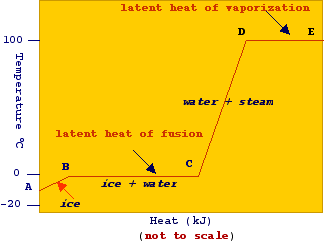
The enthalpy of fusion is the heat required to convert a solid into a liquid at its melting point.

Example:

Ice melting into water.


Enthalpy of Vaporization

The enthalpy of vaporization is the heat required to convert a liquid into vapor at its boiling point.

Example:

Water boiling into steam.


Enthalpy of Sublimation

Sublimation occurs when a solid changes directly into gas.

Example:

Dry ice turning into carbon dioxide gas.


6. Hess’s Law

Hess’s Law states that the total enthalpy change of a reaction is independent of the pathway taken.

In other words, the overall enthalpy change depends only on the initial and final states.

This law allows scientists to calculate enthalpy changes for reactions that are difficult to measure directly.


7. Bond Enthalpy

Bond enthalpy refers to the energy required to break a chemical bond.

Breaking bonds requires energy, while forming bonds releases energy.

The overall enthalpy change of a reaction depends on the balance between these two processes.


8. Calorimetry

Image
Image
Image
Image

Calorimetry is the experimental technique used to measure heat changes during chemical reactions.

The instrument used is called a calorimeter.


Coffee Cup Calorimeter

Used to measure heat changes in reactions occurring in solution.

Typically used in laboratory experiments.


Bomb Calorimeter

Used to measure heat released during combustion reactions.

The reaction occurs in a sealed metal container surrounded by water.


9. Thermochemical Equations

Thermochemical equations represent chemical reactions along with their enthalpy changes.

Example:

Hydrogen + Oxygen → Water + Heat

These equations help scientists quantify energy changes in chemical reactions.


10. Applications of Enthalpy

Enthalpy changes are important in many fields.


Industrial Chemistry

Industries use enthalpy data to design energy-efficient processes.

Examples include:

  • Fuel production
  • Fertilizer manufacturing
  • Petrochemical processing

Energy Production

Combustion reactions release large amounts of heat energy used in power plants.


Environmental Science

Enthalpy changes influence atmospheric processes and climate systems.


Biological Systems

Living organisms rely on energy released from biochemical reactions.

For example:

Cellular respiration releases heat and energy needed for life processes.


11. Importance of Enthalpy in Chemistry

Enthalpy provides insight into how energy changes occur during chemical reactions and physical transformations. By studying enthalpy, chemists can predict reaction behavior, determine whether a reaction releases or absorbs energy, and design chemical processes that maximize efficiency.

Understanding enthalpy changes also allows scientists to study reaction mechanisms, measure bond strengths, and analyze energy flow within complex systems. These insights are essential for developing new fuels, improving industrial processes, and understanding biological energy systems.


Conclusion

Enthalpy and heat changes are central concepts in thermodynamics and chemistry. Enthalpy represents the heat content of a system and allows scientists to measure energy changes during chemical reactions and physical transformations.

Reactions may be classified as exothermic or endothermic depending on whether heat is released or absorbed. Enthalpy changes also occur during processes such as melting, vaporization, combustion, and dissolution.

Principles such as Hess’s Law and bond enthalpy provide tools for calculating energy changes in complex reactions. Experimental techniques like calorimetry allow scientists to measure these heat changes accurately.

The study of enthalpy is essential for understanding energy transformations in nature and technology. From chemical manufacturing and power generation to biological metabolism and environmental processes, enthalpy plays a crucial role in explaining how energy flows through physical and chemical systems.


Thermodynamics

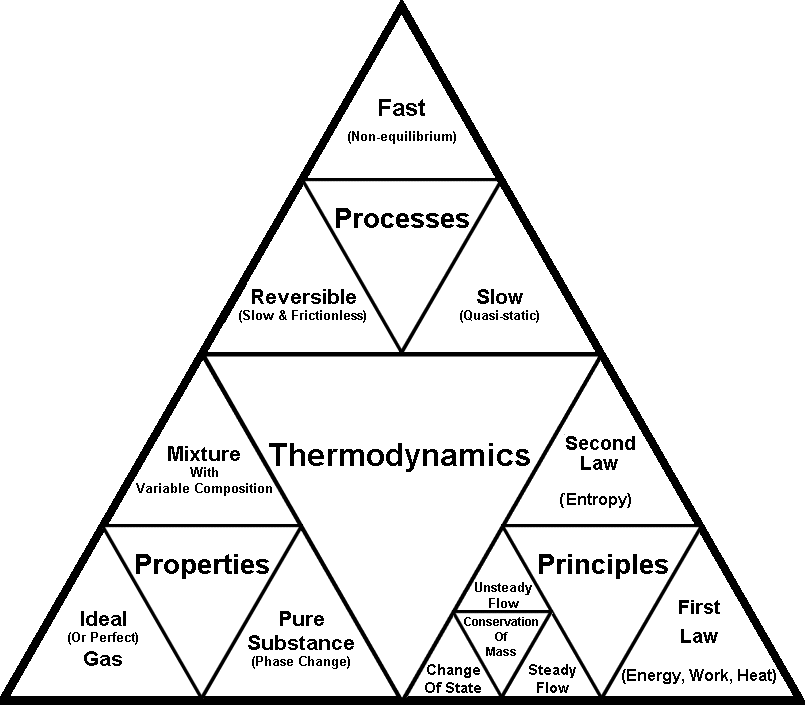
Image
Image
Image
Image

Introduction to Thermodynamics

Thermodynamics is a fundamental branch of physics and chemistry that deals with the study of energy, heat, work, and their transformations. It explains how energy moves within a system and how it interacts with its surroundings. The word thermodynamics comes from the Greek words therme meaning heat and dynamis meaning power.

Thermodynamics plays a crucial role in understanding many natural and technological processes. From engines and refrigerators to biological metabolism and atmospheric processes, thermodynamic principles help explain how energy is transferred and transformed.

In chemistry, thermodynamics helps determine whether a chemical reaction will occur spontaneously and how much energy will be released or absorbed during the reaction. In physics and engineering, it is used to design engines, turbines, power plants, and refrigeration systems.

The field of thermodynamics developed during the 19th century through the work of scientists studying steam engines and heat engines. Their investigations led to the discovery of fundamental laws governing energy transfer.

Thermodynamics is primarily concerned with macroscopic properties of systems such as:

  • Temperature
  • Pressure
  • Volume
  • Internal energy
  • Enthalpy
  • Entropy

These quantities describe the energy state of a system and how it changes during physical or chemical processes.


1. Thermodynamic Systems

A thermodynamic system is a specific portion of the universe that is chosen for study. Everything outside the system is known as the surroundings.

For example:

  • A gas inside a cylinder can be considered the system.
  • The cylinder walls and external environment are the surroundings.

Understanding the interaction between a system and its surroundings is essential in thermodynamics.


Types of Thermodynamic Systems

Thermodynamic systems are classified based on the exchange of matter and energy.

Open System

An open system can exchange both energy and matter with its surroundings.

Examples:

  • Boiling water in an open pot
  • Human body
  • Rivers and oceans

Open systems are common in biological and environmental processes.


Closed System

A closed system can exchange energy but not matter with its surroundings.

Example:

  • Gas in a sealed container where heat can pass through the walls.

Most laboratory experiments involve closed systems.


Isolated System

An isolated system cannot exchange matter or energy with its surroundings.

Example:

  • An ideal thermos flask (approximate isolated system)

In reality, perfectly isolated systems do not exist, but some systems closely approximate this condition.


2. Thermodynamic Properties

Thermodynamic properties describe the state of a system.

They are divided into two main categories.


Intensive Properties

Intensive properties do not depend on the amount of substance in the system.

Examples include:

  • Temperature
  • Pressure
  • Density

These properties remain the same regardless of system size.


Extensive Properties

Extensive properties depend on the quantity of matter.

Examples include:

  • Volume
  • Mass
  • Internal energy

If the system size doubles, these properties also double.


3. State Functions and Path Functions

Thermodynamics distinguishes between state functions and path functions.


State Functions

State functions depend only on the current state of the system, not on the path taken to reach that state.

Examples include:

  • Internal energy
  • Enthalpy
  • Entropy
  • Pressure
  • Temperature

Path Functions

Path functions depend on the specific process used to change the system.

Examples include:

  • Heat
  • Work

These quantities vary depending on how the system moves from one state to another.


4. The Zeroth Law of Thermodynamics

The Zeroth Law establishes the concept of temperature.

It states:

If two systems are in thermal equilibrium with a third system, they are also in thermal equilibrium with each other.

This principle allows the use of thermometers to measure temperature.

Example:

If object A is in thermal equilibrium with object C, and object B is also in equilibrium with object C, then A and B must be at the same temperature.

This law forms the basis for temperature measurement.


5. The First Law of Thermodynamics

\Delta U = Q – W

Definition

The First Law of Thermodynamics is essentially the law of conservation of energy.

It states that energy cannot be created or destroyed; it can only be transferred or converted from one form to another.


Explanation

According to the first law, the change in internal energy of a system depends on:

  • Heat added to the system
  • Work done by the system

If heat is added, internal energy increases.
If work is done by the system, internal energy decreases.


Internal Energy

Internal energy is the total energy contained within a system.

It includes:

  • Kinetic energy of molecules
  • Potential energy from intermolecular interactions

Changes in internal energy occur during heating, cooling, compression, expansion, or chemical reactions.


Work in Thermodynamics

Work occurs when a force causes displacement.

In thermodynamics, work often occurs when gases expand or compress.

Example:

Gas expansion pushing a piston upward.


6. Heat and Energy Transfer

Heat is the transfer of energy between systems due to temperature differences.

There are three main mechanisms of heat transfer.


Conduction

Image
Image
Image
Image

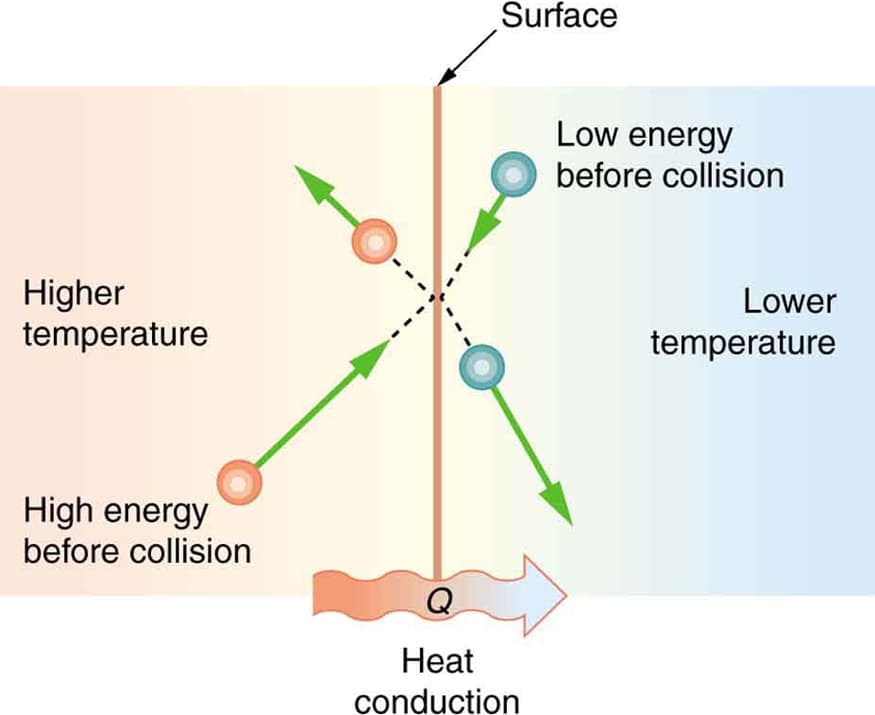
Conduction is the transfer of heat through direct contact between particles.

Example:

A metal spoon placed in hot tea becomes warm.

Heat flows from higher temperature to lower temperature regions.


Convection

Image
Image
Image
Image

Convection occurs in fluids (liquids and gases) when heat transfer occurs through fluid motion.

Examples include:

  • Boiling water
  • Atmospheric circulation

Warm fluid rises while cooler fluid sinks, creating convection currents.


Radiation

Image
Image
Image
Image

Radiation is heat transfer through electromagnetic waves.

Unlike conduction and convection, radiation does not require a medium.

Example:

Heat from the sun reaching Earth.


7. The Second Law of Thermodynamics

The Second Law introduces the concept of entropy.

It states that the entropy of an isolated system always increases over time.

In simpler terms, natural processes tend to move toward greater disorder.


Entropy

Entropy is a measure of randomness or disorder in a system.

Examples:

  • Ice melting increases entropy.
  • Gas expansion increases entropy.

Systems tend to move toward states with higher entropy.


Spontaneous Processes

A spontaneous process occurs naturally without external intervention.

Examples include:

  • Heat flowing from hot to cold objects
  • Mixing of gases
  • Dissolution of salt in water

Spontaneous processes generally increase entropy.


8. The Third Law of Thermodynamics

The Third Law states that the entropy of a perfect crystal approaches zero as the temperature approaches absolute zero.

Absolute zero is the lowest possible temperature.

Absolute zero:

0 Kelvin
−273.15 °C

At this temperature, molecular motion theoretically stops.


9. Enthalpy

Enthalpy represents the heat content of a system.

It is particularly useful when studying reactions at constant pressure.

The change in enthalpy during a reaction is called enthalpy change.


Exothermic Reactions

Exothermic reactions release heat to the surroundings.

Examples:

  • Combustion of fuels
  • Respiration in living organisms

Endothermic Reactions

Endothermic reactions absorb heat from the surroundings.

Examples:

  • Photosynthesis
  • Melting of ice

10. Thermodynamic Processes

Image
Image
Image
Image

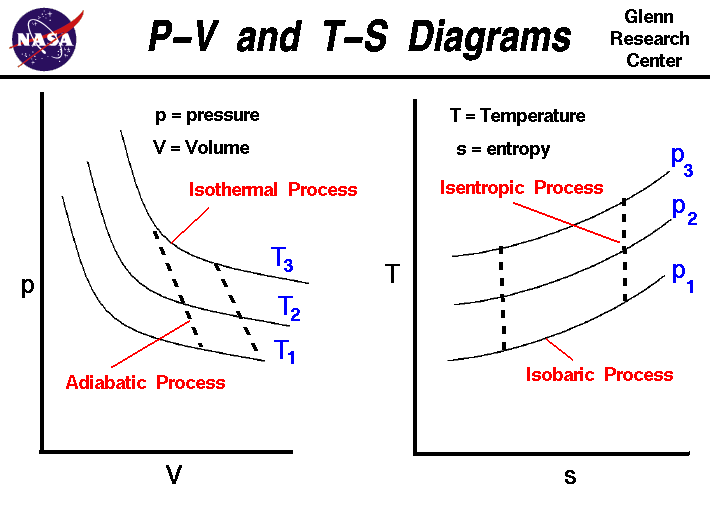
Thermodynamic processes describe how systems change from one state to another.


Isothermal Process

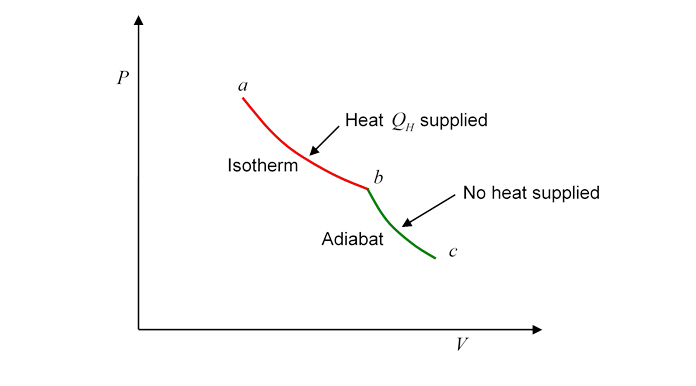
Temperature remains constant.

Heat transfer occurs to maintain constant temperature during expansion or compression.


Adiabatic Process

No heat exchange occurs between system and surroundings.

Energy changes occur only through work.


Isobaric Process

Pressure remains constant while volume and temperature may change.


Isochoric Process

Volume remains constant.

Heat transfer changes temperature and pressure.


11. Thermodynamic Cycles

Thermodynamic cycles occur when a system returns to its initial state after a series of processes.

Examples include:

  • Carnot cycle
  • Rankine cycle
  • Otto cycle

These cycles are important in heat engines and power plants.


12. Applications of Thermodynamics

Thermodynamics is essential in many scientific and engineering fields.


Power Generation

Power plants convert thermal energy into mechanical energy using thermodynamic cycles.


Refrigeration

Refrigerators and air conditioners operate based on thermodynamic principles involving heat transfer and phase changes.


Chemical Engineering

Thermodynamics helps design reactors and optimize industrial chemical processes.


Biological Systems

Living organisms rely on thermodynamic principles for metabolism and energy transfer.


Environmental Science

Thermodynamics explains climate systems, atmospheric circulation, and energy balance on Earth.


13. Importance of Thermodynamics

Thermodynamics provides the fundamental framework for understanding energy transformations in nature and technology.

It explains how energy moves between systems, how chemical reactions release or absorb heat, and how engines convert heat into mechanical work.

The laws of thermodynamics apply universally, governing processes in physics, chemistry, biology, engineering, and environmental science.

Understanding thermodynamics enables scientists and engineers to design efficient machines, improve energy systems, and develop sustainable technologies.


Conclusion

Thermodynamics is the scientific study of energy, heat, and work and the laws that govern their transformations. It provides a powerful framework for understanding how energy flows through physical and chemical systems.

The four fundamental laws of thermodynamics describe the principles of temperature equilibrium, energy conservation, entropy increase, and the behavior of matter at extremely low temperatures. These laws apply universally to all physical processes.

Key thermodynamic concepts such as internal energy, enthalpy, entropy, and thermodynamic processes help explain the behavior of systems ranging from microscopic chemical reactions to large-scale industrial machines.

Thermodynamics plays a vital role in numerous applications, including power generation, refrigeration, chemical manufacturing, biological metabolism, and environmental systems. By studying thermodynamics, scientists gain insight into the fundamental principles governing energy transformations in the universe.


Solutions and Concentration

Image
Image
Image
Image

Introduction

In chemistry, a solution is a homogeneous mixture composed of two or more substances that are uniformly distributed at the molecular or ionic level. Solutions are fundamental to both natural processes and industrial applications. Many chemical reactions occur in solutions, making them essential in biological systems, environmental science, pharmaceuticals, food chemistry, and manufacturing.

The study of solutions and concentration helps scientists understand how substances interact, dissolve, and react with one another. It also provides methods to quantify how much solute is present in a given amount of solvent or solution.

A typical solution consists of:

  • Solute – the substance that is dissolved
  • Solvent – the substance that dissolves the solute

For example, when salt dissolves in water:

  • Salt is the solute
  • Water is the solvent

Solutions can exist in all three states of matter: solid, liquid, or gas. The concept of concentration is used to describe the relative amounts of solute and solvent in a solution.

Understanding solutions and concentration is crucial in fields such as medicine, environmental monitoring, food production, chemical analysis, and industrial processes.


1. Definition of Solutions

A solution is defined as a homogeneous mixture in which one or more substances (solutes) are dissolved in another substance (solvent).

Key characteristics of solutions include:

  • Uniform composition throughout the mixture
  • Solute particles are extremely small
  • Solute particles do not settle over time
  • Components cannot be separated by simple filtration

Solutions are stable mixtures because the solute particles are dispersed at the molecular or ionic level.


2. Components of a Solution

Solvent

The solvent is the component present in the largest amount. It determines the physical state of the solution.

Examples include:

  • Water in saltwater
  • Alcohol in alcoholic beverages
  • Nitrogen in air

Water is the most common solvent and is often referred to as the universal solvent because it can dissolve many substances.


Solute

The solute is the substance that dissolves in the solvent. Solutes may be solids, liquids, or gases.

Examples include:

  • Sugar in tea
  • Carbon dioxide in soda
  • Salt in seawater

The amount of solute relative to solvent determines the concentration of the solution.


3. Types of Solutions

Image
Image
Image
Image

Solutions can be classified based on the physical state of the solvent.


Gaseous Solutions

In gaseous solutions, both solute and solvent are gases.

Example:

  • Air (mixture of nitrogen, oxygen, carbon dioxide)

Gases mix completely due to the high mobility of their molecules.


Liquid Solutions

Liquid solutions are the most common type.

Examples include:

  • Salt in water
  • Sugar in water
  • Alcohol in water

In these solutions, a solid, liquid, or gas may dissolve in a liquid solvent.


Solid Solutions

Solid solutions occur when one solid dissolves in another solid.

Examples include:

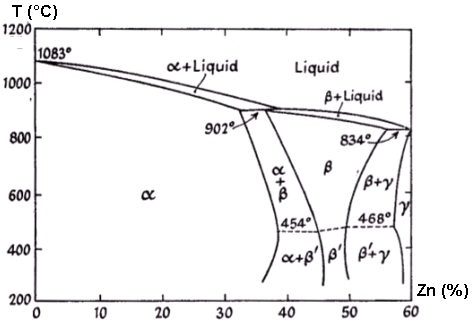
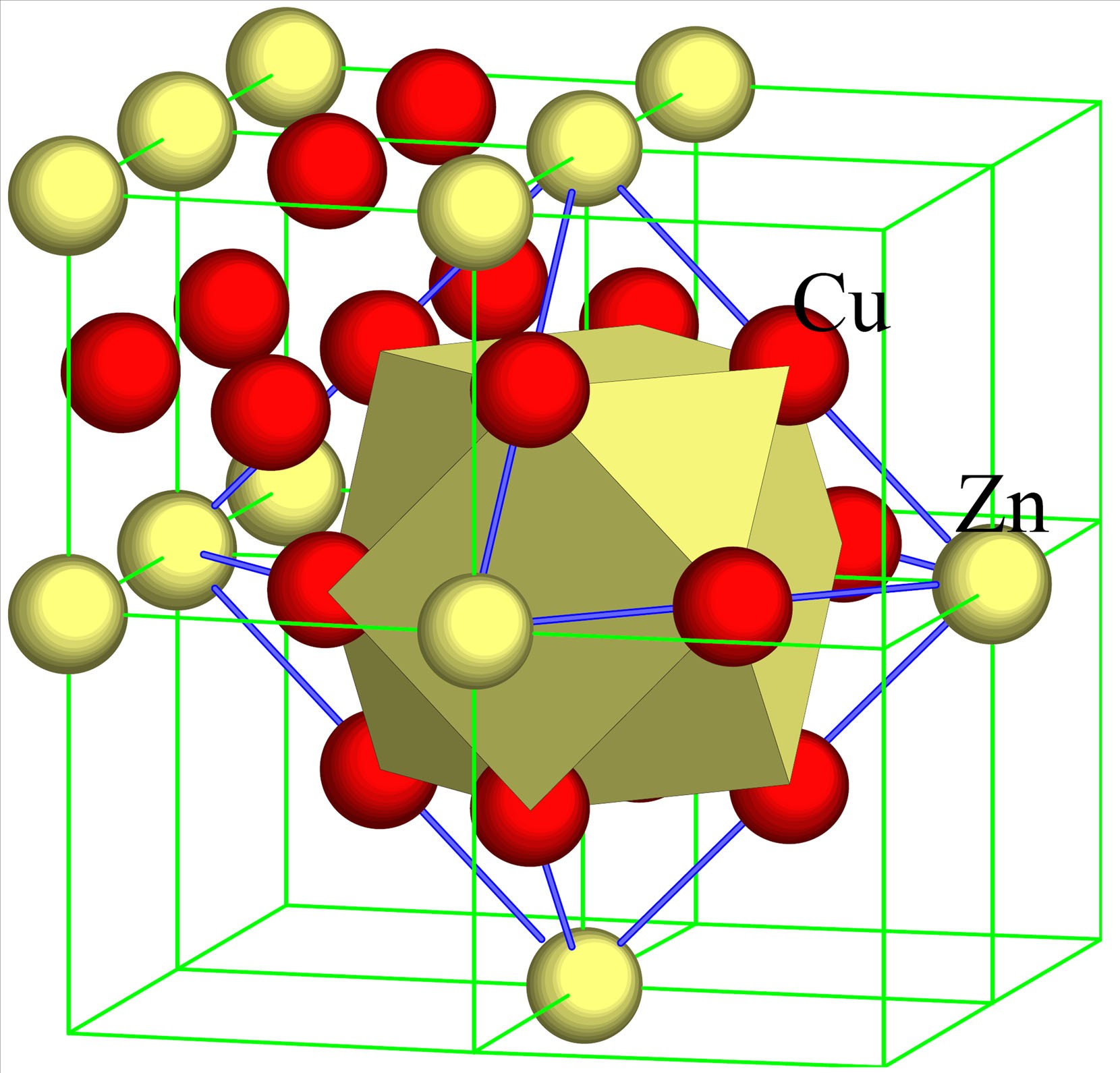
  • Alloys such as brass (copper and zinc)
  • Steel (iron and carbon)

These solutions play an important role in metallurgy and materials science.


4. Factors Affecting Solubility

Image
Image
Image
Image

Solubility refers to the maximum amount of solute that can dissolve in a given quantity of solvent at a specific temperature and pressure.

Several factors influence solubility.


Nature of Solute and Solvent

The principle “like dissolves like” states that substances with similar polarity dissolve in each other.

Examples:

  • Polar substances dissolve in polar solvents
  • Nonpolar substances dissolve in nonpolar solvents

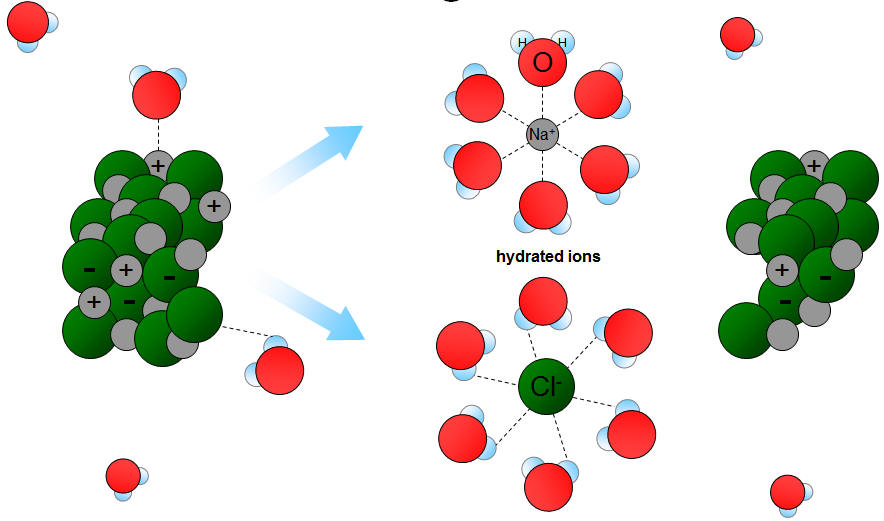
Water dissolves salt because both are polar.


Temperature

Temperature has different effects depending on the type of solute.

For solids in liquids:

  • Solubility usually increases with temperature.

For gases in liquids:

  • Solubility decreases as temperature increases.

Pressure

Pressure mainly affects gases.

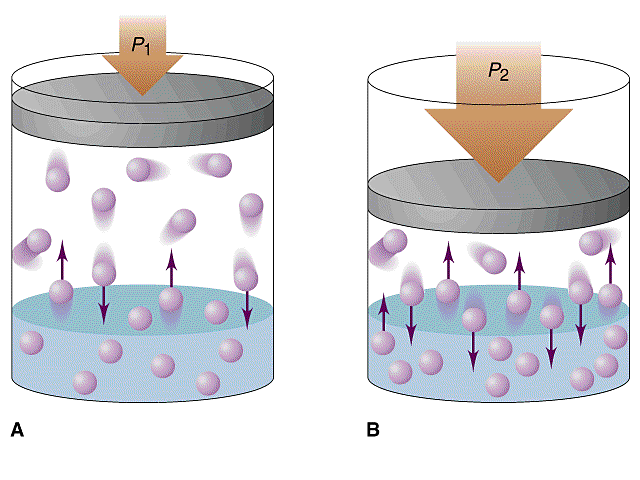
Increasing pressure increases the solubility of gases in liquids.

This principle explains why carbon dioxide stays dissolved in sealed soft drink bottles.


5. Concentration of Solutions

The concentration of a solution describes how much solute is present relative to the solvent or total solution.

Concentration can be expressed in several ways depending on the application.


6. Methods of Expressing Concentration

Mass Percentage

Mass percentage expresses the mass of solute relative to the mass of the entire solution.

Formula:

Mass % = (mass of solute / mass of solution) × 100

This method is commonly used in food and industrial chemistry.

Example:

A solution containing 10 g salt in 100 g solution has a mass percentage of 10%.


Volume Percentage

Volume percentage is used for liquid solutions.

Formula:

Volume % = (volume of solute / volume of solution) × 100

Example:

Alcohol concentration in beverages is expressed as volume percentage.


Parts per Million (ppm)

Parts per million is used for extremely dilute solutions.

Example:

Pollutant concentration in water.

1 ppm means one part of solute per one million parts of solution.


Molarity

M = \frac{n}{V}

Molarity is one of the most common concentration units in chemistry.

It represents the number of moles of solute per liter of solution.

Where:

M = molarity
n = number of moles of solute
V = volume of solution in liters


Molality

Molality expresses concentration as moles of solute per kilogram of solvent.

Formula:

Molality = moles of solute / mass of solvent (kg)

Molality is independent of temperature.


Mole Fraction

Mole fraction represents the ratio of moles of a component to the total moles in the solution.

It is often used in thermodynamics.


7. Dilution of Solutions

Dilution occurs when additional solvent is added to reduce the concentration of a solution.

The relationship between initial and final concentrations is:

M_1V_1 = M_2V_2

Where:

M₁ = initial concentration
V₁ = initial volume
M₂ = final concentration
V₂ = final volume

This equation is widely used in laboratory preparations.


8. Saturated and Unsaturated Solutions

Unsaturated Solutions

An unsaturated solution contains less solute than the maximum amount that can dissolve.

More solute can still dissolve in the solvent.


Saturated Solutions

A saturated solution contains the maximum amount of dissolved solute at a given temperature.

Any additional solute will remain undissolved.


Supersaturated Solutions

Supersaturated solutions contain more solute than the normal saturation limit.

They are unstable and can crystallize easily.


9. Colligative Properties of Solutions

Image
Image
Image
Image

Colligative properties depend on the number of solute particles rather than their chemical identity.


Vapor Pressure Lowering

When a nonvolatile solute is added to a solvent, the vapor pressure of the solution decreases.

This occurs because solute particles reduce the number of solvent molecules escaping into vapor.


Boiling Point Elevation

Adding solute raises the boiling point of the solvent.

Example:

Saltwater boils at a higher temperature than pure water.


Freezing Point Depression

Dissolving solute lowers the freezing point of a solvent.

Example:

Salt is used to melt ice on roads.


Osmotic Pressure

Osmosis is the movement of solvent through a semipermeable membrane from low solute concentration to high solute concentration.

Osmotic pressure is important in biological systems such as cells and blood circulation.


10. Applications of Solutions

Solutions are essential in many scientific and technological fields.


Biological Systems

Many biological processes occur in aqueous solutions.

Examples include:

  • Blood plasma
  • Cellular fluids
  • Nutrient transport

Medicine and Pharmaceuticals

Drug formulations often require precise solution concentrations.

Examples include:

  • Saline solutions
  • Intravenous fluids
  • Syrups

Environmental Science

Solutions are important in studying:

  • Water pollution
  • Ocean chemistry
  • Acid rain

Industrial Chemistry

Solutions are widely used in:

  • Chemical manufacturing
  • Electroplating
  • Food processing

11. Importance of Studying Solutions and Concentration

The study of solutions and concentration is fundamental in chemistry because most chemical reactions occur in solution form. By understanding how substances dissolve and how concentration affects reactions, scientists can control chemical processes with high precision.

Concentration measurements allow chemists to prepare accurate mixtures for laboratory experiments, industrial production, medical treatments, and environmental monitoring. Without accurate concentration control, reactions may proceed incorrectly or produce unsafe conditions.

Solutions also provide insight into intermolecular interactions, thermodynamics, and molecular behavior. This knowledge helps scientists design new materials, improve pharmaceuticals, and understand biological systems.


Conclusion

Solutions are homogeneous mixtures formed when one or more solutes dissolve in a solvent. They are fundamental to chemistry, biology, medicine, and industry because many natural and technological processes occur in solution form.

The behavior of solutions depends on the interactions between solute and solvent molecules, as well as factors such as temperature, pressure, and polarity. Solubility determines how much solute can dissolve, while concentration describes how much solute is present in a given amount of solution.

Various methods are used to express concentration, including mass percentage, molarity, molality, mole fraction, and parts per million. These measurements allow scientists to control chemical reactions and prepare accurate solutions for scientific and industrial applications.

Solutions also exhibit unique properties known as colligative properties, which depend on the number of dissolved particles. These properties include vapor pressure lowering, boiling point elevation, freezing point depression, and osmotic pressure.

Understanding solutions and concentration is essential for modern science and technology. From biological systems and environmental processes to industrial manufacturing and medical treatments, the principles governing solutions continue to play a vital role in our understanding of the chemical world.


Liquids and Solids

Image
Image
Image
Image

Introduction

Matter exists in several physical forms known as states of matter. The most familiar states are solid, liquid, and gas. Solids and liquids are called condensed states of matter because their particles are closely packed together compared with gases.

The study of liquids and solids is an important branch of physical chemistry and materials science because these states are responsible for most of the physical structures we see in the natural world. Rocks, metals, water, plastics, crystals, biological tissues, and many other materials exist as solids or liquids.

Unlike gases, solids and liquids have strong intermolecular interactions that hold their particles close together. However, the arrangement and movement of particles differ between the two states.

  • Solids have fixed shape and volume.
  • Liquids have fixed volume but no fixed shape.

Understanding the properties, structure, and behavior of liquids and solids helps scientists design materials, understand biological processes, develop new technologies, and explain natural phenomena.


1. The Solid State

Definition of Solids

A solid is a state of matter characterized by a definite shape and definite volume. The particles in a solid are arranged very closely and are held together by strong intermolecular forces.

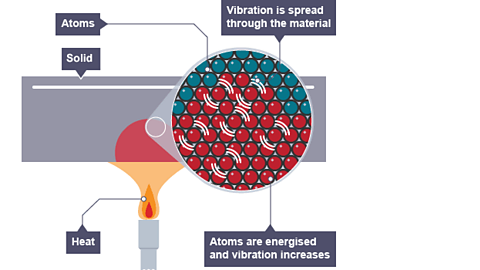
In solids, particles vibrate around fixed positions but cannot move freely from place to place.

Examples of solids include:

  • Metals (iron, copper, aluminum)
  • Minerals (quartz, diamond)
  • Organic materials (wood, plastic)
  • Ice

Characteristics of Solids

1. Definite Shape and Volume

Solids maintain their shape and volume regardless of the container in which they are placed. This happens because the particles are arranged in a stable structure.

For example, a piece of metal or rock retains its shape even when moved.


2. High Density

Solids generally have high density because their particles are packed closely together.

However, some solids such as ice have lower density than their liquid form due to special molecular structures.


3. Very Low Compressibility

Because particles are tightly packed, solids cannot be compressed easily.

Applying pressure to a solid usually results in minimal change in volume.


4. Strong Intermolecular Forces

Particles in solids are held together by strong attractive forces such as:

  • Ionic bonds
  • Covalent bonds
  • Metallic bonds
  • Van der Waals forces

These forces maintain the structural stability of solids.


5. Vibrational Motion

Particles in solids are not completely stationary. They vibrate around fixed positions.

The intensity of vibration increases with temperature.


2. Classification of Solids

Solids can be broadly classified into two main types:

  1. Crystalline solids
  2. Amorphous solids

Crystalline Solids

Image
Image
Image
Image

Crystalline solids have particles arranged in a regular, repeating pattern known as a crystal lattice.

This orderly arrangement extends throughout the entire structure.

Examples include:

  • Salt crystals
  • Quartz
  • Diamonds
  • Metals

Properties of Crystalline Solids

  1. Definite melting point
  2. Regular geometric shape
  3. Anisotropic physical properties
  4. Long-range order of particles

Types of Crystalline Solids

Crystalline solids can be classified according to the type of bonding between particles.


Ionic Solids

Ionic solids consist of positive and negative ions held together by electrostatic forces.

Examples:

  • Sodium chloride
  • Potassium bromide

Properties:

  • High melting point
  • Hard and brittle
  • Conduct electricity when molten

Covalent Network Solids

In these solids, atoms are connected through covalent bonds forming a large network.

Examples:

  • Diamond
  • Silicon carbide

Properties:

  • Very high melting point
  • Extremely hard
  • Poor electrical conductivity

Metallic Solids

Metallic solids consist of metal atoms arranged in a lattice surrounded by a sea of mobile electrons.

Examples:

  • Iron
  • Copper
  • Gold

Properties:

  • Good electrical conductivity
  • Malleable and ductile
  • Shiny appearance

Molecular Solids

These solids are composed of molecules held together by weak intermolecular forces.

Examples:

  • Ice
  • Dry ice
  • Sugar crystals

Properties:

  • Low melting points
  • Soft structure

Amorphous Solids

Image
Image
Image
Image

Amorphous solids lack long-range order in their particle arrangement.

Their atoms or molecules are arranged randomly.

Examples include:

  • Glass
  • Rubber
  • Plastics
  • Wax

Properties of Amorphous Solids

  1. No definite melting point
  2. Isotropic properties
  3. Irregular internal structure
  4. Gradual softening when heated

These solids behave somewhat like very slow-moving liquids.


3. Crystal Structure and Unit Cells

A unit cell is the smallest repeating structural unit of a crystal lattice.

By repeating the unit cell in three dimensions, the entire crystal structure is formed.


Types of Unit Cells

There are several types of crystal systems including:

  1. Cubic
  2. Tetragonal
  3. Orthorhombic
  4. Hexagonal
  5. Monoclinic
  6. Triclinic
  7. Rhombohedral

Cubic Crystal System

Common cubic structures include:

  • Simple cubic
  • Body-centered cubic
  • Face-centered cubic

Metals such as copper and aluminum often form cubic crystals.


4. The Liquid State

Definition of Liquids

A liquid is a state of matter with definite volume but no definite shape.

Liquids take the shape of the container in which they are placed.

Examples include:

  • Water
  • Oil
  • Mercury
  • Alcohol

Characteristics of Liquids

Definite Volume

Liquids maintain a constant volume because their particles remain close together.


No Fixed Shape

Liquids adapt to the shape of their container.


Moderate Density

Liquids are less dense than solids but much denser than gases.


Ability to Flow

Liquids can flow because their molecules move past one another.

This property is called fluidity.


Low Compressibility

Liquids are only slightly compressible because their particles are still relatively close together.


5. Intermolecular Forces in Liquids

Image
Image
Image
Image

The behavior of liquids is strongly influenced by intermolecular forces.

These are attractive forces between molecules.


Types of Intermolecular Forces

London Dispersion Forces

These are weak forces present in all molecules due to temporary fluctuations in electron distribution.

They are strongest in large molecules.


Dipole–Dipole Forces

These occur between polar molecules with permanent dipole moments.

Example: interactions between hydrogen chloride molecules.


Hydrogen Bonding

Hydrogen bonding is a strong type of dipole interaction.

It occurs when hydrogen is bonded to highly electronegative atoms such as:

  • Oxygen
  • Nitrogen
  • Fluorine

Water exhibits strong hydrogen bonding.


6. Physical Properties of Liquids

Viscosity

Viscosity is the resistance of a liquid to flow.

Examples:

  • Honey has high viscosity.
  • Water has low viscosity.

Viscosity decreases as temperature increases.


Surface Tension

Surface tension arises from cohesive forces between molecules at the surface of a liquid.

It causes liquids to form droplets.

Water has high surface tension due to hydrogen bonding.


Capillary Action

Capillary action is the ability of liquids to rise in narrow tubes.

This phenomenon is important in plants, where water moves through tiny vessels.


Vapor Pressure

Liquids continuously evaporate, producing vapor above their surface.

The pressure exerted by this vapor is called vapor pressure.

Higher temperature increases vapor pressure.


7. Phase Changes Between Solids and Liquids

Image
Image
Image
Image

Matter can change between solid and liquid states through phase transitions.


Melting

Melting occurs when a solid absorbs heat and becomes a liquid.

Example:

Ice melting into water.


Freezing

Freezing is the opposite of melting.

A liquid loses heat and becomes a solid.

Example:

Water turning into ice.


Crystallization

Crystallization occurs when particles organize into a structured solid during cooling.


8. Comparison Between Solids and Liquids

PropertySolidsLiquids
ShapeFixedTakes container shape
VolumeFixedFixed
Particle MotionVibrationalTranslational and vibrational
DensityHighModerate
CompressibilityVery lowSlight

9. Importance of Solids and Liquids

Solids and liquids play a crucial role in everyday life and scientific applications.


Materials Science

Understanding solid structure helps design:

  • Strong metals
  • Semiconductors
  • Nanomaterials

Biological Systems

Many biological structures depend on solids and liquids:

  • Bones (solid)
  • Blood (liquid)

Industrial Applications

Liquids and solids are used in:

  • Manufacturing
  • Chemical reactions
  • Energy storage

Environmental Science

Solid and liquid states influence:

  • Water cycles
  • Geological formations
  • Ocean systems

10. Modern Research on Solids and Liquids

Scientists continue studying condensed matter to develop advanced technologies.

Examples include:

  • Superconductors
  • Liquid crystals
  • Nanomaterials
  • Smart materials

These materials are used in electronics, medicine, and renewable energy systems.


Conclusion

Solids and liquids represent two important condensed states of matter that play a central role in both nature and technology. In solids, particles are arranged in fixed positions and held together by strong forces, giving solids their rigid shape and structural stability. Solids can exist in crystalline or amorphous forms depending on how their particles are arranged.

Liquids, on the other hand, have particles that are closely packed but able to move past one another. This gives liquids the ability to flow while still maintaining a constant volume. Properties such as viscosity, surface tension, and vapor pressure arise from intermolecular forces within liquids.

Understanding the behavior and structure of solids and liquids helps scientists explain phase changes, design new materials, and develop technologies that rely on condensed matter. From geological formations and biological systems to industrial manufacturing and advanced electronics, the study of solids and liquids continues to be one of the most important areas of physical science.


Gas Laws

Image
Image
Image
Image

Introduction to Gas Laws

Gas laws describe the relationships between pressure, volume, temperature, and the amount of gas. These relationships are fundamental in chemistry and physics because they explain how gases behave under different environmental conditions.

Gases differ significantly from solids and liquids because their molecules are far apart and move freely. Due to this freedom of motion, gases respond strongly to changes in temperature and pressure. Gas laws provide mathematical models that allow scientists to predict how gases behave when these variables change.

The study of gas laws began in the 17th century when scientists started conducting experiments with air pumps and sealed containers. Researchers such as Robert Boyle, Jacques Charles, Joseph Gay-Lussac, and Amedeo Avogadro discovered important relationships that now form the foundation of gas law theory.

Gas laws are essential in many areas of science and engineering, including meteorology, chemical engineering, medicine, environmental science, and thermodynamics. They are also crucial in understanding natural phenomena such as atmospheric pressure, weather changes, breathing mechanisms, and the behavior of gases in engines and industrial systems.

The most important gas laws include:

  • Boyle’s Law
  • Charles’s Law
  • Gay-Lussac’s Law
  • Avogadro’s Law
  • Ideal Gas Law
  • Combined Gas Law
  • Dalton’s Law of Partial Pressures
  • Graham’s Law of Diffusion

Each of these laws describes a specific relationship between gas variables.


Fundamental Variables in Gas Laws

Before studying gas laws in detail, it is important to understand the main variables involved.

Pressure (P)

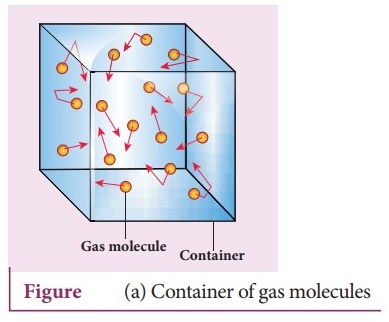
Pressure is the force exerted by gas molecules when they collide with the walls of a container.

Mathematically:

Pressure = Force / Area

Common units of pressure include:

  • Pascal (Pa)
  • Atmosphere (atm)
  • Bar
  • Torr or mmHg

At sea level, atmospheric pressure is approximately 1 atm, which equals 101,325 Pa.

Gas pressure arises because gas molecules are constantly moving and colliding with surfaces.


Volume (V)

Volume refers to the space occupied by a gas. Unlike solids or liquids, gases expand to fill the entire container in which they are placed.

Common units of volume include:

  • Liters (L)
  • Milliliters (mL)
  • Cubic meters (m³)

Volume plays a crucial role in gas laws because changing the volume of a container directly affects the pressure and temperature of the gas inside.


Temperature (T)

Temperature measures the average kinetic energy of gas molecules.

In gas law calculations, temperature must always be expressed in Kelvin (K) rather than Celsius.

Conversion formula:

K = °C + 273.15

Higher temperatures mean faster molecular motion and higher kinetic energy.


Amount of Gas (n)

The amount of gas is measured in moles.

One mole of any substance contains 6.022 × 10²³ particles, known as Avogadro’s number.

The number of gas molecules affects both pressure and volume.


Boyle’s Law

PV = \text{constant}

Definition

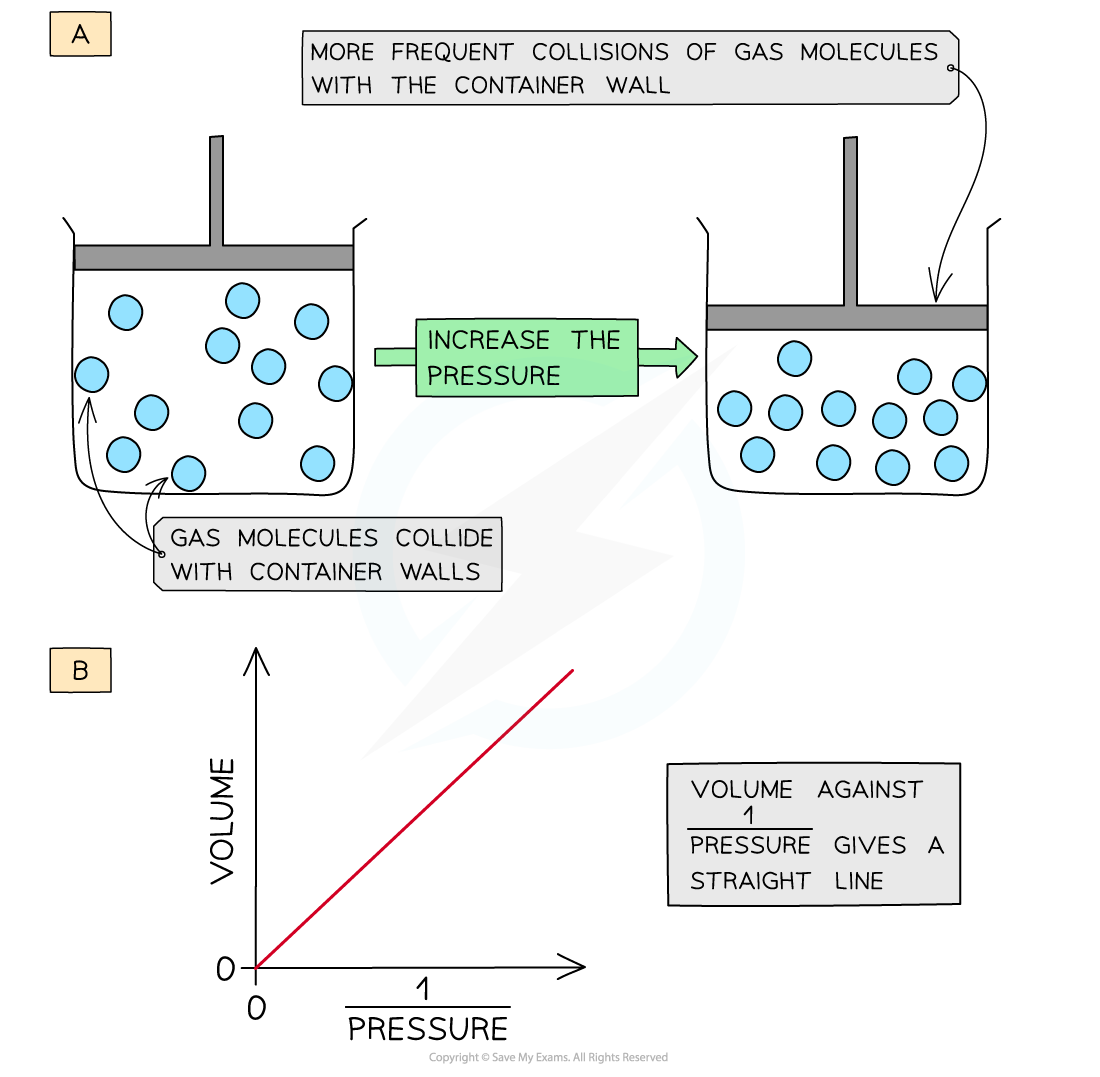
Boyle’s Law states that the pressure of a fixed amount of gas is inversely proportional to its volume when temperature is kept constant.

Mathematically:

P ∝ 1/V

This means that if the volume of a gas decreases, the pressure increases, and if the volume increases, the pressure decreases.


Mathematical Expression

Boyle’s Law can also be written as:

P₁V₁ = P₂V₂

Where:

P₁ = Initial pressure
V₁ = Initial volume
P₂ = Final pressure
V₂ = Final volume


Explanation Using Molecular Theory

According to the kinetic molecular theory:

  • Gas molecules move randomly.
  • They collide with container walls to produce pressure.

When the volume decreases:

  • Molecules have less space.
  • Collisions with container walls occur more frequently.
  • Pressure increases.

When the volume increases:

  • Molecules have more space.
  • Collisions decrease.
  • Pressure decreases.

Graphical Representation

A graph of pressure versus volume for Boyle’s Law forms a hyperbola, showing the inverse relationship between the two variables.


Practical Applications of Boyle’s Law

Boyle’s Law is applied in many real-world systems.

Breathing

During inhalation:

  • Lung volume increases.
  • Pressure inside lungs decreases.
  • Air flows into the lungs.

During exhalation:

  • Lung volume decreases.
  • Pressure increases.
  • Air flows out.

Syringes

When pulling back the plunger of a syringe:

  • Volume increases
  • Pressure decreases
  • Fluid enters the syringe

Scuba Diving

As divers descend underwater:

  • Pressure increases
  • Gas volume in lungs decreases

Divers must control breathing to prevent lung damage.


Charles’s Law

\frac{V}{T} = \text{constant}

Definition

Charles’s Law states that the volume of a gas is directly proportional to its absolute temperature when pressure is constant.

Mathematically:

V ∝ T


Mathematical Expression

Charles’s Law can also be written as:

V₁ / T₁ = V₂ / T₂

Where:

V₁ = Initial volume
T₁ = Initial temperature
V₂ = Final volume
T₂ = Final temperature


Molecular Explanation

When temperature increases:

  • Gas molecules gain kinetic energy.
  • They move faster.
  • Collisions with container walls increase.
  • Gas expands to maintain constant pressure.

When temperature decreases:

  • Molecular motion slows.
  • Gas contracts.

Graphical Representation

A graph of volume versus temperature produces a straight line when temperature is measured in Kelvin.


Practical Applications

Hot Air Balloons

Hot air balloons rise because heated air expands and becomes less dense than surrounding air.


Weather Balloons

As weather balloons rise into the atmosphere:

  • External pressure decreases
  • Balloon volume increases

Automotive Tires

When tires heat up due to friction:

  • Air inside expands
  • Pressure increases

Gay-Lussac’s Law

Definition

Gay-Lussac’s Law states that the pressure of a gas is directly proportional to its absolute temperature when volume remains constant.

Mathematically:

P ∝ T


Mathematical Expression

P₁ / T₁ = P₂ / T₂

Where:

P₁ = Initial pressure
T₁ = Initial temperature
P₂ = Final pressure
T₂ = Final temperature


Explanation

At constant volume:

  • Increasing temperature increases molecular speed.
  • Faster molecules collide with walls more forcefully.
  • Pressure increases.

Real-Life Applications

Pressure Cookers

Inside a pressure cooker:

  • Temperature rises
  • Pressure increases

This allows food to cook faster.


Aerosol Cans

Heating an aerosol can increases internal pressure, which can cause explosions.


Avogadro’s Law

V \propto n

Definition

Avogadro’s Law states that equal volumes of gases at the same temperature and pressure contain equal numbers of molecules.

This means:

Volume is directly proportional to the number of moles.


Mathematical Expression

V₁ / n₁ = V₂ / n₂

Where:

n represents number of moles.


Explanation

Adding more gas molecules increases the number of particle collisions, causing the gas to expand if pressure and temperature remain constant.


Importance

Avogadro’s Law introduced the concept of Avogadro’s number:

6.022 × 10²³ particles per mole.

This constant is fundamental to chemistry.


Combined Gas Law

The Combined Gas Law merges Boyle’s, Charles’s, and Gay-Lussac’s laws.

Mathematically:

(P₁V₁)/T₁ = (P₂V₂)/T₂

This equation is used when pressure, volume, and temperature all change simultaneously.


Ideal Gas Law

genui{“math_block_widget_always_prefetch_v2”:{“content”:”PV = nRT”}}

Definition

The Ideal Gas Law combines all basic gas relationships into one equation.

Where:

P = Pressure
V = Volume
n = Number of moles
R = Gas constant
T = Temperature


Gas Constant (R)

Different units of pressure require different values of R.

Common value:

R = 0.0821 L·atm/mol·K


Significance

The ideal gas equation allows scientists to calculate unknown gas variables.


Dalton’s Law of Partial Pressures

Image
Image
Image
Image

Definition

Dalton’s Law states that the total pressure of a gas mixture equals the sum of the partial pressures of each individual gas.

Mathematically:

Ptotal = P1 + P2 + P3 + …


Explanation

Each gas behaves independently and contributes to the total pressure as if the other gases were not present.


Applications

  • Breathing and respiration
  • Scuba diving gas mixtures
  • Industrial gas systems

Graham’s Law of Diffusion

Image
Image
Image
Image

Definition

Graham’s Law states that the rate of diffusion or effusion of a gas is inversely proportional to the square root of its molar mass.

Mathematically:

Rate ∝ 1/√M


Explanation

Lighter gases move faster than heavier gases.

Example:

Hydrogen diffuses faster than oxygen.


Real Gas Behavior

Real gases do not perfectly follow gas laws under all conditions.

Deviations occur at:

  • High pressure
  • Low temperature

This happens because real molecules:

  • Occupy volume
  • Experience intermolecular forces

Van der Waals Equation

The Van der Waals equation corrects ideal gas behavior by accounting for molecular size and intermolecular attraction.

This equation is especially useful when studying gases near liquefaction.


Applications of Gas Laws

Gas laws are widely used in many scientific fields.


Meteorology

Gas laws help explain:

  • Atmospheric pressure changes
  • Wind patterns
  • Weather systems

Medicine

Gas laws explain:

  • Lung function
  • Oxygen transport
  • Anesthesia delivery

Engineering

Applications include:

  • Internal combustion engines
  • Refrigeration systems
  • Air compressors

Environmental Science

Gas laws help scientists understand:

  • Climate change
  • Greenhouse gases
  • Air pollution behavior

Importance of Gas Laws in Science

Gas laws form a fundamental part of physical chemistry and thermodynamics. They provide a bridge between macroscopic observations and microscopic molecular behavior.

Through gas laws, scientists can understand:

  • Molecular motion
  • Energy transfer
  • Thermodynamic processes

These principles are essential in developing technologies that rely on gas behavior.


Conclusion

Gas laws describe the fundamental relationships between pressure, volume, temperature, and the amount of gas. Through the discoveries of Boyle, Charles, Gay-Lussac, and Avogadro, scientists developed mathematical models that explain how gases respond to changes in environmental conditions.

These laws are unified in the ideal gas equation, which provides a powerful tool for predicting gas behavior. Although real gases may deviate from ideal conditions, gas laws remain highly accurate for many practical situations.

Understanding gas laws is essential for chemistry, physics, engineering, meteorology, and many other scientific disciplines. From breathing and weather patterns to industrial manufacturing and space exploration, the principles of gas behavior continue to play a vital role in modern science and technology.


Gaseous State

Image
Image
Image
Image

Introduction to the Gaseous State

Matter exists in different physical forms known as states of matter. The three classical states are solid, liquid, and gas, while modern science also recognizes additional states such as plasma and Bose–Einstein condensate. Among these, the gaseous state is the most dynamic and least structured state of matter.

In the gaseous state, particles such as atoms or molecules are widely separated and move freely in all directions. Because of this freedom of motion and the large distance between particles, gases show properties that are significantly different from solids and liquids.

The gaseous state plays an essential role in nature and technology. The air we breathe is a mixture of gases, including nitrogen, oxygen, carbon dioxide, and water vapor. Many industrial processes involve gases, including combustion, refrigeration, chemical manufacturing, and energy production.

Understanding the behavior of gases helps scientists explain atmospheric processes, weather patterns, chemical reactions, and the functioning of engines and biological systems.


1. Characteristics of Gases

1.1 Lack of Definite Shape and Volume

Unlike solids and liquids, gases do not have a fixed shape or volume. Instead, they expand to fill the entire container in which they are placed.

For example, when air is placed in a balloon, the gas spreads out and occupies the entire interior space of the balloon. Similarly, gases inside a room fill the whole room evenly.

This behavior occurs because gas molecules move independently and are not held in fixed positions.


1.2 High Compressibility

Gases are highly compressible compared with solids and liquids. When pressure is applied, gas molecules can be pushed closer together because there is a large amount of empty space between them.

This property allows gases to be stored in compressed form. For example:

  • Oxygen cylinders used in hospitals
  • Compressed natural gas (CNG) used as fuel
  • Aerosol sprays

In contrast, liquids and solids cannot be compressed significantly because their particles are already closely packed.


1.3 Low Density

Density refers to the mass per unit volume of a substance.

Gases have much lower density than solids and liquids because their molecules are far apart. For example:

  • Air density ≈ 1.2 kg/m³
  • Water density ≈ 1000 kg/m³

This large difference explains why gases rise above liquids and why balloons filled with lighter gases such as helium float in the air.


1.4 Rapid Diffusion

Diffusion is the process by which particles spread from a region of high concentration to a region of low concentration.

Gases diffuse rapidly because their particles move freely and randomly. A common example is the smell of perfume spreading across a room after it is sprayed.

The rate of diffusion depends on factors such as:

  • Molecular mass
  • Temperature
  • Pressure

Lighter gases diffuse faster than heavier gases.


1.5 Ability to Exert Pressure

Gas molecules are constantly moving and colliding with the walls of their container. These collisions produce gas pressure.

Pressure is defined as the force exerted per unit area.

Gas pressure depends on:

  • Number of molecules
  • Temperature
  • Volume of the container

This principle explains why increasing the temperature of a gas in a sealed container increases the pressure.


2. Molecular Nature of Gases

Image
Image
Image
Image

The microscopic behavior of gases is explained by the Kinetic Molecular Theory (KMT).

2.1 Basic Assumptions of Kinetic Molecular Theory

The theory is based on several fundamental assumptions:

  1. Gases consist of a large number of tiny particles (atoms or molecules).
  2. Particles move continuously in random directions.
  3. The volume of gas molecules is negligible compared with the volume of the container.
  4. No intermolecular forces act between gas molecules, except during collisions.
  5. Collisions between molecules and container walls are perfectly elastic.
  6. The average kinetic energy of molecules is proportional to absolute temperature.

These assumptions allow scientists to explain gas behavior mathematically.


2.2 Random Motion of Gas Molecules

Gas molecules move randomly and rapidly in all directions. This random motion results in frequent collisions between molecules and with the walls of the container.

These collisions are responsible for gas pressure.


2.3 Mean Free Path

The mean free path is the average distance a molecule travels between two successive collisions.

Factors affecting mean free path include:

  • Temperature
  • Pressure
  • Size of molecules

At higher pressures, molecules are closer together, so the mean free path decreases.


2.4 Kinetic Energy of Gas Molecules

The kinetic energy of gas molecules depends on temperature.

Higher temperature means molecules move faster and possess more kinetic energy. This relationship explains many gas laws.


3. Gas Laws

Gas laws describe the mathematical relationships between pressure, volume, temperature, and the number of gas molecules.


3.1 Boyle’s Law

PV = \text{constant}

Boyle’s Law states that the pressure of a fixed amount of gas is inversely proportional to its volume at constant temperature.

If the volume decreases, pressure increases.

Examples include:

  • Compressing air in a syringe
  • Breathing process in lungs

3.2 Charles’s Law

\frac{V}{T} = \text{constant}

Charles’s Law states that the volume of a gas is directly proportional to its absolute temperature at constant pressure.

As temperature increases, gas expands.

Example:
Hot air balloons rise because heated air expands and becomes less dense.


3.3 Gay-Lussac’s Law

Gay-Lussac’s Law states that pressure is directly proportional to temperature when volume is constant.

Mathematically:

P ∝ T

This explains why sealed containers can explode when heated.


3.4 Avogadro’s Law

Avogadro’s Law states:

Equal volumes of gases at the same temperature and pressure contain equal numbers of molecules.

This law introduced the concept of Avogadro’s number, approximately:

6.022 × 10²³ particles per mole.


3.5 Ideal Gas Equation

genui{“math_block_widget_always_prefetch_v2”:{“content”:”PV = nRT”}}

The ideal gas equation combines all gas laws into a single formula.

Where:

P = Pressure
V = Volume
n = Number of moles
R = Gas constant
T = Temperature (Kelvin)

This equation is widely used in chemistry and physics.


4. Real Gases

Image
Image
Image
Image

In reality, gases do not perfectly follow the ideal gas equation.

4.1 Reasons for Deviation

Real gases deviate because:

  1. Gas molecules occupy volume.
  2. Intermolecular attractions exist.

These factors become important at:

  • High pressure
  • Low temperature

4.2 Van der Waals Equation

To correct deviations from ideal behavior, the Van der Waals equation was proposed.

It modifies pressure and volume terms to account for molecular size and attraction forces.


4.3 Critical Temperature and Pressure

The critical temperature is the highest temperature at which a gas can be liquefied.

The critical pressure is the minimum pressure required to liquefy a gas at its critical temperature.

Above these values, gases cannot be liquefied.


5. Liquefaction of Gases

Liquefaction is the process of converting gases into liquids.

It occurs through:

  • Increasing pressure
  • Decreasing temperature

Important methods include:

  1. Linde Process
  2. Claude Process

Liquefied gases are widely used in industries.

Examples include:

  • Liquid oxygen
  • Liquid nitrogen
  • Liquefied petroleum gas (LPG)

6. Diffusion and Effusion of Gases

6.1 Diffusion

Diffusion is the mixing of gases due to random molecular motion.

Factors affecting diffusion:

  • Temperature
  • Molecular mass
  • Pressure

Higher temperature increases diffusion rate.


6.2 Effusion

Effusion is the escape of gas molecules through a tiny hole without significant collisions.

Effusion rate depends on molecular mass.


6.3 Graham’s Law

Graham’s Law states:

Rate of diffusion ∝ 1/√M

Where M is molar mass.

This means lighter gases diffuse faster.


7. Partial Pressure of Gases

In mixtures of gases, each gas contributes to the total pressure.

Dalton’s Law of Partial Pressures

Total pressure = sum of partial pressures of individual gases.

Mathematically:

Ptotal = P1 + P2 + P3 + …

This law is important in atmospheric science and respiration.


8. Gas Mixtures

The atmosphere is an example of a gas mixture.

Composition of dry air approximately:

  • Nitrogen – 78%
  • Oxygen – 21%
  • Argon – 0.93%
  • Carbon dioxide – 0.04%

Gas mixtures behave according to the same gas laws as individual gases.


9. Applications of the Gaseous State

9.1 Atmospheric Science

Understanding gas behavior helps explain:

  • Weather patterns
  • Wind formation
  • Atmospheric pressure

9.2 Industrial Applications

Gases are widely used in industries:

  • Oxygen in steel production
  • Nitrogen for food preservation
  • Hydrogen in fuel cells

9.3 Medical Applications

Examples include:

  • Oxygen therapy
  • Anesthetic gases
  • Respiratory treatments

9.4 Environmental Applications

Gas laws help in understanding:

  • Air pollution
  • Greenhouse gases
  • Climate change

10. Importance of Studying the Gaseous State

The gaseous state is fundamental to both scientific research and everyday life.

Understanding gas behavior helps in:

  • Designing engines
  • Predicting atmospheric changes
  • Developing industrial chemical processes
  • Studying biological respiration

Because gases are the most mobile form of matter, they provide valuable insights into molecular motion and energy.


Conclusion

The gaseous state represents one of the most dynamic and fundamental states of matter. Gases differ from solids and liquids in their lack of fixed shape and volume, high compressibility, low density, and rapid diffusion. These properties arise from the large separation between gas molecules and their continuous random motion.

The behavior of gases is described by various gas laws such as Boyle’s law, Charles’s law, Gay-Lussac’s law, and Avogadro’s law. These relationships are unified in the ideal gas equation, which forms the basis of many calculations in chemistry and physics.

However, real gases deviate from ideal behavior under extreme conditions, requiring more advanced models such as the Van der Waals equation. Concepts like diffusion, effusion, partial pressures, and liquefaction further explain how gases behave in real environments.

From atmospheric science and industrial processes to medical applications and environmental studies, the gaseous state plays a critical role in modern science and technology. Understanding gases not only provides insight into molecular behavior but also enables advancements in energy production, chemical manufacturing, and environmental protection.
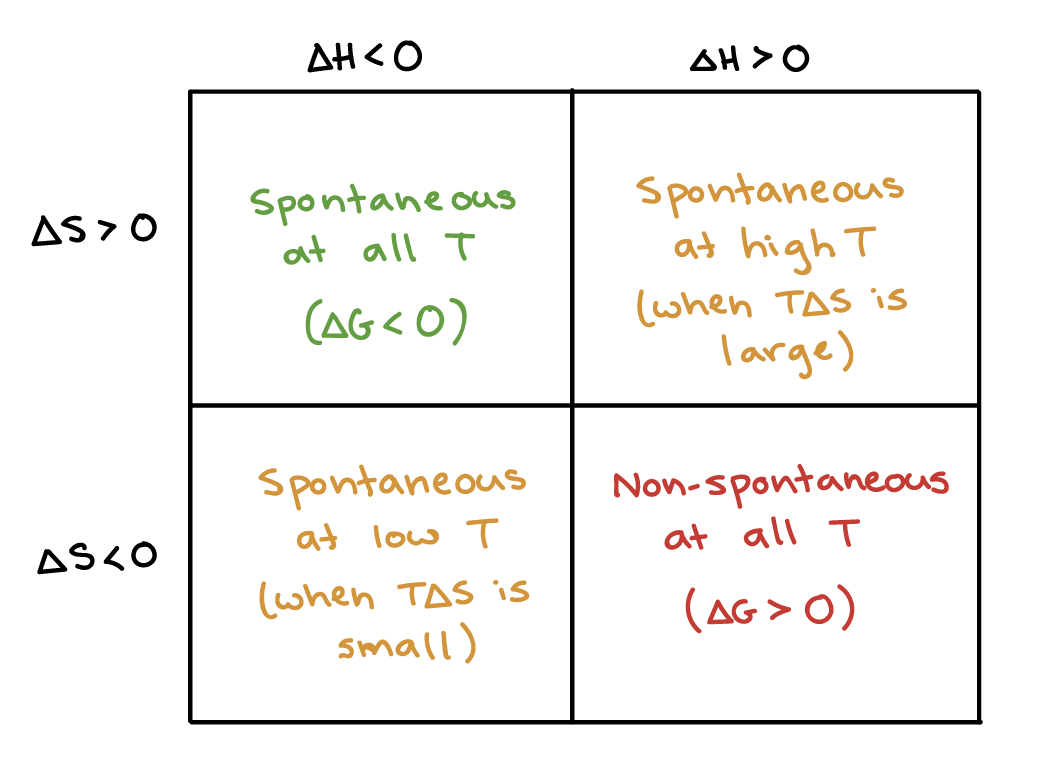

Types of Chemical Reactions

Image
Image
Image

1. Introduction to Chemical Reactions

Chemical reactions are processes in which substances called reactants undergo chemical changes to form new substances known as products. During a chemical reaction, atoms are rearranged to create different molecular structures, resulting in substances with new properties.

Chemical reactions are fundamental to chemistry because they explain how matter transforms from one form to another. Every reaction involves the breaking of existing chemical bonds and the formation of new bonds between atoms.

Chemical reactions occur everywhere in nature and daily life. Examples include:

  • Rusting of iron
  • Burning of fuels
  • Digestion of food
  • Photosynthesis in plants
  • Respiration in living organisms

Scientists classify chemical reactions into different types based on the patterns of reactant and product formation. Understanding these classifications helps chemists predict how substances react and allows them to design reactions for industrial and scientific applications.

The most common types of chemical reactions include:

  • Synthesis reactions
  • Decomposition reactions
  • Single displacement reactions
  • Double displacement reactions
  • Combustion reactions

Additional classifications include acid–base reactions, redox reactions, and precipitation reactions.


2. Synthesis (Combination) Reactions

Image
Image
Image
Image

A synthesis reaction, also known as a combination reaction, occurs when two or more substances combine to form a single product.

General form:

A + B → AB

In this reaction type, multiple reactants join together to produce one compound.

Example:

2H₂ + O₂ → 2H₂O

In this reaction, hydrogen and oxygen combine to form water.

Another example:

2Na + Cl₂ → 2NaCl

Here, sodium reacts with chlorine to produce sodium chloride.

Synthesis reactions are common in nature and industrial processes. They are often used to produce compounds from simpler substances.

Characteristics of synthesis reactions include:

  • Formation of a single product
  • Combination of elements or compounds
  • Often exothermic reactions

These reactions are important in chemical manufacturing and materials production.


3. Decomposition Reactions

Image
Image
Image
Image

A decomposition reaction occurs when a single compound breaks down into two or more simpler substances.

General form:

AB → A + B

In these reactions, chemical bonds are broken, resulting in simpler products.

Example:

2H₂O₂ → 2H₂O + O₂

Hydrogen peroxide decomposes into water and oxygen.

Another example:

CaCO₃ → CaO + CO₂

Calcium carbonate decomposes into calcium oxide and carbon dioxide.

Decomposition reactions often require energy input, such as heat, light, or electricity.

Types of decomposition reactions include:

  • Thermal decomposition
  • Electrolytic decomposition
  • Photodecomposition

These reactions play important roles in industrial processes and energy production.


4. Single Displacement Reactions

Image
Image
Image
Image

A single displacement reaction, also called a single replacement reaction, occurs when one element replaces another element in a compound.

General form:

A + BC → AC + B

In this reaction, a more reactive element displaces a less reactive element from a compound.

Example:

Zn + CuSO₄ → ZnSO₄ + Cu

Zinc replaces copper in copper sulfate.

Another example:

Cl₂ + 2NaBr → 2NaCl + Br₂

Chlorine displaces bromine from sodium bromide.

Single displacement reactions are governed by reactivity series, which ranks elements according to their ability to displace other elements.

These reactions are widely used in metallurgy and chemical synthesis.


5. Double Displacement Reactions

Image
Image
Image
Image

A double displacement reaction, also known as a double replacement reaction, occurs when two compounds exchange ions to form two new compounds.

General form:

AB + CD → AD + CB

These reactions typically occur in aqueous solutions.

Example:

AgNO₃ + NaCl → AgCl + NaNO₃

In this reaction, silver ions combine with chloride ions to form silver chloride.

Another example:

HCl + NaOH → NaCl + H₂O

This is an acid–base neutralization reaction.

Double displacement reactions often produce:

  • Precipitates
  • Water
  • Gases

These reactions are commonly observed in laboratory experiments and industrial processes.


6. Combustion Reactions

Image
Image
Image

A combustion reaction occurs when a substance reacts rapidly with oxygen to release energy in the form of heat and light.

Combustion reactions often involve hydrocarbons.

Example:

CH₄ + 2O₂ → CO₂ + 2H₂O

Methane reacts with oxygen to produce carbon dioxide and water.

Characteristics of combustion reactions include:

  • Rapid oxidation
  • Release of heat and light
  • Formation of carbon dioxide and water

Combustion reactions are essential in:

  • Energy production
  • Internal combustion engines
  • Industrial heating processes

These reactions power many modern technologies.


7. Acid–Base Reactions

Image
Image
Image
Image

Acid–base reactions involve the transfer of protons between substances.

In these reactions:

  • Acids donate hydrogen ions (H⁺).
  • Bases accept hydrogen ions.

Example:

HCl + NaOH → NaCl + H₂O

Hydrochloric acid reacts with sodium hydroxide to produce sodium chloride and water.

These reactions are called neutralization reactions.

Acid–base reactions play important roles in:

  • Biological systems
  • Environmental chemistry
  • Industrial processes
  • Pharmaceutical chemistry

8. Redox (Oxidation–Reduction) Reactions

Image
Image
Image
Image

Redox reactions involve the transfer of electrons between substances.

Oxidation refers to the loss of electrons, while reduction refers to the gain of electrons.

Example:

Zn + Cu²⁺ → Zn²⁺ + Cu

Zinc loses electrons (oxidation), while copper ions gain electrons (reduction).

Redox reactions occur in many processes such as:

  • Corrosion
  • Photosynthesis
  • Cellular respiration
  • Electrochemical batteries

These reactions are fundamental to energy transfer in chemistry.
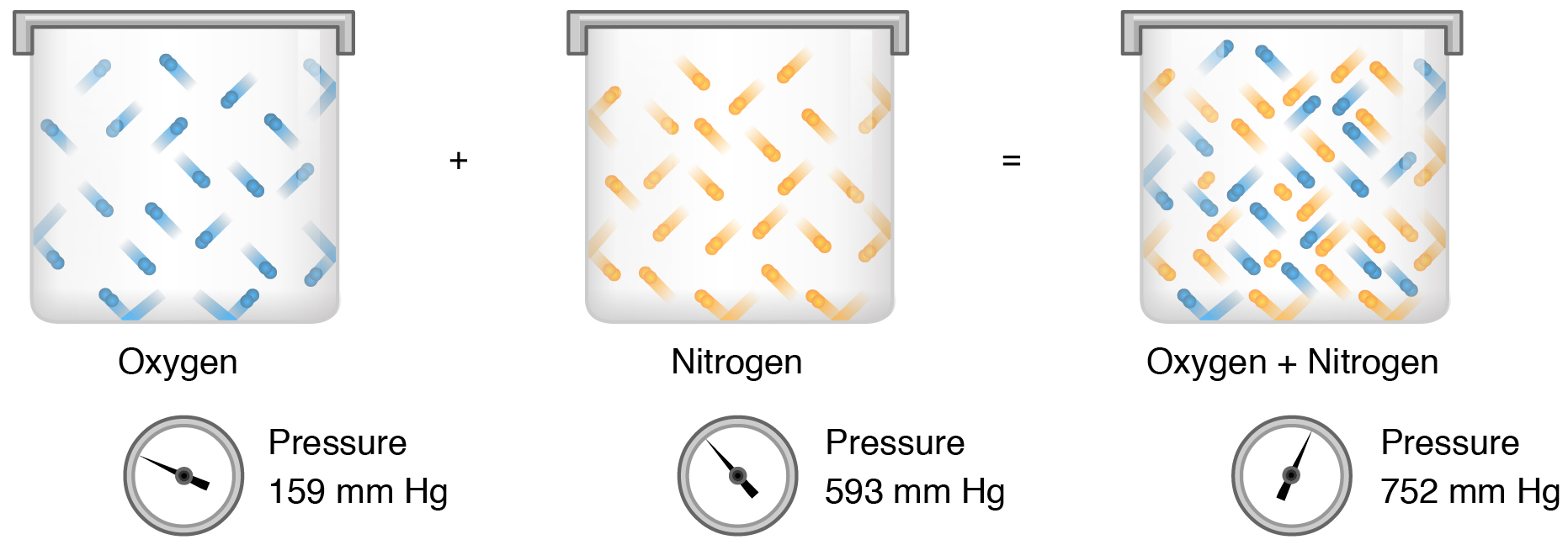

9. Precipitation Reactions

Image
Image
Image
Image

A precipitation reaction occurs when two aqueous solutions react to form an insoluble solid called a precipitate.

Example:

AgNO₃ + NaCl → AgCl + NaNO₃

Silver chloride forms as a white solid precipitate.

Precipitation reactions are used in:

  • Chemical analysis
  • Water purification
  • Industrial chemical processes

They are commonly used to identify specific ions in solutions.


10. Energy Changes in Chemical Reactions

Image
Image
Image
Image

Chemical reactions can also be classified based on energy changes.

Exothermic Reactions

Release energy as heat or light.

Example:

Combustion reactions.

Endothermic Reactions

Absorb energy from surroundings.

Example:

Photosynthesis.

Energy changes influence reaction rates and feasibility.


11. Importance of Chemical Reactions

Chemical reactions are essential for understanding the transformation of matter.

They explain:

  • Biological processes
  • Industrial manufacturing
  • Environmental chemistry
  • Energy production
  • Material synthesis

By studying reaction types, chemists can predict how substances behave under different conditions.


12. Conclusion

Chemical reactions describe the transformation of substances through the rearrangement of atoms and the breaking and formation of chemical bonds. Classifying reactions into types such as synthesis, decomposition, displacement, combustion, and redox reactions helps chemists understand and predict chemical behavior.

These reactions occur constantly in nature, from biological processes inside living organisms to large-scale industrial chemical production. Understanding the types of chemical reactions allows scientists to control chemical processes, develop new materials, produce energy, and improve technologies.

Chemical reactions form the foundation of chemistry and play a central role in shaping the physical world and advancing scientific knowledge.


Tags