Tag Archives: atomic structure

Electron Configuration

Image
Image
Image
Image

1. Introduction to Electron Configuration

Electron configuration is the arrangement of electrons in the orbitals of an atom or molecule. It describes how electrons occupy different energy levels and subshells around the nucleus. Understanding electron configuration is fundamental to chemistry because it explains the chemical behavior of elements, including their bonding properties, reactivity, and position in the periodic table.

Electrons occupy regions around the nucleus known as atomic orbitals. These orbitals represent probability distributions where electrons are most likely to be found. The distribution of electrons among these orbitals follows specific rules derived from quantum mechanics.

Electron configuration helps explain many important chemical phenomena, including:

  • Periodic trends in the periodic table
  • Chemical bonding and molecular structure
  • Ion formation
  • Magnetic properties of substances
  • Spectroscopic behavior of atoms

The concept of electron configuration emerged from the development of quantum mechanics in the early twentieth century. Scientists such as Niels Bohr, Erwin Schrödinger, and Wolfgang Pauli contributed to the understanding of electron behavior in atoms.

Each element has a unique electron configuration determined by the number of electrons in its atoms. For neutral atoms, the number of electrons equals the number of protons in the nucleus.

Electron configuration provides insight into the stability of atoms and their tendency to gain, lose, or share electrons during chemical reactions.


2. Energy Levels and Atomic Orbitals

Image
Image
Image
Image

Electrons in atoms occupy specific energy levels known as shells. Each shell contains one or more subshells, and each subshell contains orbitals.

Principal Energy Levels

The principal energy level is represented by the principal quantum number (n).

Possible values of n are:

1, 2, 3, 4, …

As the value of n increases:

  • The energy of electrons increases.
  • The average distance from the nucleus increases.
  • The orbitals become larger.

Each energy level can hold a maximum number of electrons given by the formula:

Maximum electrons = 2n²

Examples:

n = 1 → 2 electrons
n = 2 → 8 electrons
n = 3 → 18 electrons
n = 4 → 32 electrons


Subshells

Each principal energy level contains subshells defined by the azimuthal quantum number (l).

Subshell types include:

  • s subshell
  • p subshell
  • d subshell
  • f subshell

Each subshell contains a specific number of orbitals.


Orbitals

Orbitals are regions in space where electrons are most likely to be found.

Each orbital can hold a maximum of two electrons with opposite spins.

Number of orbitals in each subshell:

s subshell → 1 orbital → 2 electrons
p subshell → 3 orbitals → 6 electrons
d subshell → 5 orbitals → 10 electrons
f subshell → 7 orbitals → 14 electrons


3. Principles Governing Electron Configuration

Image
Image
Image
Image

Electron configuration follows three important principles.

Aufbau Principle

The Aufbau principle states that electrons fill orbitals in order of increasing energy.

Lower-energy orbitals are filled before higher-energy orbitals.

This principle determines the sequence in which orbitals are filled.

Orbital filling order generally follows:

1s → 2s → 2p → 3s → 3p → 4s → 3d → 4p → 5s → 4d → 5p → 6s → 4f → 5d → 6p → 7s


Pauli Exclusion Principle

The Pauli Exclusion Principle states that:

No two electrons in an atom can have the same set of four quantum numbers.

Because of this rule:

  • Each orbital holds at most two electrons.
  • These electrons must have opposite spins.

Hund’s Rule

Hund’s rule states that electrons occupy orbitals singly before pairing.

When multiple orbitals of the same energy are available, electrons fill them one at a time with parallel spins.

This arrangement minimizes electron repulsion and increases stability.


4. Writing Electron Configurations

Image
Image
Image
Image

Electron configurations are written using a notation that indicates:

  • Energy level (n)
  • Subshell (s, p, d, f)
  • Number of electrons in the subshell

Example:

Hydrogen:

1s¹

Helium:

1s²

Lithium:

1s² 2s¹

Carbon:

1s² 2s² 2p²

Oxygen:

1s² 2s² 2p⁴

This notation shows how electrons are distributed across orbitals.


Orbital Diagrams

Orbital diagrams represent orbitals as boxes and electrons as arrows.

Example for carbon:

1s ↑↓
2s ↑↓
2p ↑ ↑

The arrows represent electron spin.


5. Noble Gas Configuration

Image
Image
Image
Image

To simplify electron configurations for large atoms, scientists use noble gas shorthand notation.

In this method:

  • The electron configuration of the nearest noble gas is used as a core.
  • Remaining electrons are written after the noble gas symbol.

Example:

Sodium:

Full configuration:

1s² 2s² 2p⁶ 3s¹

Shorthand:

[Ne] 3s¹

Iron:

[Ar] 4s² 3d⁶

This notation makes electron configurations easier to write and understand.


6. Electron Configuration and the Periodic Table

Image
Image
Image
Image

The structure of the periodic table is directly related to electron configuration.

Elements are arranged according to the filling of orbitals.

s-block

Includes Groups 1 and 2.

Electrons are added to s orbitals.

p-block

Includes Groups 13–18.

Electrons fill p orbitals.

d-block

Contains transition metals.

Electrons fill d orbitals.

f-block

Includes lanthanides and actinides.

Electrons fill f orbitals.

This arrangement explains periodic trends such as atomic radius and ionization energy.


7. Exceptions to Electron Configuration

Although the Aufbau principle generally predicts electron configurations accurately, there are exceptions.

These occur when half-filled or fully filled subshells provide extra stability.

Examples include:

Chromium:

Expected:
[Ar] 4s² 3d⁴

Actual:
[Ar] 4s¹ 3d⁵

Copper:

Expected:
[Ar] 4s² 3d⁹

Actual:
[Ar] 4s¹ 3d¹⁰

These exceptions occur because half-filled and fully filled d subshells are more stable.


8. Electron Configuration of Ions

Atoms can gain or lose electrons to form ions.

Cations

Positive ions form when atoms lose electrons.

Example:

Sodium:

Na → Na⁺ + e⁻

Electron configuration:

Na: [Ne] 3s¹
Na⁺: [Ne]


Anions

Negative ions form when atoms gain electrons.

Example:

Chlorine:

Cl + e⁻ → Cl⁻

Electron configuration:

Cl: [Ne] 3s² 3p⁵
Cl⁻: [Ne] 3s² 3p⁶

Ion formation often results in noble gas configurations, which are highly stable.


9. Electron Configuration and Chemical Bonding

Electron configuration determines how atoms interact during chemical reactions.

Atoms tend to achieve stable electron arrangements similar to noble gases.

This occurs through:

  • Electron transfer (ionic bonding)
  • Electron sharing (covalent bonding)
  • Electron pooling (metallic bonding)

Valence electrons—the electrons in the outermost shell—play the most important role in bonding.


10. Magnetic Properties and Electron Configuration

Electron configuration influences the magnetic behavior of substances.

Diamagnetic Substances

Atoms with all electrons paired are diamagnetic.

They are weakly repelled by magnetic fields.

Paramagnetic Substances

Atoms with unpaired electrons are paramagnetic.

They are attracted to magnetic fields.

Transition metals often show paramagnetism due to unpaired d electrons.


11. Applications of Electron Configuration

Electron configuration has many applications in science and technology.

Chemical Reactivity

It helps predict how elements react and form compounds.

Spectroscopy

Electron transitions between orbitals produce characteristic spectral lines.

Materials Science

Understanding electron arrangements helps design semiconductors and superconductors.

Quantum Chemistry

Electron configurations form the basis for theoretical calculations of molecular behavior.

Nanotechnology

Manipulating electron behavior allows the development of advanced nanoscale materials.


12. Conclusion

Electron configuration is a fundamental concept in chemistry that describes the arrangement of electrons within atoms. It provides deep insight into atomic structure, chemical bonding, and the periodic organization of elements.

By following the principles of the Aufbau rule, Pauli exclusion principle, and Hund’s rule, electrons fill atomic orbitals in predictable patterns. These patterns explain the stability, reactivity, and physical properties of elements.

Electron configuration also plays a crucial role in modern scientific fields such as spectroscopy, materials science, nanotechnology, and quantum chemistry.

Understanding electron configuration allows scientists to interpret atomic behavior and design new technologies based on the manipulation of electrons.
Tags

Quantum Numbers

Image
Image
Image
Image

1. Introduction to Quantum Numbers

Quantum numbers are a set of numerical values used in quantum mechanics to describe the energy, position, orientation, and spin of electrons within an atom. They arise from the mathematical solutions of the Schrödinger wave equation and are fundamental to understanding the quantum mechanical model of the atom.

In classical atomic models, electrons were thought to move in fixed circular orbits around the nucleus. However, the development of quantum mechanics revealed that electrons behave both as particles and waves, making their exact location impossible to determine precisely. Instead, electrons exist in regions of probability called atomic orbitals.

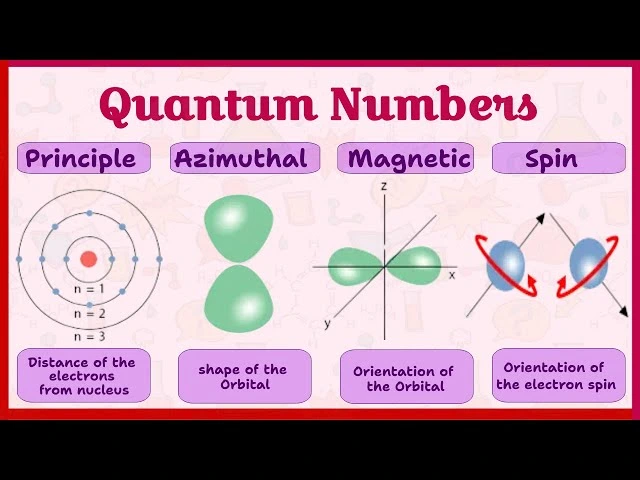
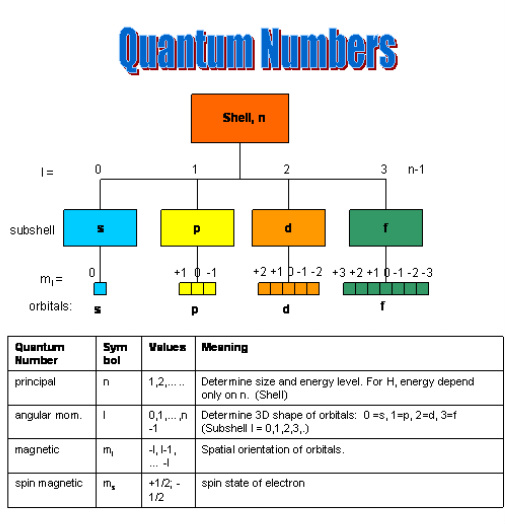
Quantum numbers help describe these orbitals and specify the quantum state of an electron. Each electron in an atom is characterized by a unique set of four quantum numbers:

  • Principal quantum number (n)
  • Azimuthal or angular momentum quantum number (l)
  • Magnetic quantum number (mₗ)
  • Spin quantum number (mₛ)

These numbers determine how electrons are arranged within atoms and explain many atomic properties such as electron configuration, chemical bonding, and periodic trends.

Quantum numbers are essential in modern chemistry, atomic physics, spectroscopy, and quantum mechanics. They provide a systematic way to describe the complex behavior of electrons within atoms and molecules.


2. Origin of Quantum Numbers

Image
Image
Image
Image

Quantum numbers originate from the development of quantum mechanics in the early twentieth century. Several important discoveries contributed to this development.

Wave–Particle Duality

Louis de Broglie proposed that particles such as electrons exhibit both wave-like and particle-like properties. This concept is known as wave–particle duality.

Electrons behave as waves when moving around the nucleus, leading to the formation of standing wave patterns that correspond to allowed energy levels.

Schrödinger Wave Equation

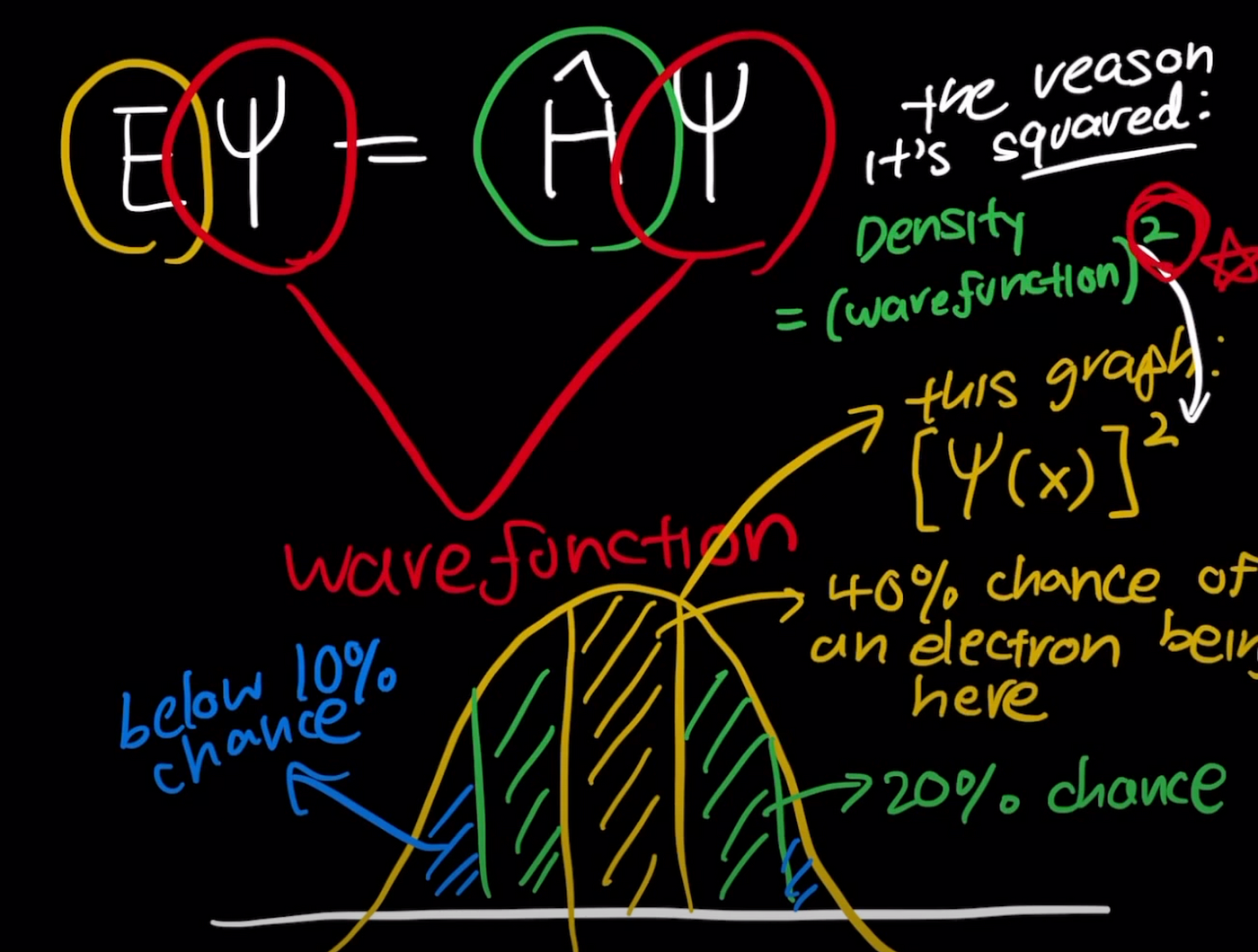
Erwin Schrödinger developed a mathematical equation describing how the quantum state of a physical system changes over time.

Solutions to this equation produce wave functions, which describe the probability of finding an electron in a particular region around the nucleus.

The solutions of the Schrödinger equation introduce quantum numbers that define these wave functions.

Heisenberg Uncertainty Principle

Werner Heisenberg showed that it is impossible to simultaneously determine the exact position and momentum of an electron.

Because of this uncertainty, electrons cannot be described as moving in fixed paths. Instead, their behavior is represented by probability distributions.

Quantum numbers therefore provide a way to describe the properties of these probability distributions.


3. Principal Quantum Number (n)

Image
Image
Image
Image

The principal quantum number, represented by the symbol n, describes the main energy level or shell of an electron within an atom.

Possible Values

The principal quantum number can take positive integer values:

n = 1, 2, 3, 4, …

Each value corresponds to a different electron shell.

Energy Levels

As the value of n increases:

  • The energy of the electron increases.
  • The average distance from the nucleus increases.
  • The size of the orbital becomes larger.

Shell Names

Electron shells are often labeled using letters:

n = 1 → K shell
n = 2 → L shell
n = 3 → M shell
n = 4 → N shell

Maximum Number of Electrons

Each shell can hold a maximum number of electrons determined by:

Maximum electrons = 2n²

Examples:

n = 1 → 2 electrons
n = 2 → 8 electrons
n = 3 → 18 electrons
n = 4 → 32 electrons

The principal quantum number therefore determines the overall size and energy of orbitals.


4. Azimuthal Quantum Number (l)

Image
Image
Image

The azimuthal quantum number, also called the angular momentum quantum number, is represented by l.

It describes the shape of the electron orbital.

Possible Values

The value of l depends on the principal quantum number n.

Possible values range from:

l = 0 to (n − 1)

Example:

If n = 3

Possible values of l are:

l = 0, 1, 2

Subshells

Each value of l corresponds to a specific subshell.

l = 0 → s subshell
l = 1 → p subshell
l = 2 → d subshell
l = 3 → f subshell

These subshells have different shapes and energy levels.

Orbital Shapes

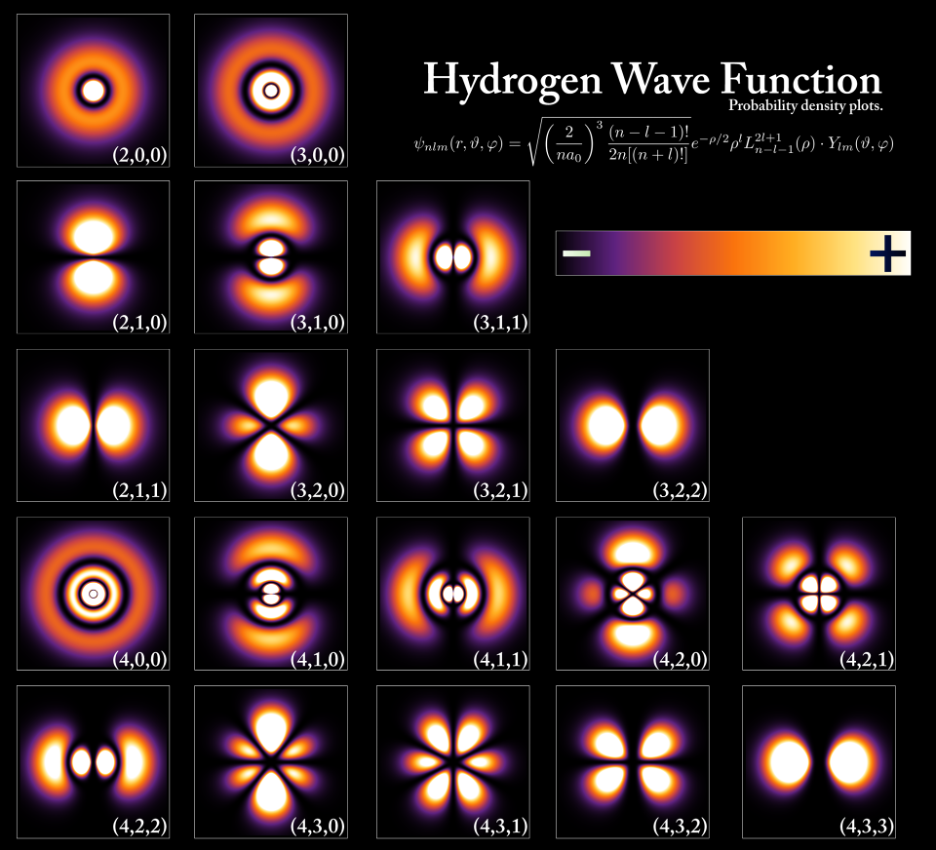
  • s orbitals are spherical.
  • p orbitals have dumbbell shapes.
  • d orbitals have cloverleaf shapes.
  • f orbitals have complex shapes.

These shapes influence how atoms interact and bond with other atoms.


5. Magnetic Quantum Number (mₗ)

Image
Image
Image
Image

The magnetic quantum number, represented by mₗ, describes the orientation of an orbital in space.

Possible Values

The value of mₗ ranges from:

−l to +l

including zero.

Example:

If l = 1

Possible mₗ values:

−1, 0, +1

This means that the p subshell contains three orbitals.

Number of Orbitals

The number of orbitals in a subshell can be calculated using:

2l + 1

Examples:

s subshell (l = 0) → 1 orbital
p subshell (l = 1) → 3 orbitals
d subshell (l = 2) → 5 orbitals
f subshell (l = 3) → 7 orbitals

Each orbital can hold up to two electrons.


6. Spin Quantum Number (mₛ)

Image
Image
Image
Image

The spin quantum number, represented by mₛ, describes the spin direction of an electron.

Electrons behave as if they rotate around their own axis, producing a magnetic field.

Possible Values

The spin quantum number can have only two values:

+1/2
−1/2

These represent two possible spin orientations.

Pauli Exclusion Principle

The Pauli Exclusion Principle states that:

No two electrons in the same atom can have the same set of four quantum numbers.

Because of this principle:

  • Each orbital can hold a maximum of two electrons.
  • The electrons must have opposite spins.

This rule is fundamental for determining electron configurations.


7. Relationship Between Quantum Numbers and Atomic Orbitals

Quantum numbers define the characteristics of atomic orbitals.

Each orbital is uniquely defined by three quantum numbers:

n, l, and mₗ.

Electrons occupying these orbitals are further distinguished by the spin quantum number.

Example

Consider the orbital:

n = 2
l = 1

This corresponds to the 2p subshell.

Possible mₗ values:

−1, 0, +1

Therefore, the 2p subshell contains three orbitals.

Each orbital can contain two electrons, giving a maximum of six electrons in the 2p subshell.

Quantum numbers therefore determine the entire electronic structure of atoms.


8. Quantum Numbers and Electron Configuration

Quantum numbers help explain how electrons fill orbitals in atoms.

Three important principles guide electron arrangement.

Aufbau Principle

Electrons occupy orbitals with the lowest energy first.

Pauli Exclusion Principle

Each orbital holds a maximum of two electrons with opposite spins.

Hund’s Rule

Electrons occupy orbitals singly before pairing.

These principles explain the electron configurations of elements in the periodic table.


9. Quantum Numbers and the Periodic Table

Image
Image
Image
Image

The structure of the periodic table is closely related to quantum numbers.

s-block

Elements in the first two groups fill the s subshell.

p-block

Elements in groups 13–18 fill p orbitals.

d-block

Transition metals involve filling of d orbitals.

f-block

Lanthanides and actinides involve f orbitals.

Quantum numbers therefore explain the arrangement of elements in the periodic table.


10. Importance of Quantum Numbers

Quantum numbers are crucial for understanding many aspects of chemistry and physics.

Atomic Structure

They describe the arrangement of electrons within atoms.

Chemical Bonding

Orbital shapes and orientations determine bonding patterns.

Spectroscopy

Quantum transitions between energy levels produce spectral lines.

Magnetism

Electron spin explains magnetic properties of materials.

Quantum Chemistry

Quantum numbers form the basis for calculations of molecular structures and reactions.


11. Applications of Quantum Numbers

Quantum numbers have numerous applications in modern science and technology.

Semiconductor Technology

Understanding electron orbitals is essential for designing electronic devices.

Laser Technology

Laser operation relies on electron transitions between quantum energy levels.

Magnetic Resonance Imaging (MRI)

MRI uses electron and nuclear spin properties.

Spectroscopy

Quantum numbers help identify elements and compounds through spectral analysis.

Nanotechnology

Quantum behavior becomes significant at very small scales.


12. Conclusion

Quantum numbers provide a powerful framework for describing the behavior of electrons within atoms. By defining the energy, shape, orientation, and spin of electron orbitals, quantum numbers form the foundation of modern atomic theory.

The four quantum numbers—principal, azimuthal, magnetic, and spin—collectively describe the quantum state of electrons. These numbers explain the structure of atomic orbitals, electron configurations, and the organization of the periodic table.

Understanding quantum numbers is essential for studying advanced topics in chemistry, physics, and materials science. They enable scientists to predict atomic properties, chemical bonding patterns, and the behavior of matter at the microscopic level.

As research in quantum mechanics continues to evolve, quantum numbers remain a fundamental concept in understanding the complex and fascinating world of atoms and subatomic particles.


Tags

Atomic Models

Image
Image
Image
Image

1. Introduction to Atomic Models

Atomic models are conceptual representations used to explain the structure and behavior of atoms. Because atoms are extremely small and cannot be observed directly with the naked eye, scientists use models to describe their internal structure and explain experimental observations.

Over the centuries, scientific understanding of atoms has evolved through a series of discoveries and experiments. Each new model improved upon earlier ones by explaining additional experimental evidence. Atomic models help scientists understand:

  • The arrangement of subatomic particles
  • Chemical bonding and reactions
  • The periodic table of elements
  • Spectral lines of atoms
  • The behavior of matter at microscopic levels

The development of atomic models represents one of the most important progressions in the history of science. From early philosophical ideas to the modern quantum mechanical model, each step has contributed to a deeper understanding of matter.

Atomic models are not exact pictures of atoms but rather scientific frameworks that approximate atomic structure based on available evidence.


2. Early Philosophical Concepts of Atoms

Image
Image
Image
Image

The earliest ideas about atoms originated in ancient Greece around 400 BCE. Philosophers such as Democritus and Leucippus proposed that matter consisted of tiny indivisible particles called atoms, derived from the Greek word meaning “uncuttable.”

According to their theory:

  • Matter is composed of extremely small particles.
  • These particles cannot be divided further.
  • Different substances are formed by different arrangements of atoms.

Although this concept was remarkably insightful, it was based on philosophical reasoning rather than experimental evidence. Therefore, it did not gain widespread acceptance in scientific circles at the time.

For many centuries afterward, the dominant view of matter was based on the four classical elements proposed by Aristotle:

  • Earth
  • Water
  • Air
  • Fire

It was not until the development of modern experimental science in the eighteenth and nineteenth centuries that atomic theory began to gain scientific support.


3. Dalton’s Atomic Model (Solid Sphere Model)

Image
Image
Image
Image

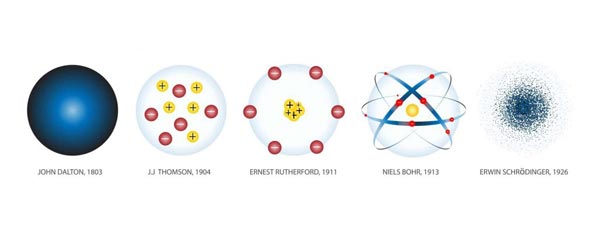
The first scientific atomic model was proposed by John Dalton in the early nineteenth century.

Dalton’s model was based on experimental observations related to chemical reactions and the laws of chemical combination.

Dalton’s Atomic Theory

Dalton proposed several fundamental principles:

  1. Matter is composed of tiny indivisible particles called atoms.
  2. Atoms of a given element are identical in mass and properties.
  3. Atoms of different elements differ in mass and properties.
  4. Compounds form when atoms combine in fixed whole-number ratios.
  5. Chemical reactions involve the rearrangement of atoms.

Characteristics of Dalton’s Model

Dalton imagined atoms as solid, indivisible spheres, similar to tiny billiard balls.

This model successfully explained several chemical laws, including:

  • Law of conservation of mass
  • Law of definite proportions
  • Law of multiple proportions

Limitations of Dalton’s Model

Although Dalton’s theory was revolutionary, later discoveries revealed several limitations:

  • Atoms are divisible and contain subatomic particles.
  • Atoms of the same element can have different masses (isotopes).
  • Atoms can undergo nuclear reactions.

Despite these limitations, Dalton’s model laid the foundation for modern atomic theory.


4. Thomson’s Atomic Model (Plum Pudding Model)

Image
Image
Image
Image

The discovery of the electron in 1897 by J. J. Thomson led to a new atomic model.

Through experiments with cathode ray tubes, Thomson demonstrated that atoms contain negatively charged particles.

Thomson’s Model Description

Thomson proposed the plum pudding model of the atom.

In this model:

  • The atom is a positively charged sphere.
  • Electrons are embedded throughout the sphere like raisins in a pudding.

This arrangement ensured that the atom remained electrically neutral.

Contributions of Thomson’s Model

The model introduced the concept of subatomic particles, proving that atoms were not indivisible.

It also explained the electrical properties of atoms.

Limitations

Thomson’s model could not explain:

  • The existence of a dense nucleus
  • The scattering of alpha particles observed in later experiments

These limitations led to the development of a new atomic model.


5. Rutherford’s Nuclear Model

Image
Image
Image
Image

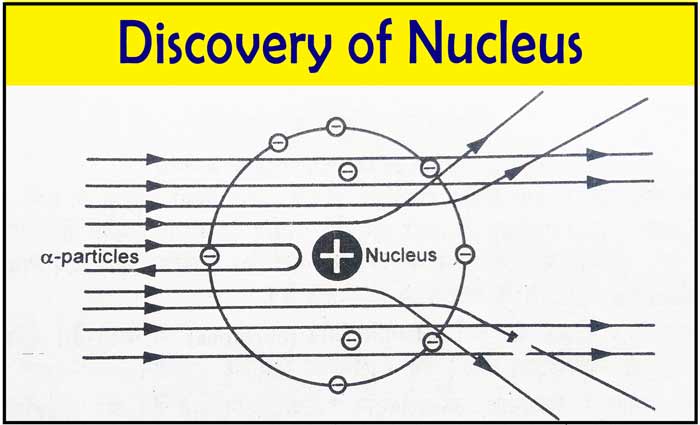
In 1911, Ernest Rutherford conducted the famous gold foil experiment, which revolutionized the understanding of atomic structure.

Gold Foil Experiment

Rutherford and his colleagues directed a beam of alpha particles at a thin sheet of gold foil.

Observations:

  • Most alpha particles passed straight through the foil.
  • Some particles were deflected slightly.
  • A few particles bounced back at large angles.

Conclusions

From these observations, Rutherford concluded that:

  1. Atoms are mostly empty space.
  2. Positive charge is concentrated in a tiny central nucleus.
  3. Electrons move around the nucleus.

Rutherford’s Atomic Model

The atom consists of:

  • A small, dense, positively charged nucleus
  • Electrons orbiting the nucleus
  • Large empty space between the nucleus and electrons

Limitations

Rutherford’s model could not explain:

  • Why electrons do not spiral into the nucleus
  • The discrete spectral lines observed in atomic emission spectra

These problems led to the development of the Bohr model.


6. Bohr’s Atomic Model

Image
Image
Image
Image

In 1913, Niels Bohr proposed an improved atomic model that incorporated ideas from quantum theory.

Main Features of Bohr’s Model

  1. Electrons move in fixed circular orbits around the nucleus.
  2. Each orbit corresponds to a specific energy level.
  3. Electrons can jump between energy levels by absorbing or emitting energy.
  4. Energy is quantized and exists in discrete units.

Explanation of Atomic Spectra

Bohr’s model successfully explained the spectral lines of hydrogen.

When electrons jump from higher energy levels to lower levels, they emit light of specific wavelengths.

Advantages

Bohr’s model explained:

  • Atomic emission spectra
  • Stability of atoms
  • Quantized energy levels

Limitations

Bohr’s model works well only for hydrogen and hydrogen-like atoms.

It cannot accurately describe atoms with multiple electrons.


7. Quantum Mechanical Model of the Atom

Image
Image
Image
Image

The modern understanding of atomic structure is based on quantum mechanics.

This model was developed through the work of scientists such as:

  • Erwin Schrödinger
  • Werner Heisenberg
  • Louis de Broglie

Key Principles

Wave-Particle Duality

Electrons behave both as particles and waves.

Uncertainty Principle

The exact position and momentum of an electron cannot be known simultaneously.

Schrödinger Wave Equation

This equation describes the probability distribution of electrons in atoms.

Orbitals

Instead of fixed orbits, electrons occupy orbitals, which are regions where electrons are most likely to be found.

Types of orbitals include:

  • s orbitals (spherical)
  • p orbitals (dumbbell-shaped)
  • d orbitals (clover-shaped)
  • f orbitals (complex shapes)

This model accurately explains atomic structure and chemical bonding.


8. Comparison of Atomic Models

Each atomic model improved upon the previous one.

Dalton Model

Atoms are indivisible solid spheres.

Thomson Model

Atoms contain electrons embedded in positive charge.

Rutherford Model

Atoms contain a dense central nucleus.

Bohr Model

Electrons occupy quantized energy levels.

Quantum Mechanical Model

Electrons exist in probability clouds called orbitals.

This progression reflects the advancement of experimental techniques and scientific understanding.


9. Importance of Atomic Models

Atomic models are essential for understanding many aspects of chemistry and physics.

Chemical Bonding

Models explain how atoms combine to form molecules.

Periodic Table

Atomic structure determines periodic trends.

Spectroscopy

Atomic models explain emission and absorption spectra.

Material Science

Understanding electron behavior helps design new materials.

Nanotechnology

Atomic-level understanding enables manipulation of matter at extremely small scales.


10. Applications in Modern Science

Atomic models play a crucial role in many technological fields.

Electronics

Semiconductors rely on understanding electron energy levels.

Nuclear Energy

Nuclear models explain fission and fusion reactions.

Medical Technology

Radiation therapy and imaging technologies rely on atomic principles.

Astronomy

Spectral analysis helps identify elements in stars and galaxies.


11. Conclusion

The development of atomic models represents a remarkable journey in scientific discovery. Starting from philosophical ideas about indivisible particles, scientists gradually uncovered the complex internal structure of atoms.

Dalton’s model introduced the concept of atoms as fundamental building blocks of matter. Thomson’s discovery of electrons revealed that atoms contain subatomic particles. Rutherford’s experiments demonstrated the existence of a dense nucleus. Bohr introduced quantized electron energy levels, and the quantum mechanical model provided a sophisticated description of electron behavior.

Today, the quantum mechanical model remains the most accurate representation of atomic structure. It continues to guide research in chemistry, physics, materials science, and nanotechnology.

The evolution of atomic models highlights the importance of experimentation, theoretical insight, and technological advancement in expanding our understanding of the natural world.


Tags

Atomic Structure

Image
Image
Image
Image

1. Introduction to Atomic Structure

Atomic structure is one of the most fundamental concepts in chemistry and physics. It describes the internal composition of atoms and explains how subatomic particles are arranged and interact within an atom. Understanding atomic structure is essential for explaining the chemical behavior of elements, the formation of molecules, and the nature of chemical reactions.

An atom is the smallest unit of an element that retains the chemical properties of that element. All matter in the universe—whether solid, liquid, gas, or plasma—is made up of atoms. These atoms combine in various ways to form molecules and compounds.

The idea that matter is composed of tiny indivisible particles dates back to ancient philosophers. However, modern atomic theory developed through centuries of scientific investigation and experimentation.

The study of atomic structure provides insight into several important topics, including:

  • Chemical bonding
  • Periodic table organization
  • Spectroscopy
  • Quantum mechanics
  • Nuclear reactions
  • Material properties

Atoms are incredibly small. The typical diameter of an atom is about 10⁻¹⁰ meters (0.1 nanometers). Despite their tiny size, atoms consist of smaller components known as subatomic particles.

The three main subatomic particles are:

  • Protons
  • Neutrons
  • Electrons

These particles determine the mass, charge, and behavior of atoms.


2. Historical Development of Atomic Theory

Image
Image
Image
Image

The concept of atoms has evolved through many scientific discoveries.

Early Philosophical Ideas

The earliest ideas about atoms were proposed by ancient Greek philosophers such as Democritus around 400 BCE. He suggested that matter is composed of indivisible particles called atoms, derived from the Greek word meaning “uncuttable.”

However, these ideas were philosophical rather than scientific because they were not supported by experiments.


Dalton’s Atomic Theory (1803)

The first modern scientific atomic theory was proposed by John Dalton in the early 19th century.

Dalton’s atomic theory included several key ideas:

  1. Matter is composed of tiny indivisible atoms.
  2. Atoms of the same element are identical in mass and properties.
  3. Atoms of different elements differ in mass and properties.
  4. Atoms combine in simple whole-number ratios to form compounds.
  5. Chemical reactions involve the rearrangement of atoms.

Dalton’s model represented atoms as solid spheres.


Thomson’s Model (1897)

In 1897, J. J. Thomson discovered the electron through experiments with cathode rays.

He proposed the plum pudding model, in which:

  • The atom is a positively charged sphere
  • Electrons are embedded within it

Although this model explained the presence of electrons, it did not accurately represent atomic structure.


Rutherford’s Nuclear Model (1911)

Ernest Rutherford conducted the famous gold foil experiment.

In this experiment, alpha particles were directed toward a thin sheet of gold foil. Most particles passed straight through, but some were deflected at large angles.

This led to several conclusions:

  • Atoms are mostly empty space.
  • The positive charge is concentrated in a tiny central nucleus.
  • Electrons move around the nucleus.

This discovery introduced the concept of the atomic nucleus.


Bohr’s Atomic Model (1913)

Niels Bohr improved Rutherford’s model by introducing quantized energy levels.

According to Bohr:

  • Electrons move in fixed circular orbits around the nucleus.
  • Each orbit corresponds to a specific energy level.
  • Electrons can jump between levels by absorbing or emitting energy.

Bohr’s model explained the spectral lines of hydrogen but could not fully explain more complex atoms.


Quantum Mechanical Model (Modern Theory)

The modern understanding of atomic structure is based on quantum mechanics.

Instead of fixed orbits, electrons exist in orbitals, which are regions of probability where electrons are most likely to be found.

This model was developed through the work of scientists such as:

  • Erwin Schrödinger
  • Werner Heisenberg
  • Louis de Broglie

The quantum mechanical model remains the most accurate description of atomic structure.


3. Subatomic Particles

Image
Image
Image
Image

Atoms contain three primary subatomic particles.

Protons

Protons are positively charged particles located in the nucleus of an atom.

Characteristics of protons:

  • Positive electric charge (+1)
  • Mass approximately 1 atomic mass unit (amu)
  • Located in the nucleus

The number of protons in an atom determines the atomic number, which identifies the element.


Neutrons

Neutrons are electrically neutral particles located in the nucleus.

Characteristics of neutrons:

  • No electric charge
  • Mass approximately 1 atomic mass unit
  • Located in the nucleus

Neutrons contribute to the overall mass of the atom and help stabilize the nucleus.


Electrons

Electrons are negatively charged particles that move around the nucleus in orbitals.

Characteristics of electrons:

  • Negative electric charge (−1)
  • Very small mass (about 1/1836 of a proton)
  • Located outside the nucleus

Electrons determine the chemical properties and bonding behavior of atoms.


4. Atomic Number and Mass Number

Every atom has specific numerical characteristics that define it.

Atomic Number

The atomic number (Z) is the number of protons in the nucleus.

It uniquely identifies an element.

For example:

Hydrogen → 1 proton
Carbon → 6 protons
Oxygen → 8 protons

Atoms of the same element always have the same atomic number.


Mass Number

The mass number (A) is the total number of protons and neutrons in the nucleus.

Mass Number = Protons + Neutrons

Mass number determines the approximate mass of the atom.


5. Isotopes

Image
Image
Image
Image

Isotopes are atoms of the same element that have the same number of protons but different numbers of neutrons.

Because they have different numbers of neutrons, isotopes have different mass numbers.

Example: Hydrogen isotopes

Protium → 1 proton, 0 neutrons
Deuterium → 1 proton, 1 neutron
Tritium → 1 proton, 2 neutrons

Although isotopes have similar chemical properties, their physical properties may differ.

Isotopes are important in many applications:

  • Medical imaging
  • Radiotherapy
  • Carbon dating
  • Nuclear energy

6. Electronic Structure of Atoms

Image
Image
Image
Image

Electrons occupy specific energy levels around the nucleus.

These energy levels are called electron shells or principal energy levels.

Each shell can hold a maximum number of electrons determined by the formula:

Maximum electrons = 2n²

Where n is the energy level.

Example:

n = 1 → 2 electrons
n = 2 → 8 electrons
n = 3 → 18 electrons


Subshells and Orbitals

Each energy level contains subshells.

The main types of subshells are:

  • s
  • p
  • d
  • f

Each subshell contains orbitals where electrons are most likely to be found.

Orbital shapes include:

  • s orbital → spherical
  • p orbital → dumbbell-shaped
  • d orbital → complex shapes
  • f orbital → highly complex shapes

7. Quantum Numbers

Quantum numbers describe the location and energy of electrons in atoms.

There are four quantum numbers.

Principal Quantum Number (n)

Determines the main energy level of the electron.

Angular Momentum Quantum Number (l)

Determines the shape of the orbital.

Magnetic Quantum Number (m)

Determines the orientation of the orbital.

Spin Quantum Number (s)

Represents the spin direction of the electron.

Quantum numbers provide a mathematical description of electron behavior.


8. Electron Configuration

Electron configuration describes how electrons are distributed among atomic orbitals.

Electrons follow three important principles when filling orbitals.

Aufbau Principle

Electrons occupy the lowest energy orbitals first.

Pauli Exclusion Principle

No two electrons in an atom can have the same set of quantum numbers.

Hund’s Rule

Electrons occupy orbitals singly before pairing up.

Example electron configuration:

Oxygen (8 electrons):

1s² 2s² 2p⁴


9. Atomic Orbitals and Electron Clouds

The modern quantum model describes electrons as existing in probability clouds rather than fixed orbits.

An orbital represents a region in space where the probability of finding an electron is highest.

This model explains many phenomena that earlier atomic models could not explain.

Electron clouds create the shapes and sizes of atoms and influence chemical bonding.


10. Atomic Spectra

When electrons move between energy levels, they absorb or emit energy in the form of light.

This produces atomic spectra, which appear as specific lines of color.

Each element has a unique spectral pattern that acts like a fingerprint.

Spectroscopy uses these spectra to identify elements in:

  • stars
  • distant galaxies
  • chemical samples

11. Nuclear Stability and Radioactivity

The stability of an atom depends on the balance between protons and neutrons in the nucleus.

When nuclei become unstable, they may undergo radioactive decay.

Common types of radioactive decay include:

  • Alpha decay
  • Beta decay
  • Gamma radiation

Radioactivity plays important roles in:

  • nuclear medicine
  • radiometric dating
  • nuclear power generation

12. Importance of Atomic Structure

Understanding atomic structure is crucial for many scientific fields.

Chemistry

Explains chemical bonding and reactions.

Physics

Helps understand quantum mechanics and nuclear physics.

Material Science

Determines properties of metals, semiconductors, and polymers.

Medicine

Radioisotopes are used in medical imaging and cancer treatment.

Astronomy

Atomic spectra help scientists identify elements in stars and galaxies.


13. Conclusion

Atomic structure forms the foundation of modern chemistry and physics. The discovery that atoms consist of protons, neutrons, and electrons revolutionized our understanding of matter.

Over time, atomic models evolved from simple solid spheres to the sophisticated quantum mechanical model that describes electron behavior using probability distributions.

Knowledge of atomic structure allows scientists to understand chemical bonding, predict the properties of elements, and develop new technologies in medicine, energy, and materials science.

As scientific research continues, deeper exploration of atomic and subatomic particles continues to reveal new insights into the fundamental nature of matter and the universe.


Tags

Matter and Its Classification

Image
Image
Image
Image

1. Introduction to Matter

Matter is one of the most fundamental concepts in chemistry and physical science. Everything that exists in the physical universe, from the smallest microscopic particles to enormous celestial bodies such as planets and stars, is composed of matter. Matter can be defined as anything that has mass and occupies space. This definition may appear simple, but it encompasses a vast range of materials and substances that make up our universe.

Matter exists in various forms and structures. It includes everyday objects like water, air, rocks, plants, animals, metals, plastics, and countless other materials. Even the human body is composed entirely of matter. Understanding matter and how it behaves is essential for studying chemistry because chemistry focuses on the composition, structure, properties, and transformations of matter.

In chemistry, matter is studied at different levels. Scientists investigate matter at the macroscopic level, which includes visible materials and substances we can observe directly. They also study matter at the microscopic level, which involves atoms, molecules, and subatomic particles that cannot be seen with the naked eye.

Matter exhibits different characteristics depending on its composition and the arrangement of its particles. Because of this diversity, scientists classify matter into various categories to better understand its properties and behavior.

The classification of matter helps scientists organize substances into groups based on similarities in their physical and chemical properties. This organization simplifies the study of matter and provides a framework for predicting how substances will behave under different conditions.


2. Properties of Matter

Matter possesses certain characteristics known as properties, which describe how a substance behaves and how it can be identified. These properties are broadly divided into two categories: physical properties and chemical properties.

Physical Properties

Physical properties are characteristics that can be observed or measured without changing the chemical identity of the substance. These properties describe the appearance and behavior of matter under various conditions.

Some common physical properties include:

Mass

Mass refers to the amount of matter present in an object. It is usually measured in kilograms or grams. Mass remains constant regardless of location.

Volume

Volume is the amount of space occupied by a substance. Liquids and gases take the shape of their containers, while solids usually have fixed shapes.

Density

Density is defined as the mass per unit volume of a substance. It indicates how tightly packed the particles of matter are within a given space.

Color and Appearance

Many substances can be identified by their color or physical appearance. For example, copper has a reddish color, while sulfur is yellow.

Melting Point

The melting point is the temperature at which a solid changes into a liquid.

Boiling Point

The boiling point is the temperature at which a liquid changes into a gas.

Solubility

Solubility describes the ability of a substance to dissolve in another substance.

Electrical Conductivity

Some materials, such as metals, can conduct electricity, while others cannot.

Physical properties are useful in identifying substances and determining their potential applications.


Chemical Properties

Chemical properties describe the ability of a substance to undergo chemical reactions and form new substances.

Examples of chemical properties include:

Reactivity

Reactivity describes how easily a substance reacts with other substances.

Flammability

Flammability refers to the ability of a substance to burn in the presence of oxygen.

Corrosion

Certain metals react with oxygen and moisture to form oxides, leading to corrosion.

Acidity and Basicity

These properties describe the chemical behavior of substances in aqueous solutions.

Chemical properties can only be observed when a chemical change occurs.


3. States of Matter

Image
Image
Image
Image

Matter exists in different physical states, depending on temperature and pressure conditions. The four primary states of matter are solid, liquid, gas, and plasma.

Solid

In solids, particles are tightly packed in a fixed arrangement. The strong intermolecular forces between particles keep them in place, allowing only small vibrations.

Characteristics of solids:

  • Definite shape
  • Definite volume
  • High density
  • Particles closely packed
  • Very limited movement of particles

Examples of solids include:

  • Ice
  • Wood
  • Metals
  • Salt
  • Rocks

Solids can be further classified into crystalline solids and amorphous solids.

Crystalline solids have an orderly repeating structure, while amorphous solids have irregular particle arrangements.


Liquid

Liquids have a definite volume but no fixed shape. They take the shape of the container that holds them.

Characteristics of liquids:

  • Definite volume
  • No fixed shape
  • Moderate density
  • Particles close together but able to move
  • Ability to flow

Examples of liquids include:

  • Water
  • Oil
  • Alcohol
  • Mercury

Liquids exhibit properties such as viscosity, surface tension, and capillary action.


Gas

Gases have neither definite shape nor definite volume. They expand to fill the entire container.

Characteristics of gases:

  • No fixed shape
  • No fixed volume
  • Very low density
  • Particles move freely and rapidly
  • Highly compressible

Examples of gases include:

  • Oxygen
  • Nitrogen
  • Carbon dioxide
  • Hydrogen

The behavior of gases is described by various gas laws.


Plasma

Plasma is considered the fourth state of matter. It consists of highly energized charged particles such as ions and electrons.

Plasma forms when gases are heated to extremely high temperatures or exposed to strong electromagnetic fields.

Examples include:

  • Lightning
  • The Sun and stars
  • Neon lights
  • Plasma televisions
  • Auroras

Plasma conducts electricity and responds strongly to magnetic fields.


4. Classification of Matter

Image
Image
Image
Image

Matter can be classified into two major categories:

  1. Pure substances
  2. Mixtures

This classification is based on composition and uniformity.


5. Pure Substances

Pure substances are forms of matter that have a fixed chemical composition and consistent properties throughout the sample.

They cannot be separated into simpler substances by physical methods.

Pure substances are divided into two categories:

  1. Elements
  2. Compounds

Elements

An element is the simplest form of matter that cannot be broken down into simpler substances by chemical reactions.

Elements consist of only one type of atom.

Examples of elements include:

  • Hydrogen
  • Oxygen
  • Carbon
  • Iron
  • Gold
  • Silver
  • Nitrogen

Each element has a unique atomic number that represents the number of protons in its nucleus.

More than 118 elements are known today.

Elements are organized in the periodic table based on their atomic number and chemical properties.

Elements can be classified into several groups:

Metals

Metals are elements that are typically shiny, conductive, and malleable.

Examples:

  • Iron
  • Copper
  • Aluminum
  • Gold

Nonmetals

Nonmetals generally lack metallic properties.

Examples:

  • Oxygen
  • Nitrogen
  • Sulfur
  • Carbon

Metalloids

Metalloids possess properties intermediate between metals and nonmetals.

Examples:

  • Silicon
  • Germanium

Compounds

Compounds are substances formed when two or more elements chemically combine in fixed proportions.

The atoms in a compound are held together by chemical bonds.

Examples include:

  • Water (H₂O)
  • Carbon dioxide (CO₂)
  • Sodium chloride (NaCl)
  • Methane (CH₄)
  • Ammonia (NH₃)

Compounds have properties that differ from the elements that compose them.

For example:

Hydrogen and oxygen are gases, but when they combine chemically, they form water, which is a liquid.

Compounds can only be separated into their elements through chemical reactions, not physical processes.


6. Mixtures

A mixture is a combination of two or more substances that are physically combined rather than chemically bonded.

The components of a mixture retain their individual properties and can be separated using physical methods.

Examples of mixtures include:

  • Air
  • Saltwater
  • Soil
  • Sand and sugar mixture
  • Alloys such as brass and steel

Mixtures are divided into two types:

  1. Homogeneous mixtures
  2. Heterogeneous mixtures

Homogeneous Mixtures

Homogeneous mixtures have a uniform composition throughout the entire mixture.

They appear as a single phase.

Examples include:

  • Salt dissolved in water
  • Sugar solution
  • Air
  • Vinegar
  • Alcohol-water mixture

These mixtures are often referred to as solutions.

A solution contains:

  • Solute (the substance dissolved)
  • Solvent (the substance that dissolves the solute)

For example, in saltwater:

Salt = solute
Water = solvent


Heterogeneous Mixtures

Heterogeneous mixtures have non-uniform composition and contain visibly different components.

Examples include:

  • Sand in water
  • Oil and water
  • Salad
  • Soil
  • Granite

The different components in heterogeneous mixtures can usually be seen with the naked eye.


7. Methods of Separating Mixtures

Image
Image
Image
Image

Because mixtures consist of physically combined substances, they can be separated using various physical methods.

Filtration

Filtration separates insoluble solids from liquids using a filter medium.

Example: separating sand from water.

Distillation

Distillation separates liquids based on differences in boiling points.

Example: separating alcohol from water.

Chromatography

Chromatography separates substances based on their movement through a medium.

Example: separating pigments in ink.

Centrifugation

Centrifugation uses rapid spinning to separate substances of different densities.

Example: separating blood components.

Evaporation

Evaporation separates dissolved solids from liquids.

Example: obtaining salt from seawater.


8. Changes in Matter

Matter can undergo two main types of changes.

Physical Changes

Physical changes affect the form or state of matter but do not alter its chemical composition.

Examples:

  • Melting ice
  • Freezing water
  • Breaking glass
  • Dissolving sugar

These changes are often reversible.


Chemical Changes

Chemical changes produce new substances with different chemical compositions.

Examples:

  • Burning wood
  • Rusting iron
  • Cooking food
  • Fermentation

Chemical changes usually involve energy changes and the formation of new chemical bonds.


9. Importance of Studying Matter and Its Classification

Understanding matter and its classification is fundamental to chemistry and other sciences.

It helps scientists:

  • Understand the structure of substances
  • Predict chemical behavior
  • Develop new materials
  • Improve industrial processes
  • Design medicines and chemicals
  • Study environmental changes

This classification also provides a foundation for more advanced topics such as thermodynamics, chemical bonding, quantum chemistry, and materials science.


10. Conclusion

Matter forms the basis of everything in the physical universe. By studying matter and its classification, scientists can better understand the nature of substances and how they interact with each other.

The classification of matter into pure substances and mixtures provides a structured way to study materials based on their composition and properties. Further division into elements, compounds, homogeneous mixtures, and heterogeneous mixtures allows scientists to organize and analyze substances efficiently.

Understanding matter is the first step toward exploring more complex concepts in chemistry such as atomic structure, chemical reactions, thermodynamics, and molecular interactions.

As science advances, the study of matter continues to play a vital role in developing new technologies, improving industrial processes, and addressing global challenges such as energy production, environmental sustainability, and human health.


Tags

Introduction to Chemistry

Image
Image
Image
Image

1. What is Chemistry?

Chemistry is the scientific study of matter, its composition, structure, properties, and the changes it undergoes during chemical reactions. It is often referred to as the “central science” because it connects and overlaps with many other scientific disciplines such as physics, biology, geology, environmental science, medicine, and engineering.

Matter exists everywhere in the universe. Everything around us—including air, water, soil, plants, animals, metals, plastics, medicines, and even the human body—is made of chemical substances. Chemistry investigates how these substances are formed, how they interact, and how they transform into new substances.

Chemistry not only explains natural phenomena but also enables scientists to create new materials, medicines, fuels, and technologies that improve modern life.

For example:

  • The digestion of food in the human body involves chemical reactions.
  • The rusting of iron is a chemical process.
  • The burning of fuel in vehicles is a chemical reaction producing energy.
  • Photosynthesis in plants converts sunlight, water, and carbon dioxide into glucose and oxygen.

Because of its universal relevance, chemistry plays a fundamental role in understanding both natural and industrial processes.


2. Importance of Chemistry in Everyday Life

Image
Image
Image

Chemistry is deeply embedded in our daily activities and modern civilization. Its applications extend across various fields.

Medicine and Healthcare

Chemistry is essential in the development of medicines and medical treatments. Pharmaceutical chemistry studies chemical compounds used to prevent, diagnose, and cure diseases.

Examples include:

  • Antibiotics used to fight bacterial infections
  • Pain relievers and anti-inflammatory drugs
  • Vaccines that stimulate immunity
  • Chemotherapy drugs for cancer treatment

Understanding biochemical reactions in the human body also helps scientists design targeted drugs with minimal side effects.

Food and Nutrition

Food chemistry studies the chemical composition of food and the transformations that occur during cooking, preservation, and digestion.

Examples include:

  • Fermentation processes in bread, yogurt, and cheese
  • Caramelization and Maillard reactions during cooking
  • Nutrient composition such as proteins, carbohydrates, fats, vitamins, and minerals

Food chemistry also helps improve shelf life and food safety.

Agriculture

Chemistry contributes to increased agricultural productivity through:

  • Fertilizers that supply nutrients to crops
  • Pesticides and herbicides that control pests and weeds
  • Soil chemistry analysis to optimize crop growth

Agricultural chemistry plays a vital role in feeding the growing global population.

Industry

Industrial chemistry is responsible for the large-scale production of chemicals and materials such as:

  • Plastics
  • Synthetic fibers
  • Rubber
  • Paints and dyes
  • Detergents and cleaning agents
  • Fuels and petrochemicals

Modern industries rely heavily on chemical processes.

Environment

Environmental chemistry studies the chemical processes occurring in air, water, and soil. It helps address environmental issues such as:

  • Air pollution
  • Water contamination
  • Climate change
  • Ozone layer depletion

Chemists develop technologies for pollution control, waste treatment, and sustainable energy.


3. Matter: The Fundamental Concept in Chemistry

Image
Image
Image
Image

Matter is defined as anything that has mass and occupies space.

Everything in the universe—from microscopic particles to massive stars—is composed of matter.

States of Matter

Matter exists in several physical states depending on temperature and pressure.

Solid

In solids, particles are tightly packed in a fixed structure. Solids have definite shape and volume.

Examples:

  • Ice
  • Wood
  • Metals
  • Rocks

Liquid

Liquids have a definite volume but no fixed shape. They take the shape of their container.

Examples:

  • Water
  • Oil
  • Alcohol

Particles in liquids are close together but can move around each other.

Gas

Gases have neither fixed shape nor fixed volume. They expand to fill their container.

Examples:

  • Oxygen
  • Nitrogen
  • Carbon dioxide

Gas particles move freely and are widely spaced.

Plasma

Plasma is an ionized state of matter where atoms lose electrons and become charged particles.

Examples:

  • Lightning
  • The Sun and stars
  • Neon lights

4. Physical and Chemical Properties

Properties describe the characteristics of matter.

Physical Properties

Physical properties can be observed without changing the chemical identity of a substance.

Examples include:

  • Color
  • Density
  • Melting point
  • Boiling point
  • Solubility
  • Electrical conductivity

For instance, water boiling at 100°C is a physical property.

Chemical Properties

Chemical properties describe how a substance reacts to form new substances.

Examples include:

  • Flammability
  • Reactivity with oxygen
  • Acidity or basicity
  • Corrosion behavior

Rusting of iron is a chemical property.


5. Physical and Chemical Changes

Matter undergoes two main types of changes.

Physical Change

A physical change alters the form or appearance of a substance but not its chemical composition.

Examples:

  • Melting ice
  • Boiling water
  • Breaking glass
  • Dissolving sugar in water

The original substance remains chemically unchanged.

Chemical Change

A chemical change produces new substances with different properties.

Examples:

  • Burning wood
  • Rusting iron
  • Cooking food
  • Fermentation

Chemical reactions involve breaking and forming chemical bonds.


6. Atoms: The Building Blocks of Matter

Image
Image
Image
Image

Atoms are the smallest units of matter that retain the properties of an element.

The concept of atoms dates back to ancient Greek philosophers but was scientifically developed in the 19th and 20th centuries.

Structure of an Atom

Atoms consist of three primary subatomic particles.

Protons

Protons carry a positive charge and are located in the nucleus.

Neutrons

Neutrons have no electric charge and also reside in the nucleus.

Electrons

Electrons carry a negative charge and orbit the nucleus in energy levels or orbitals.

The nucleus contains most of the atom’s mass.


7. Elements, Compounds, and Mixtures

Matter can be classified into three categories.

Elements

An element is a pure substance made of only one type of atom.

Examples:

  • Hydrogen
  • Oxygen
  • Carbon
  • Iron
  • Gold

There are more than 100 known elements.

Compounds

Compounds are substances formed when two or more elements combine chemically in fixed ratios.

Examples:

  • Water (H₂O)
  • Carbon dioxide (CO₂)
  • Sodium chloride (NaCl)

Compounds have properties different from the elements that form them.

Mixtures

Mixtures are combinations of substances that are physically combined but not chemically bonded.

Examples:

  • Air
  • Saltwater
  • Soil
  • Alloys

Mixtures can be separated by physical methods such as filtration, distillation, or evaporation.


8. The Periodic Table

Image
Image
Image
Image

The periodic table is a systematic arrangement of chemical elements based on their atomic number and properties.

It was first organized by the Russian chemist Dmitri Mendeleev in 1869.

Structure of the Periodic Table

The periodic table consists of:

Periods

Horizontal rows in the periodic table.

Groups

Vertical columns where elements share similar chemical properties.

For example:

  • Group 1: Alkali metals
  • Group 17: Halogens
  • Group 18: Noble gases

The periodic table allows scientists to predict properties and reactions of elements.


9. Chemical Bonds

Atoms combine with each other to form molecules through chemical bonds.

Ionic Bonds

Ionic bonds occur when electrons are transferred from one atom to another.

Example:

Sodium chloride (NaCl)

One atom loses an electron and becomes positive, while the other gains an electron and becomes negative.

Covalent Bonds

Covalent bonds form when atoms share electrons.

Examples:

  • Water (H₂O)
  • Oxygen (O₂)
  • Methane (CH₄)

Metallic Bonds

Metallic bonding occurs in metals where electrons move freely among metal atoms, creating electrical conductivity.

Examples include iron, copper, and aluminum.


10. Chemical Reactions

Image
Image
Image
Image

A chemical reaction is a process in which substances transform into new substances.

The substances that start the reaction are called reactants, and the substances produced are called products.

Example reaction:

Hydrogen + Oxygen → Water

Chemical reactions involve:

  • Breaking existing chemical bonds
  • Forming new bonds
  • Rearranging atoms

Types of chemical reactions include:

  • Synthesis reactions
  • Decomposition reactions
  • Single replacement reactions
  • Double replacement reactions
  • Combustion reactions

11. Branches of Chemistry

Chemistry is divided into several major branches.

Organic Chemistry

Study of carbon-containing compounds such as hydrocarbons, alcohols, and polymers.

Inorganic Chemistry

Study of inorganic substances such as metals, minerals, and salts.

Physical Chemistry

Focuses on the physical principles governing chemical systems, including thermodynamics and quantum mechanics.

Analytical Chemistry

Concerned with determining the composition of substances using techniques like spectroscopy and chromatography.

Biochemistry

Study of chemical processes in living organisms, including proteins, enzymes, DNA, and metabolism.


12. The Scientific Method in Chemistry

Chemists use the scientific method to investigate phenomena.

Steps include:

  1. Observation
  2. Formulating a hypothesis
  3. Experimentation
  4. Data analysis
  5. Drawing conclusions
  6. Developing theories

This systematic approach ensures reliable and reproducible results.


13. Laboratory Safety

Safety is essential in chemistry laboratories.

Common safety practices include:

  • Wearing protective goggles
  • Using gloves and lab coats
  • Proper chemical storage
  • Labeling chemicals clearly
  • Using fume hoods for toxic substances
  • Proper waste disposal

Laboratory safety minimizes accidents and exposure to hazardous chemicals.


14. Chemistry and Future Technologies

Chemistry will continue to drive future scientific advancements.

Emerging areas include:

  • Nanotechnology
  • Green chemistry
  • Renewable energy
  • Drug discovery
  • Advanced materials
  • Artificial photosynthesis
  • Sustainable chemical manufacturing

These innovations aim to solve global challenges such as climate change, energy shortages, and disease.


15. Conclusion

Chemistry provides a fundamental understanding of the material world. By studying atoms, molecules, and chemical reactions, chemists uncover the principles that govern matter and energy.

From everyday activities such as cooking and cleaning to advanced technologies like pharmaceuticals and renewable energy systems, chemistry plays a crucial role in shaping modern civilization.

Understanding the introduction to chemistry lays the foundation for exploring deeper topics such as atomic theory, thermodynamics, organic synthesis, quantum chemistry, and biochemical processes.

Through continuous research and discovery, chemistry remains one of the most dynamic and impactful scientific disciplines.


Tags