


Introduction to Polygons
Polygons are one of the fundamental shapes studied in geometry. The word polygon comes from the Greek words poly, meaning many, and gonia, meaning angles. Therefore, a polygon is a geometric figure that has many angles and sides.
In mathematics, a polygon is defined as a closed two-dimensional shape formed by straight line segments. These line segments are called sides, and the points where the sides meet are called vertices.
Polygons are among the simplest and most common geometric shapes. They appear in many natural and man-made structures, including buildings, road signs, tiling patterns, computer graphics, and architectural designs. Understanding polygons helps mathematicians analyze shapes, calculate areas, study symmetry, and solve geometric problems.
The study of polygons forms an essential part of plane geometry and is closely related to other topics such as triangles, quadrilaterals, circles, and trigonometry.
Definition of a Polygon
A polygon is a closed geometric figure in a plane made up of a finite number of straight line segments connected end to end.
Important characteristics include:
- The shape must be closed
- The sides must be straight
- The sides must not cross each other
- Each side connects exactly two vertices
Example shapes that are polygons include triangles, rectangles, pentagons, and hexagons.
Shapes with curved sides, such as circles or ellipses, are not polygons.
Basic Components of Polygons
Every polygon consists of several fundamental components.
Sides
The straight line segments that form the boundary of the polygon.
Example:
A pentagon has five sides.
Vertices
The points where two sides meet.
Example:
A hexagon has six vertices.
Angles
Each pair of adjacent sides forms an angle inside the polygon.
These are called interior angles.
Diagonals
A diagonal is a line segment connecting two non-adjacent vertices.
Example:
A quadrilateral has two diagonals.
Classification of Polygons
Polygons can be classified in several ways.
Classification Based on Number of Sides
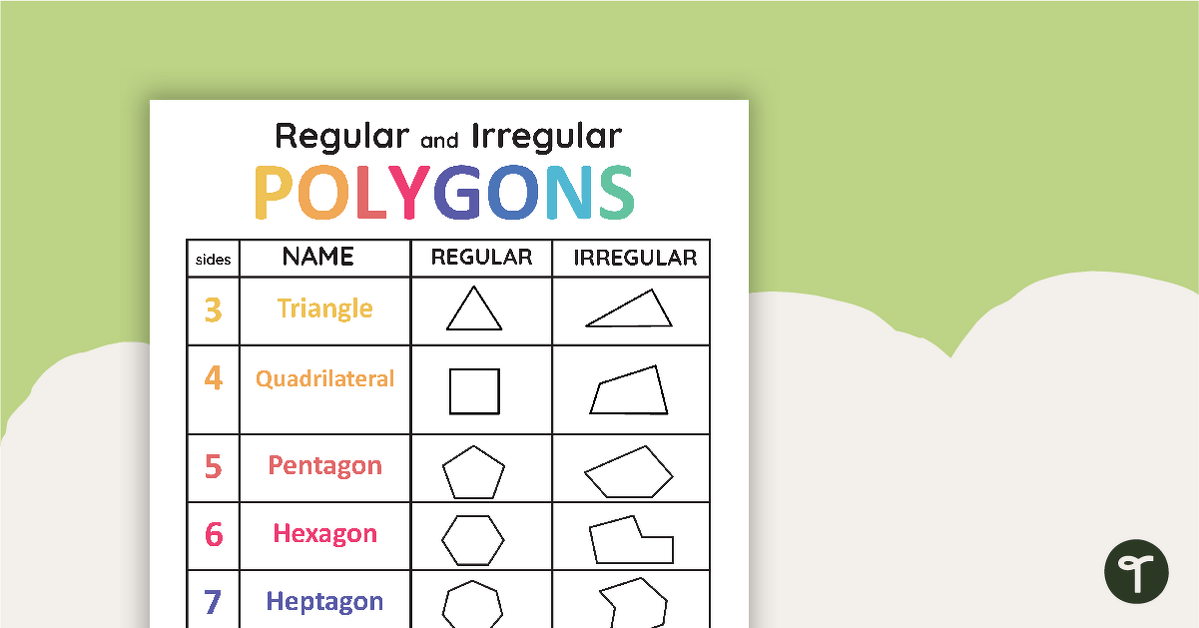
Polygons are often named based on how many sides they have.
Triangle
A polygon with 3 sides.
Example:
Equilateral triangle.
Quadrilateral
A polygon with 4 sides.
Examples include squares and rectangles.
Pentagon
A polygon with 5 sides.
Example:
The shape of many national buildings and logos.
Hexagon
A polygon with 6 sides.
Example:
Honeycomb cells created by bees.
Heptagon
A polygon with 7 sides.
Octagon
A polygon with 8 sides.
Example:
Stop traffic sign.
Nonagon
A polygon with 9 sides.
Decagon
A polygon with 10 sides.
Regular Polygons
A regular polygon has:
- All sides equal
- All angles equal
Examples:
- Equilateral triangle
- Square
- Regular pentagon
- Regular hexagon
Regular polygons are highly symmetrical.
Irregular Polygons
An irregular polygon does not have equal sides or equal angles.
Example:
A quadrilateral with unequal sides.
Convex Polygons
A polygon is convex if all interior angles are less than 180°.
Properties:
- All diagonals lie inside the polygon.
- The shape bulges outward.
Most common polygons are convex.
Concave Polygons
A concave polygon has at least one interior angle greater than 180°.
Properties:
- Some diagonals lie outside the polygon.
- The shape has an inward indentation.
Interior Angles of Polygons
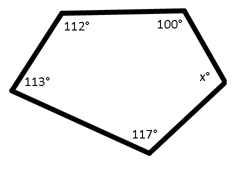
The sum of the interior angles of a polygon depends on the number of sides.
Formula:
[
(n-2) \times 180^\circ
]
Where:
(n) = number of sides.
Example:
For a pentagon:
[
(5-2)\times180 = 540^\circ
]
Interior Angle of Regular Polygon
In a regular polygon, all interior angles are equal.
Formula:
[
\frac{(n-2) \times 180}{n}
]
Example:
Hexagon:
[
\frac{(6-2)\times180}{6} = 120^\circ
]
Exterior Angles of Polygons
Exterior angles are formed when a side of the polygon is extended.
The sum of all exterior angles of any polygon is always:
[
360^\circ
]
This rule applies regardless of the number of sides.
Number of Diagonals in a Polygon
The number of diagonals in a polygon is given by the formula:
[
\frac{n(n-3)}{2}
]
Example:
For a hexagon:
[
\frac{6(6-3)}{2} = 9
]
So a hexagon has 9 diagonals.
Area of Polygons
Different polygons have different area formulas.
Area of a Triangle
[
A = \frac{1}{2}bh
]
Area of a Square
[
A = s^2
]
Where (s) is side length.
Area of a Rectangle
[
A = length \times width
]
Area of a Regular Polygon
Formula:
[
A = \frac{1}{2} ap
]
Where:
- (a) = apothem
- (p) = perimeter
Apothem
The apothem is the perpendicular distance from the center of a regular polygon to one of its sides.
It helps calculate the area of regular polygons.
Perimeter of Polygons
The perimeter of a polygon is the total length of its sides.
Example:
If a pentagon has sides:
5, 5, 5, 5, 5
Perimeter:
[
25
]
Symmetry in Polygons
Regular polygons have symmetrical properties.
Example:
A square has:
- 4 lines of symmetry
- rotational symmetry
Regular polygons have symmetry equal to the number of sides.
Tessellations
Polygons can be used to tile a plane without gaps.
This is called tessellation.
Examples:
- Squares
- Equilateral triangles
- Regular hexagons
These shapes can cover surfaces completely.
Polygons in Coordinate Geometry
Polygons can be represented using coordinates.
Example:
Vertices:
[
(1,2), (4,2), (4,5), (1,5)
]
These points form a rectangle.
Coordinate geometry allows calculation of:
- distance
- slopes
- area
Applications of Polygons
Polygons are used extensively in real-world applications.
Architecture
Buildings and floor plans often use polygonal shapes.
Engineering
Engineers use polygons to design structures and mechanical components.
Computer Graphics
Polygons form the basis of 3D models and digital images.
Example:
Video games use polygons to create objects.
Cartography
Maps use polygons to represent regions and boundaries.
Art and Design
Polygons are used in patterns, mosaics, and decorative designs.
Polygons in Nature
Many natural structures resemble polygons.
Examples include:
- honeycombs
- crystal shapes
- turtle shells
Hexagonal shapes in honeycombs maximize space efficiency.
Historical Development of Polygon Geometry
Ancient mathematicians studied polygons extensively.
Greek mathematician Euclid analyzed properties of regular polygons.
Later mathematicians expanded polygon geometry through trigonometry and analytic geometry.
Today, polygons remain essential in both pure mathematics and applied sciences.
Polygons in Advanced Mathematics
Polygons are important in advanced topics such as:
- computational geometry
- topology
- fractal geometry
- polygon triangulation
These concepts help analyze complex shapes and algorithms.
Importance of Polygons
Polygons are important because they:
- form the basis of geometric shapes
- help calculate areas and perimeters
- appear in architecture and engineering
- form the foundation of computer graphics
Understanding polygons helps build knowledge of geometry and spatial reasoning.
Conclusion
Polygons are fundamental geometric shapes formed by straight line segments connected to create closed figures. They include a wide range of shapes such as triangles, quadrilaterals, pentagons, hexagons, and many others. By studying polygons, mathematicians gain insight into geometric relationships, symmetry, angle measurements, and area calculations.
Polygons also play a crucial role in many practical applications including architecture, engineering, computer graphics, and design. Their simple yet powerful structure allows them to represent both basic shapes and complex models in mathematics and technology.
Through the study of polygons, students develop essential geometric skills that support further learning in trigonometry, coordinate geometry, and advanced mathematical analysis.