


Introduction
Nuclear fission is a nuclear reaction in which a heavy atomic nucleus splits into two or more smaller nuclei along with the release of a large amount of energy. This process also produces additional particles such as neutrons and gamma radiation.
Nuclear fission is one of the most important discoveries in nuclear physics because it demonstrated that enormous amounts of energy can be released from atomic nuclei. The energy released during fission comes from the conversion of mass into energy according to the relation
[
E = mc^2
]
where (E) is energy, (m) is mass, and (c) is the speed of light.
The phenomenon of nuclear fission was discovered in 1938 by Otto Hahn and Fritz Strassmann. The theoretical explanation of the process was later provided by Lise Meitner and Otto Frisch.
The discovery of nuclear fission revolutionized science and technology, leading to the development of nuclear power plants and nuclear weapons. Today, nuclear fission remains one of the primary sources of nuclear energy used to generate electricity worldwide.
Basic Principle of Nuclear Fission
In nuclear fission, a heavy nucleus such as uranium or plutonium absorbs a neutron and becomes unstable. The unstable nucleus then splits into two smaller nuclei, called fission fragments, along with additional neutrons and a large amount of energy.
A typical fission reaction can be represented as
[
^{235}{92}U + ^1_0n \rightarrow ^{141}{56}Ba + ^{92}_{36}Kr + 3 ^1_0n + Energy
]
In this reaction:
- Uranium-235 absorbs a neutron.
- The nucleus becomes unstable.
- It splits into barium and krypton nuclei.
- Three neutrons and energy are released.
The released neutrons can initiate further fission reactions, producing a chain reaction.
Energy Release in Fission
The energy released during nuclear fission comes from the difference in mass between the original nucleus and the final products.
The total mass of the products is slightly less than the mass of the original nucleus and neutron.
The missing mass is converted into energy according to Einstein’s equation.
Typical energy released per fission event:
[
\approx 200 , MeV
]
This energy is enormous compared with chemical reactions.
Binding Energy and Fission

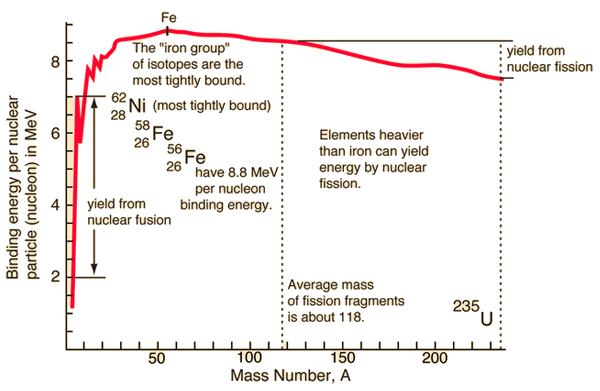

The binding energy curve explains why fission releases energy.
The binding energy per nucleon increases as heavy nuclei split into smaller nuclei.
This means the fission products are more tightly bound than the original nucleus, resulting in energy release.
Chain Reaction


A chain reaction occurs when neutrons produced during fission trigger additional fission reactions.
The process continues as long as sufficient fissile material is present.
Two types of chain reactions exist:
Controlled Chain Reaction
Occurs in nuclear reactors.
Neutron production is carefully regulated.
Uncontrolled Chain Reaction
Occurs in nuclear weapons.
Rapid and uncontrolled energy release produces an explosion.
Fissile Materials
Certain isotopes readily undergo nuclear fission.
Common fissile materials include:
- Uranium-235
- Plutonium-239
- Uranium-233
These isotopes can sustain chain reactions because they release multiple neutrons during fission.
Critical Mass
For a chain reaction to occur, a minimum amount of fissile material is required.
This minimum quantity is called critical mass.
If the mass is below this value, too many neutrons escape and the chain reaction stops.
Critical mass depends on:
- Shape of the material
- Density
- Presence of neutron reflectors
Nuclear Reactors


A nuclear reactor is a device designed to control nuclear fission reactions and use the released energy to generate electricity.
The main components of a nuclear reactor include:
Fuel Rods
Contain fissile materials such as uranium.
Moderator
Slows down neutrons to increase the probability of fission.
Control Rods
Absorb neutrons and regulate the chain reaction.
Coolant
Transfers heat produced by fission to generate steam.
The steam drives turbines connected to electric generators.
Types of Nuclear Reactors
Several reactor designs are used worldwide.
Common types include:
Pressurized Water Reactor (PWR)
Uses pressurized water as coolant and moderator.
Boiling Water Reactor (BWR)
Water boils directly in the reactor core.
Fast Breeder Reactor
Produces more fissile material than it consumes.
These reactors vary in design but operate on the same fission principle.
Nuclear Weapons
Nuclear fission reactions are also used in atomic bombs.
An atomic bomb uses an uncontrolled chain reaction to release enormous energy.
Two main designs exist:
- Gun-type fission weapon
- Implosion-type fission weapon
The first atomic bombs were developed during the Manhattan Project.
Radioactive Fission Products
Fission produces many radioactive isotopes.
These products include elements such as:
- Cesium
- Strontium
- Iodine
These isotopes decay over time and produce radiation.
Managing fission products is a major challenge in nuclear energy.
Nuclear Waste
Nuclear reactors produce radioactive waste that must be handled carefully.
Types of nuclear waste include:
- High-level waste
- Intermediate-level waste
- Low-level waste
Safe storage methods include deep geological repositories.
Advantages of Nuclear Fission
Nuclear fission offers several advantages.
High Energy Density
A small amount of fuel produces enormous energy.
Reliable Electricity Production
Nuclear power plants operate continuously.
Low Carbon Emissions
Fission energy produces minimal greenhouse gases.
Disadvantages of Nuclear Fission
Despite its benefits, nuclear fission has several challenges.
Radioactive Waste
Long-term storage of nuclear waste is required.
Nuclear Accidents
Reactor failures can release radiation.
Nuclear Proliferation
Fission technology can be used to produce weapons.
Nuclear Safety
Modern nuclear reactors include multiple safety systems such as:
- Emergency shutdown mechanisms
- Containment structures
- Cooling systems
These systems reduce the risk of accidents.
Applications of Nuclear Fission
Nuclear fission has many important applications.
Electricity Generation
Nuclear power plants produce electricity worldwide.
Medical Isotopes
Fission reactors produce isotopes used in medicine.
Research Reactors
Used for scientific experiments and neutron studies.
Space Power Systems
Radioisotope generators provide power for spacecraft.
Fission in Astrophysics
Although fusion dominates stellar energy production, fission also occurs in certain astrophysical processes.
Heavy elements created during supernova explosions may undergo spontaneous fission.
These reactions contribute to the distribution of elements in the universe.
Modern Research in Fission
Scientists continue to study nuclear fission to improve safety and efficiency.
Research areas include:
- Advanced reactor designs
- Nuclear waste reduction
- Fast neutron reactors
- Small modular reactors
These innovations aim to make nuclear power safer and more sustainable.
Conclusion
Nuclear fission is a powerful nuclear reaction in which heavy atomic nuclei split into smaller nuclei, releasing large amounts of energy. The discovery of fission transformed our understanding of atomic structure and opened the door to nuclear energy technology.
Controlled fission reactions in nuclear reactors provide electricity for millions of people around the world, while uncontrolled reactions form the basis of nuclear weapons. Although nuclear fission offers significant advantages such as high energy density and low carbon emissions, it also presents challenges related to radioactive waste and nuclear safety.
Continued research and technological development aim to improve the safety, efficiency, and sustainability of nuclear fission energy. As global energy demand increases, nuclear fission remains an important component of the world’s energy landscape.