
Tag Archives: graph algorithms

Algorithms

Image
Image
Image
Image

1. Introduction to Algorithms

An algorithm is a step-by-step procedure or set of instructions designed to solve a specific problem or perform a particular task. Algorithms are fundamental to computer science and programming because they describe the logic behind how computers process data and perform operations.

In simple terms, an algorithm is like a recipe that tells a computer what to do and in what order to do it. Each algorithm consists of clearly defined steps that lead to a desired output when given certain inputs.

Algorithms are not limited to computer programs; they are used in everyday life as well. For example:

  • Following a recipe to cook a dish
  • Instructions for assembling furniture
  • Steps for solving a mathematical equation
  • Directions for navigating a route on a map

Algorithms play a crucial role in modern technology. They power search engines, social media platforms, navigation systems, artificial intelligence applications, and data analysis tools.


2. Characteristics of an Algorithm

For a procedure to be considered an algorithm, it must satisfy certain characteristics.

Input

An algorithm takes zero or more inputs.

Example:

Numbers provided to perform calculations.


Output

An algorithm produces at least one output.

Example:

The result of a mathematical operation.


Definiteness

Each step must be clearly defined and unambiguous.


Finiteness

The algorithm must terminate after a finite number of steps.


Effectiveness

Every step should be basic enough to be performed exactly and in finite time.


3. Representation of Algorithms

Algorithms can be represented in several ways.


Flowcharts

Flowcharts use graphical symbols to represent algorithm steps.

Common symbols include:

  • Oval (start/end)
  • Rectangle (process)
  • Diamond (decision)

Flowcharts help visualize algorithm logic.


Pseudocode

Pseudocode describes algorithms using a mix of natural language and programming constructs.

Example:

START
Read number
If number is even
   print "Even"
Else
   print "Odd"
END

Programming Languages

Algorithms are implemented using languages such as:

  • Python
  • Java
  • C++
  • JavaScript

4. Types of Algorithms

Algorithms can be classified based on their design and application.


Brute Force Algorithms

Brute force algorithms try all possible solutions until the correct one is found.

Example:

Searching every number in a list.

Advantages:

  • Simple to implement.

Disadvantages:

  • Inefficient for large data.

Divide and Conquer

This technique divides a problem into smaller subproblems, solves them independently, and combines the results.

Examples:

  • Merge sort
  • Quick sort
  • Binary search

Greedy Algorithms

Greedy algorithms make the best choice at each step.

Example:

Selecting the shortest edge in minimum spanning tree algorithms.


Dynamic Programming

Dynamic programming solves complex problems by storing results of subproblems.

Examples:

  • Fibonacci sequence
  • Knapsack problem

Backtracking Algorithms

Backtracking systematically explores all possible solutions.

Example:

Solving puzzles like Sudoku.


5. Searching Algorithms

Searching algorithms find elements within data structures.


Linear Search

Checks every element sequentially.

Example:

Search for number in an array.

Time complexity:

O(n)


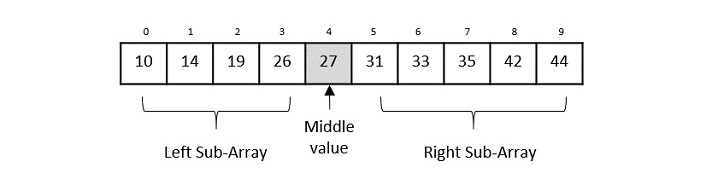
Binary Search

Works on sorted arrays.

Process:

Divide array into halves repeatedly.

Time complexity:

O(log n)

Binary search is much faster than linear search.


6. Sorting Algorithms

Sorting algorithms arrange data in a specific order.

Examples include:


Bubble Sort

Repeatedly compares adjacent elements.

Simple but inefficient.

Time complexity:

O(n²)


Selection Sort

Selects the smallest element and swaps it with the first element.


Insertion Sort

Builds sorted list gradually.


Merge Sort

Uses divide-and-conquer.

Time complexity:

O(n log n)


Quick Sort

Highly efficient sorting algorithm.

Average complexity:

O(n log n)


7. Graph Algorithms

Graph algorithms operate on graph structures.

Examples include:


Breadth-First Search (BFS)

Explores vertices level by level.

Used in shortest path problems.


Depth-First Search (DFS)

Explores as far as possible before backtracking.

Used for cycle detection.


Dijkstra’s Algorithm

Finds shortest path in weighted graphs.

Used in navigation systems.


8. Algorithm Complexity

Algorithm complexity measures efficiency.

Two main types:

  • Time complexity
  • Space complexity

Time Complexity

Time complexity measures how long an algorithm takes.

Common complexity classes:

O(1) constant time
O(log n) logarithmic
O(n) linear
O(n log n)
O(n²) quadratic


Space Complexity

Space complexity measures memory usage.

Efficient algorithms use minimal memory.


9. Big-O Notation

Big-O notation describes the upper bound of algorithm complexity.

Example:

Binary search → O(log n)

Bubble sort → O(n²)

Big-O helps compare algorithm efficiency.


10. Recursion in Algorithms

Recursion occurs when a function calls itself.

Example:

Factorial calculation.

n! = n × (n−1)!

Recursion simplifies certain problems but may use more memory.


11. Algorithm Optimization

Optimization improves algorithm efficiency.

Techniques include:

  • reducing unnecessary operations
  • using efficient data structures
  • caching intermediate results

12. Parallel Algorithms

Parallel algorithms execute multiple operations simultaneously.

Used in:

  • supercomputers
  • distributed systems
  • machine learning

13. Randomized Algorithms

Randomized algorithms use randomness in decision-making.

Example:

Randomized quicksort.

They often provide good average performance.


14. Approximation Algorithms

Used when exact solutions are difficult.

Example:

Traveling salesman problem.

Approximation algorithms provide near-optimal solutions.


15. Algorithms in Artificial Intelligence

AI relies heavily on algorithms.

Examples:

  • search algorithms
  • machine learning algorithms
  • optimization techniques

16. Algorithms in Cryptography

Encryption methods use algorithms.

Examples:

  • RSA algorithm
  • AES encryption

These algorithms protect digital data.


17. Algorithms in Data Science

Data science uses algorithms for:

  • data analysis
  • pattern recognition
  • predictive modeling

Machine learning algorithms include:

  • decision trees
  • neural networks
  • clustering algorithms

18. Algorithms in Everyday Life

Algorithms are used in many daily applications.

Examples:

  • Google search ranking
  • GPS navigation
  • recommendation systems
  • online shopping suggestions

19. Importance of Algorithms

Algorithms allow computers to solve problems efficiently.

They help manage large datasets, automate processes, and optimize decision-making.

Without algorithms, modern computing systems would not function effectively.


Conclusion

Algorithms are fundamental to computer science and mathematics, providing systematic methods for solving problems and processing information. From simple tasks such as searching and sorting data to complex operations in artificial intelligence and cryptography, algorithms play a crucial role in modern technology.

Understanding algorithms involves studying their design, efficiency, and implementation. Concepts such as time complexity, recursion, and optimization help developers create faster and more efficient programs. Algorithms are also essential in fields such as machine learning, data science, networking, and cybersecurity.

As technology continues to evolve, the importance of algorithms continues to grow. Efficient algorithms enable faster computation, better decision-making, and improved performance across various applications. Mastering algorithms is therefore essential for anyone interested in computer science, data science, or software engineering.
Tags

Graph Theory

Image
Image
Image
Image

1. Introduction to Graph Theory

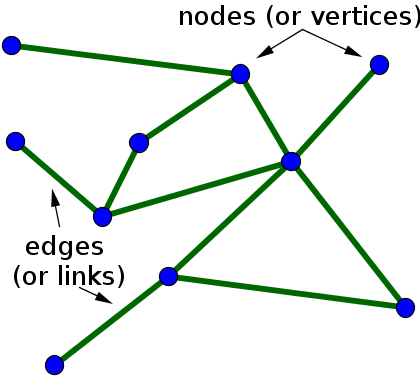
Graph theory is a branch of discrete mathematics that studies graphs, which are mathematical structures used to represent relationships between objects. A graph consists of vertices (nodes) and edges (connections) that link pairs of vertices.

Graph theory is widely used in many fields including computer science, telecommunications, transportation networks, social network analysis, artificial intelligence, and operations research. It helps in modeling systems where objects are connected through relationships.

For example:

  • Cities connected by roads
  • Computers connected in a network
  • People connected in social networks
  • Web pages connected by hyperlinks

All these systems can be represented using graphs.

Graph theory originated in 1736 when the mathematician Leonhard Euler solved the famous Seven Bridges of Königsberg problem, which is considered the first problem in graph theory.

Today, graph theory plays an important role in solving complex problems related to networks, optimization, routing, and data organization.


2. Basic Concepts of Graph Theory

A graph is defined as an ordered pair:

G = (V, E)

Where:

V = set of vertices (nodes)
E = set of edges (connections)

Vertices represent objects, while edges represent relationships between those objects.

Example:

V = {A, B, C}

E = {(A,B), (B,C)}

This graph connects vertex A to B and B to C.


3. Components of a Graph

A graph consists of several components.

Vertices

Vertices (or nodes) represent entities in the graph.

Example:

Cities in a transportation network.


Edges

Edges connect vertices and represent relationships.

Example:

Roads connecting cities.

Edges may be directed or undirected.


4. Types of Graphs

Graphs can be classified based on their properties.


Undirected Graph

Edges have no direction.

Example:

Friendship network.

If A is connected to B, then B is connected to A.


Directed Graph

Edges have direction.

Also called digraphs.

Example:

Twitter followers.

If A follows B, B may not follow A.


Weighted Graph

Edges contain numerical values called weights.

Example:

Distances between cities.


Unweighted Graph

Edges do not have weights.

Only connections matter.


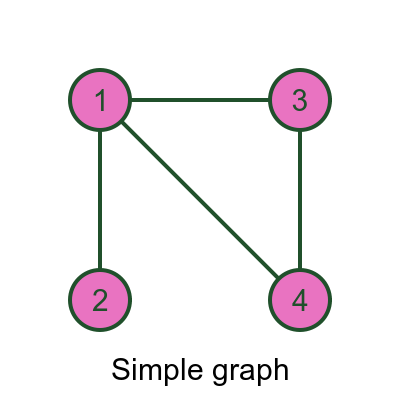
Simple Graph

A graph without loops or multiple edges.


Multigraph

A graph where multiple edges can exist between two vertices.


Complete Graph

Every pair of vertices is connected.

Example:

A complete graph with n vertices has:

n(n−1)/2 edges.


Null Graph

A graph with vertices but no edges.


5. Degree of a Vertex

The degree of a vertex is the number of edges connected to it.

Symbol:

deg(v)

Example:

If vertex A connects to three edges:

deg(A) = 3


Degree in Directed Graphs

Directed graphs have two degrees:

In-degree

Number of incoming edges.

Out-degree

Number of outgoing edges.


6. Paths in Graphs

A path is a sequence of vertices connected by edges.

Example:

A → B → C → D

Path length equals the number of edges.

Paths are important for analyzing connectivity.


7. Cycles

A cycle is a path that starts and ends at the same vertex.

Example:

A → B → C → A

Graphs without cycles are called acyclic graphs.


8. Connected Graphs

A graph is connected if there is a path between every pair of vertices.

If some vertices are isolated, the graph is disconnected.


9. Trees in Graph Theory

A tree is a special type of graph.

Properties:

  • Connected
  • No cycles

Trees are widely used in computer science.

Example:

File system directories.


10. Spanning Trees

A spanning tree connects all vertices of a graph with the minimum number of edges.

If a graph has:

n vertices

A spanning tree has:

n − 1 edges.

Spanning trees are used in network design.


11. Graph Representation

Graphs can be represented in different ways.


Adjacency Matrix

A matrix representing connections.

Example:

If vertex A connects to B:

Matrix entry = 1.


Adjacency List

Each vertex stores a list of its neighbors.

This method saves memory for sparse graphs.


12. Graph Traversal

Graph traversal means visiting all vertices.

Two main algorithms:


Breadth First Search (BFS)

Explores vertices level by level.

Uses a queue.

Applications:

  • shortest path
  • network broadcasting

Depth First Search (DFS)

Explores vertices deeply before backtracking.

Uses stack or recursion.

Applications:

  • cycle detection
  • connectivity analysis

13. Shortest Path Algorithms

Graphs often represent networks where finding the shortest path is important.


Dijkstra’s Algorithm

Finds the shortest path in weighted graphs.

Used in navigation systems.


Bellman-Ford Algorithm

Handles graphs with negative weights.


Floyd-Warshall Algorithm

Finds shortest paths between all vertex pairs.


14. Graph Coloring

Graph coloring assigns colors to vertices so that adjacent vertices have different colors.

Applications include:

  • scheduling problems
  • map coloring
  • register allocation in compilers

15. Bipartite Graphs

A graph is bipartite if vertices can be divided into two sets such that edges connect only between sets.

Example:

Student–course relationship graphs.


16. Planar Graphs

A graph is planar if it can be drawn without edges crossing.

Planar graphs are used in circuit design.


17. Eulerian Graphs

A graph is Eulerian if it contains a path that visits every edge exactly once.

Euler solved the famous Seven Bridges problem using this concept.


18. Hamiltonian Graphs

A Hamiltonian path visits every vertex exactly once.

A Hamiltonian cycle starts and ends at the same vertex.

Used in route optimization problems.


19. Applications of Graph Theory

Graph theory has numerous applications.


Computer Networks

Graph theory models communication networks.

Nodes represent devices.

Edges represent communication links.


Social Networks

Graphs represent relationships between people.

Examples:

  • Facebook friends
  • LinkedIn connections

Transportation Systems

Road networks can be modeled using graphs.

Helps find shortest routes.


Web Search Engines

Search engines use graph algorithms.

Example:

PageRank algorithm.


Biology

Graphs represent biological networks.

Examples:

  • neural networks
  • protein interactions

Artificial Intelligence

Graphs represent knowledge structures.

Used in reasoning systems.


Scheduling Problems

Graph coloring solves scheduling conflicts.

Example:

exam timetables.


20. Importance of Graph Theory

Graph theory provides powerful tools for analyzing networks and relationships.

It helps solve problems involving connectivity, optimization, and routing.

Modern technology relies heavily on graph theory for communication systems, search engines, and social network analysis.


Conclusion

Graph theory is a powerful branch of mathematics that studies networks of connected objects. By representing systems as vertices and edges, graph theory provides a framework for analyzing relationships, connectivity, and structures in complex systems. From simple graphs representing friendships to large networks like the internet, graph theory helps scientists and engineers understand how systems are organized and how they function.

The concepts of paths, cycles, trees, graph traversal, and shortest path algorithms are fundamental tools used in many real-world applications. Graph theory plays a crucial role in computer science, telecommunications, transportation networks, artificial intelligence, and social network analysis.

As technology continues to evolve, the importance of graph theory continues to grow, providing mathematical tools for solving complex network problems and enabling advancements in data analysis, communication systems, and optimization techniques.


Tags