


Introduction
Superconductivity is a remarkable physical phenomenon in which certain materials exhibit zero electrical resistance and perfect diamagnetism when cooled below a specific temperature known as the critical temperature. This phenomenon allows electric current to flow indefinitely without any energy loss.
Superconductivity was first discovered in 1911 by Heike Kamerlingh Onnes while studying the electrical properties of mercury at very low temperatures. When mercury was cooled to about 4.2 K, its electrical resistance suddenly dropped to zero. This surprising result marked the discovery of superconductivity.
Superconductivity has become one of the most important topics in condensed matter physics and materials science. It has led to technological innovations such as superconducting magnets, magnetic levitation systems, medical imaging devices, and quantum computing technologies.
Theoretical understanding of superconductivity improved significantly with the development of the BCS theory, proposed by John Bardeen, Leon Cooper, and John Robert Schrieffer.
Basic Properties of Superconductors
Superconductors exhibit several unique properties that distinguish them from ordinary conductors.
Zero Electrical Resistance
In the superconducting state, electrical resistance becomes exactly zero.
This means:
- Electric current can flow indefinitely without energy loss.
Perfect Diamagnetism
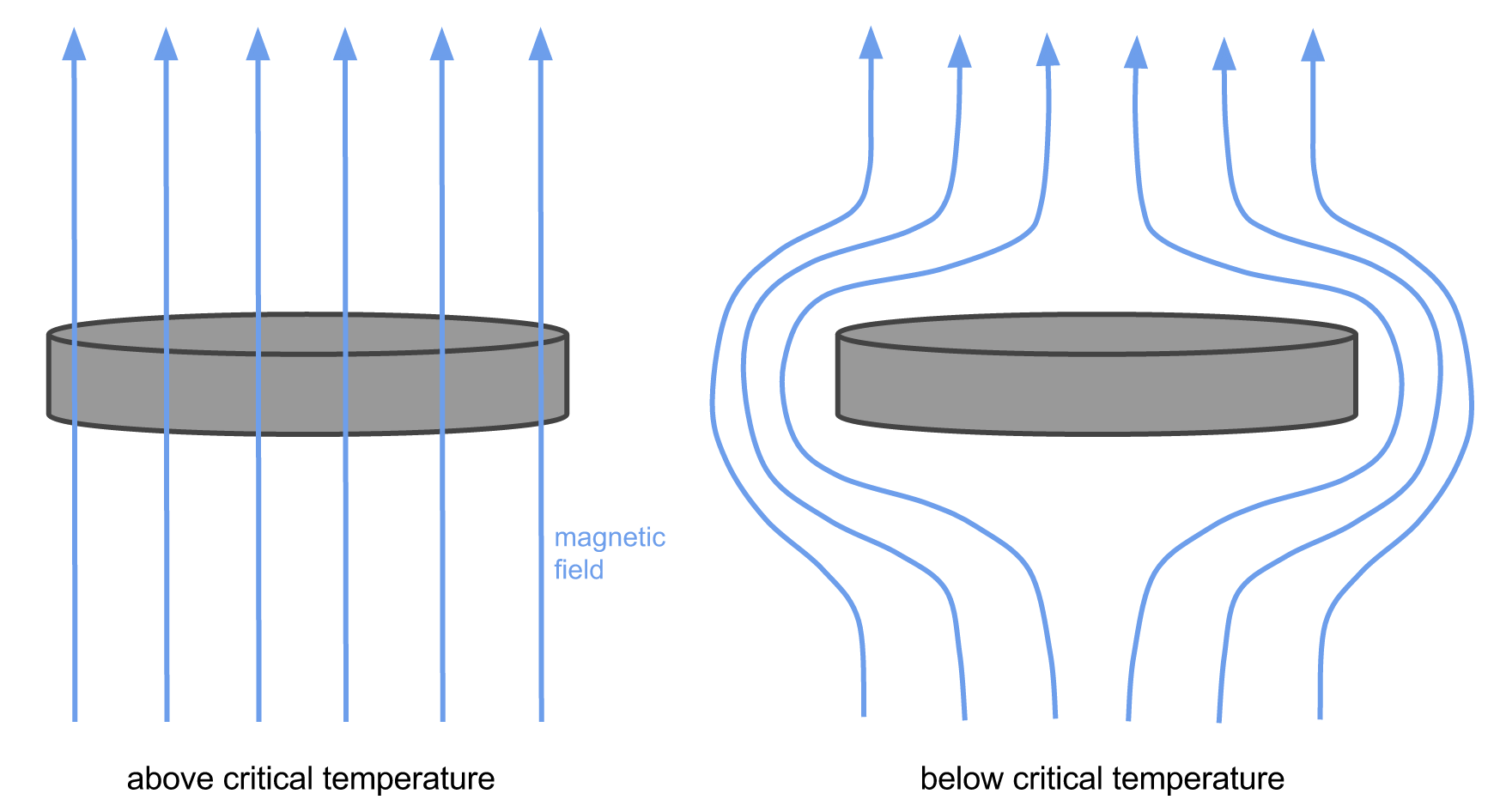
Superconductors expel magnetic fields from their interior, a phenomenon known as the Meissner effect.
Critical Temperature
Superconductivity occurs only below a certain temperature called the critical temperature (Tc).
Critical Magnetic Field
A sufficiently strong magnetic field can destroy superconductivity.
Critical Current
If the current through a superconductor exceeds a certain value, superconductivity is lost.
Zero Electrical Resistance
One of the most striking features of superconductors is the complete disappearance of electrical resistance.
In normal conductors, electrical resistance occurs because electrons collide with atoms and impurities within the material.
These collisions cause energy loss in the form of heat.
In superconductors, however, electrons move through the material without scattering.
This allows current to flow indefinitely.
Experiments have shown that currents in superconducting loops can persist for years without measurable decay.
Meissner Effect


The Meissner effect is the complete expulsion of magnetic fields from the interior of a superconductor when it enters the superconducting state.
This effect distinguishes superconductors from ordinary perfect conductors.
When a material becomes superconducting:
- Magnetic field lines are expelled from the interior.
- The material becomes perfectly diamagnetic.
This phenomenon enables magnetic levitation experiments in which magnets float above superconductors.
Critical Parameters
Superconductors are characterized by three important critical parameters.
Critical Temperature (Tc)
The temperature below which superconductivity occurs.
Critical Magnetic Field (Hc)
The maximum magnetic field that the superconductor can withstand.
Critical Current Density (Jc)
The maximum current that can flow without destroying superconductivity.
If any of these parameters exceed their critical values, the material returns to its normal conducting state.
Types of Superconductors
Superconductors are classified into two main categories.
Type I Superconductors


Type I superconductors exhibit a complete Meissner effect.
Characteristics:
- Perfect diamagnetism
- Single critical magnetic field
- Abrupt transition between superconducting and normal states
Examples include:
- Mercury
- Lead
- Tin
These materials are typically pure metals.
Type II Superconductors

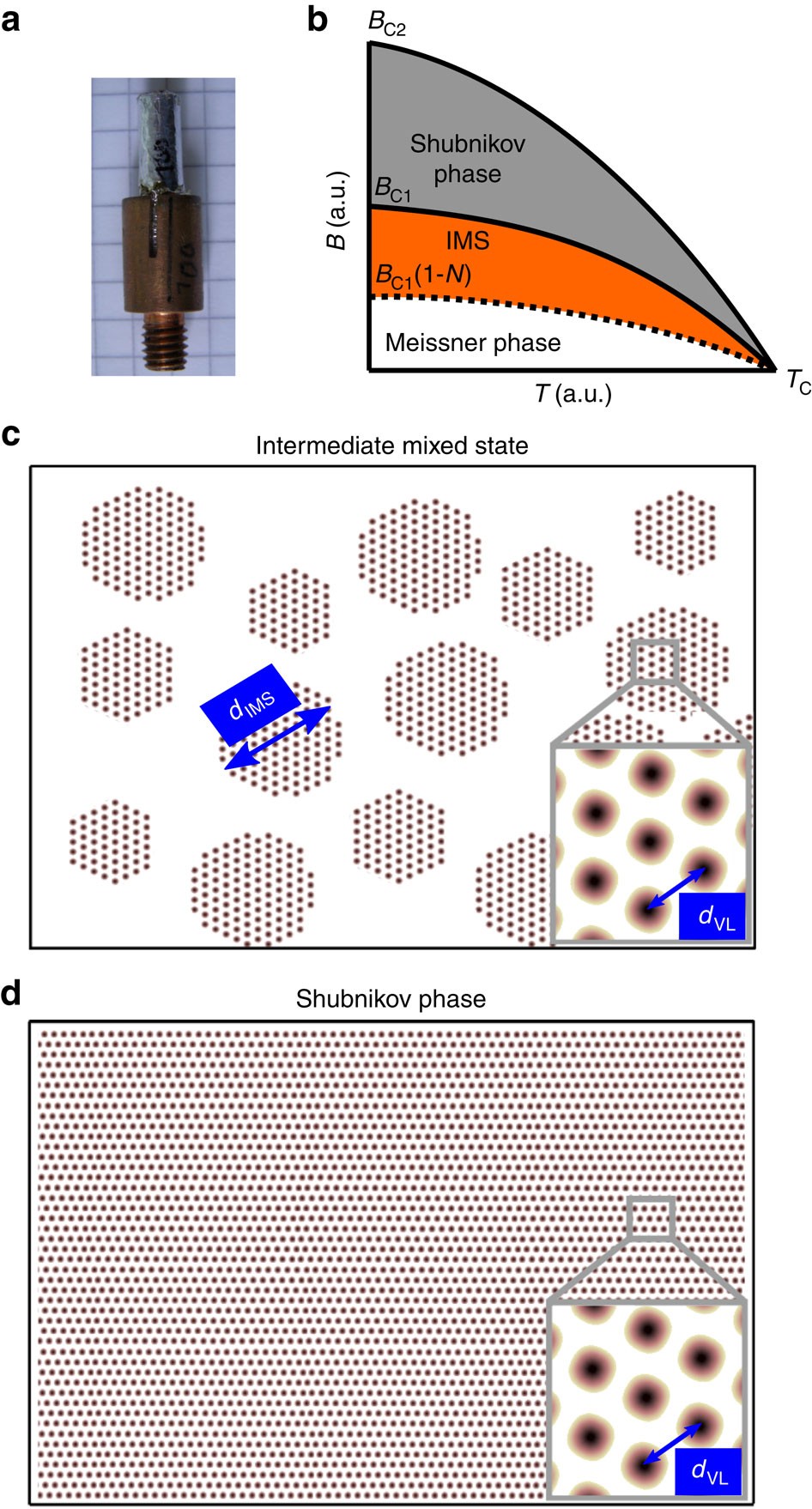
Type II superconductors behave differently.
They have two critical magnetic fields:
- Lower critical field
- Upper critical field
Between these values, the material enters a mixed state where magnetic flux partially penetrates the material.
These superconductors can withstand much stronger magnetic fields.
Examples include:
- Niobium-titanium alloys
- High-temperature superconductors
BCS Theory
The microscopic explanation of superconductivity was developed in 1957 through the BCS theory.
This theory was proposed by John Bardeen, Leon Cooper, and John Robert Schrieffer.
Cooper Pairs

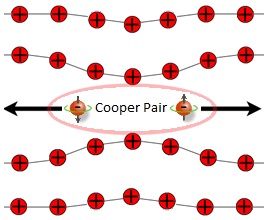
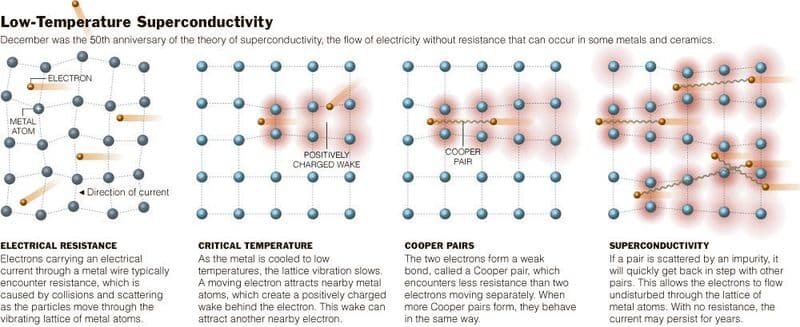
According to BCS theory, electrons in a superconductor form pairs known as Cooper pairs.
Normally, electrons repel each other because they have the same negative charge.
However, in superconductors, interactions with lattice vibrations allow electrons to pair up.
These pairs move through the lattice without scattering, producing zero electrical resistance.
Energy Gap in Superconductors
Superconductors exhibit an energy gap between the ground state and excited electron states.
This energy gap prevents electrons from scattering easily.
As a result, electrical resistance disappears.
The energy gap decreases as temperature approaches the critical temperature.
High-Temperature Superconductors
In 1986, scientists discovered a new class of materials called high-temperature superconductors.
These materials exhibit superconductivity at much higher temperatures than conventional superconductors.
Important discoveries were made by Johannes Georg Bednorz and Karl Alexander Müller.
High-temperature superconductors often consist of complex ceramic compounds containing copper and oxygen.
Applications of Superconductivity
Superconductivity has many important technological applications.
Superconducting Magnets
Superconducting magnets generate extremely strong magnetic fields.
These magnets are used in:
- MRI machines
- Particle accelerators
- Magnetic confinement fusion reactors
Magnetic Levitation
Superconductors can produce magnetic levitation due to the Meissner effect.
This principle is used in maglev trains, which float above tracks and experience very little friction.
Power Transmission
Superconducting cables can transmit electricity with minimal energy loss.
This could improve the efficiency of electrical power grids.
Quantum Computing
Superconducting circuits are used in quantum computers.
These systems use quantum properties to perform extremely complex calculations.
Particle Physics
Superconducting magnets are essential in large research facilities such as the CERN particle accelerator complex.
Challenges in Superconductivity
Despite its advantages, superconductivity faces several challenges.
Low Operating Temperatures
Most superconductors require extremely low temperatures.
Material Complexity
High-temperature superconductors are difficult to manufacture.
Cooling Costs
Maintaining cryogenic temperatures can be expensive.
Scientists continue to research new materials that may exhibit superconductivity at higher temperatures.
Future of Superconductivity
The discovery of room-temperature superconductors would revolutionize many industries.
Potential benefits include:
- Lossless electrical power transmission
- More efficient electronics
- Faster computing systems
- Improved transportation systems
Research continues worldwide to discover new superconducting materials and better understand the mechanisms behind superconductivity.
Conclusion
Superconductivity is one of the most fascinating phenomena in modern physics. It occurs when certain materials exhibit zero electrical resistance and perfect diamagnetism below a critical temperature. The discovery of superconductivity opened new fields of research in condensed matter physics and led to numerous technological applications.
Theoretical understanding of superconductivity improved significantly with the development of BCS theory, which explains the formation of Cooper pairs and the absence of electrical resistance. Advances in high-temperature superconductors have expanded the potential applications of this phenomenon.
Although challenges remain, continued research into superconducting materials and technologies may lead to transformative developments in energy, computing, transportation, and medical technology. Superconductivity remains a key area of scientific exploration with the potential to reshape future technologies.