
Introduction
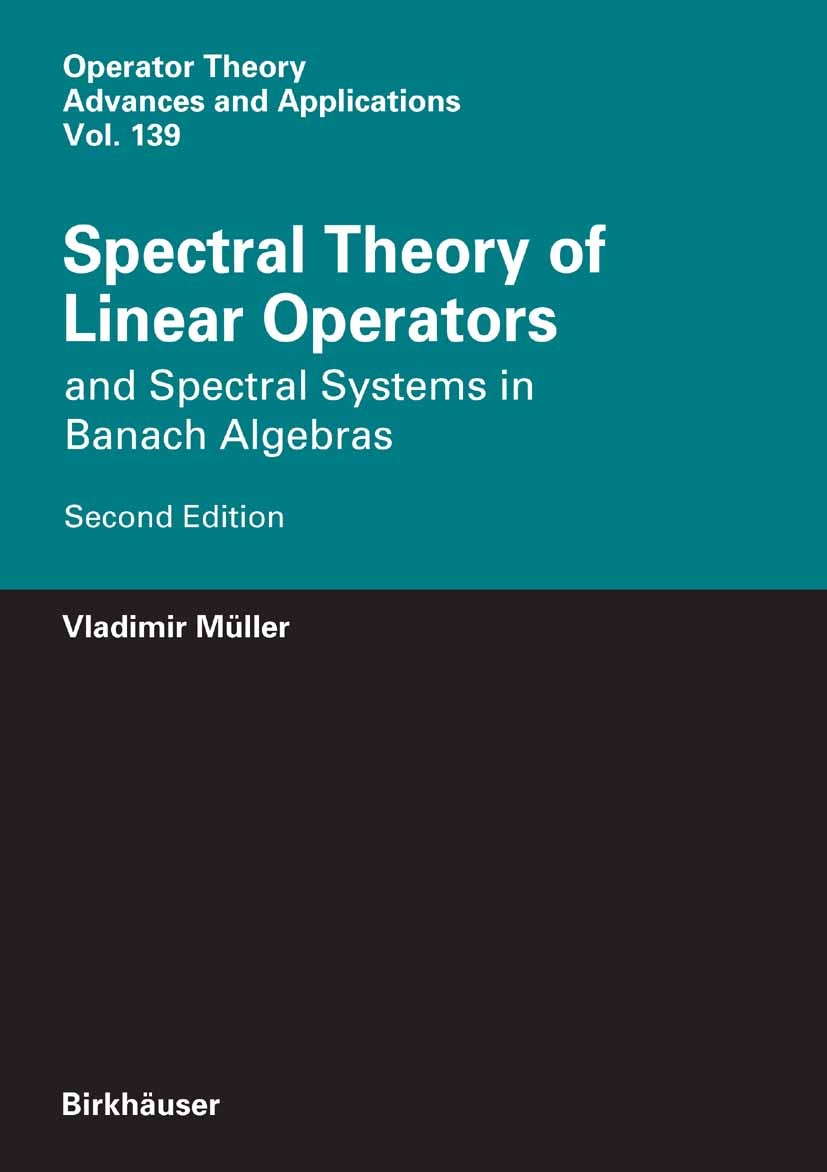
Functional analysis is a branch of mathematical analysis that studies vector spaces with infinite dimensions and the functions that act on them. It combines ideas from linear algebra, calculus, topology, and abstract algebra to analyze spaces of functions and the operators that act on those spaces.
Unlike classical analysis, which often deals with real numbers and finite-dimensional vectors, functional analysis focuses on function spaces, where each point in the space represents an entire function rather than a single number.
Functional analysis is fundamental in many areas of mathematics and science. It provides the mathematical foundation for fields such as quantum mechanics, differential equations, signal processing, and numerical analysis.
The field developed during the late nineteenth and early twentieth centuries through the work of mathematicians such as David Hilbert and Stefan Banach.
Today, functional analysis is a central area of modern mathematics and has profound applications in both theoretical and applied sciences.
Basic Idea of Functional Analysis
Functional analysis studies vector spaces of functions and the transformations between them.
In ordinary linear algebra, vectors may look like:
[
(1,2,3)
]
But in functional analysis, vectors may be entire functions such as:
[
f(x) = x^2
]
Thus, a vector space may consist of functions like:
- polynomials
- continuous functions
- integrable functions
Functional analysis studies the properties of these spaces and the operators acting on them.
Vector Spaces
A vector space is a collection of objects called vectors that can be added together and multiplied by scalars.
Examples include:
- Euclidean spaces
- spaces of functions
- sequences of numbers
In functional analysis, vector spaces often contain infinitely many dimensions.
These spaces are essential for describing complex mathematical systems.
Normed Vector Spaces
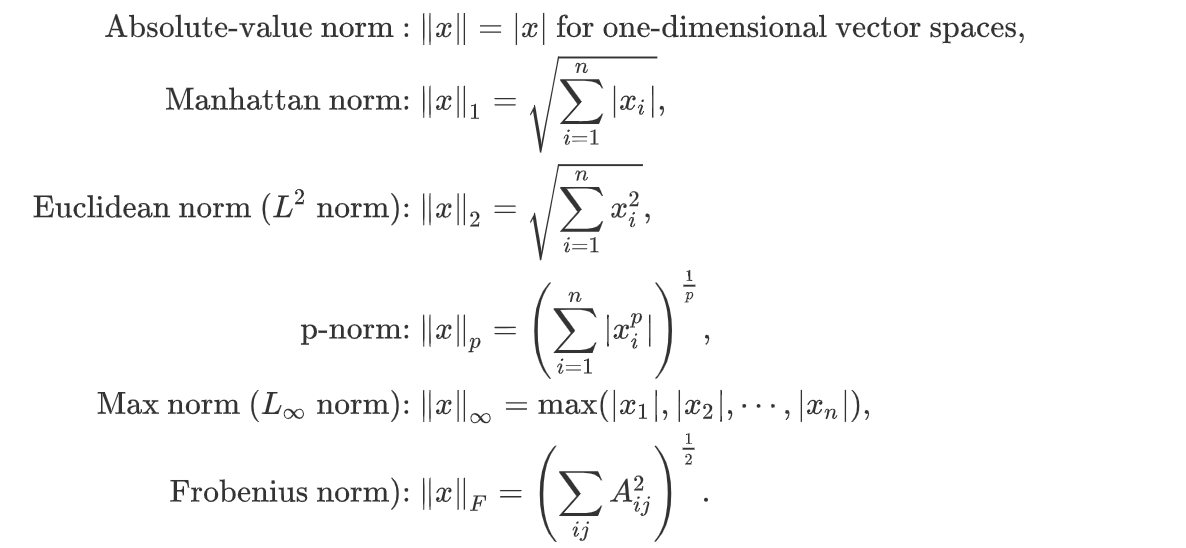
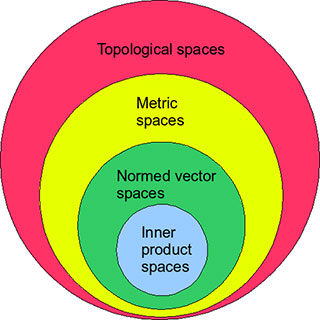
A normed vector space is a vector space equipped with a function called a norm, which measures the size or length of vectors.
A norm is written as:
[
|x|
]
The norm satisfies several properties:
- Non-negativity
- Homogeneity
- Triangle inequality
Norms allow mathematicians to define distances between elements in function spaces.
Banach Spaces

A Banach space is a complete normed vector space.
Completeness means that every Cauchy sequence in the space converges to a point within the space.
Banach spaces are essential because they ensure that limits of sequences remain within the space.
Examples of Banach spaces include:
- spaces of continuous functions
- spaces of integrable functions
- sequence spaces
Banach spaces play a major role in analysis and differential equations.
Hilbert Spaces
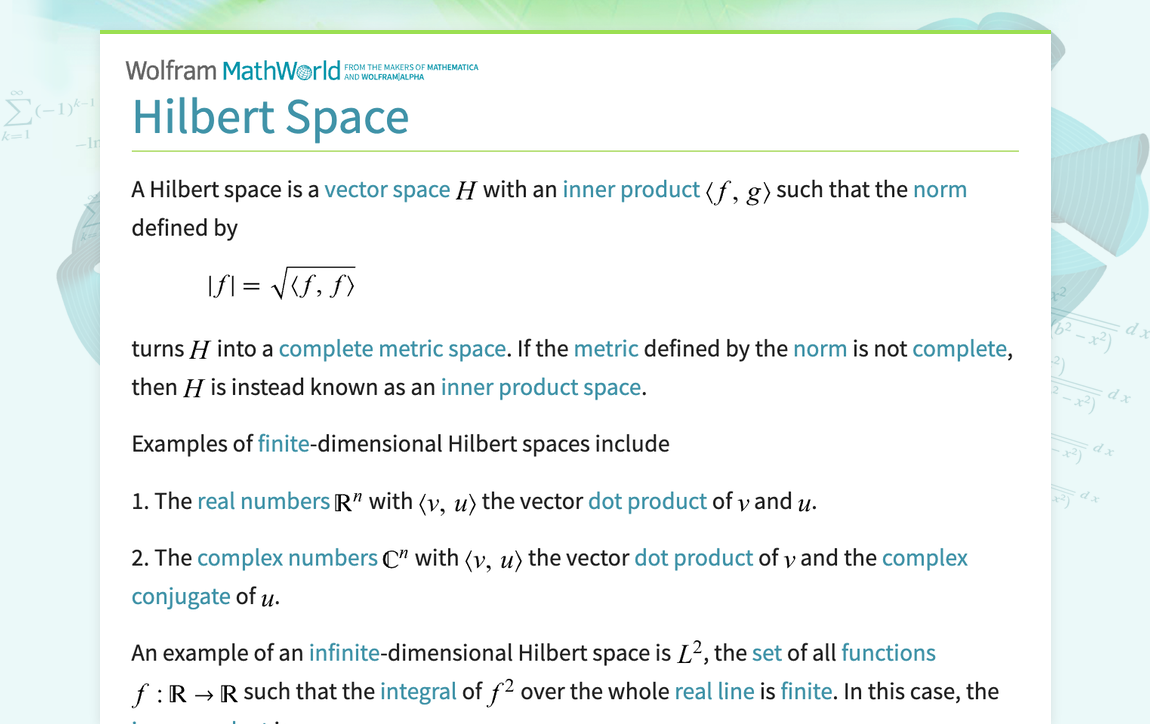


A Hilbert space is a special type of Banach space that includes an inner product.
The inner product defines angles and orthogonality between vectors.
The inner product is typically written as:
[
\langle x,y \rangle
]
Hilbert spaces generalize the concept of Euclidean geometry to infinite-dimensional spaces.
They are extremely important in quantum mechanics because quantum states are represented as vectors in Hilbert spaces.
Linear Operators
Functional analysis studies linear operators, which are functions that map one vector space to another while preserving linear structure.
A linear operator satisfies:
[
T(ax + by) = aT(x) + bT(y)
]
Operators can represent many mathematical processes such as:
- differentiation
- integration
- transformations
Understanding operators is a major focus of functional analysis.
Bounded Linear Operators
A linear operator is bounded if it maps bounded sets to bounded sets.
Bounded operators are important because they behave well with respect to limits.
Most operators used in practical applications must be bounded to ensure stability.
Operator Norm
The size of an operator can be measured using the operator norm.
The operator norm measures the maximum stretching effect of an operator on vectors.
This concept is essential for studying operator stability.
Spectral Theory
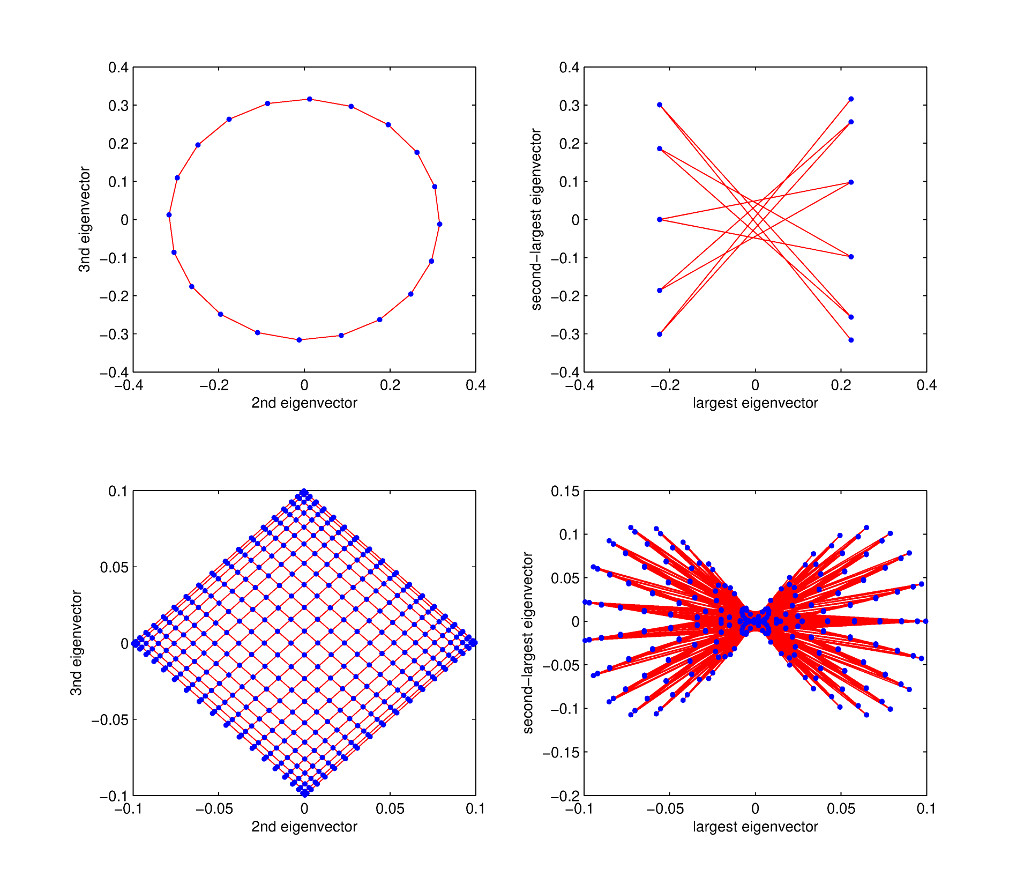

Spectral theory studies eigenvalues and eigenvectors of operators.
In functional analysis, operators may act on infinite-dimensional spaces, making spectral theory more complex.
Spectral theory is fundamental in quantum mechanics, where observable quantities correspond to operators.
The eigenvalues represent measurable physical quantities.
Functional Spaces
Functional analysis deals with many types of function spaces.
Important examples include:
Lp Spaces
Spaces of functions whose absolute value raised to the power (p) is integrable.
Sobolev Spaces
Spaces used in the study of partial differential equations.
Sequence Spaces
Spaces consisting of infinite sequences of numbers.
These spaces provide frameworks for studying mathematical problems.
Dual Spaces
Every vector space has a corresponding dual space.
The dual space consists of all linear functionals defined on the original space.
A linear functional maps vectors to real numbers.
Dual spaces are important in optimization and theoretical analysis.
Hahn–Banach Theorem
The Hahn–Banach theorem is one of the most important results in functional analysis.
It states that linear functionals defined on a subspace can be extended to the entire space without increasing their norm.
This theorem has many applications in analysis and optimization.
Fixed Point Theorems
Functional analysis also includes fixed point theorems, which state that under certain conditions a function has a point that maps to itself.
Examples include:
- Banach fixed point theorem
- Schauder fixed point theorem
Fixed point theorems are widely used in solving differential equations.
Functional Analysis and Differential Equations
Functional analysis provides powerful tools for solving differential equations.
Many differential equations can be reformulated as operator equations in function spaces.
This allows mathematicians to apply operator theory and spectral methods to analyze solutions.
Applications of Functional Analysis
Functional analysis has many applications in science and engineering.
Quantum Mechanics
Quantum mechanics relies heavily on functional analysis.
Quantum states are represented as vectors in Hilbert spaces, and physical observables are represented by operators.
Signal Processing
Functional analysis helps analyze signals and transform them using mathematical tools.
Examples include Fourier transforms and wavelet analysis.
Control Theory
Functional analysis provides frameworks for analyzing dynamic systems and designing control strategies.
Numerical Analysis
Many numerical algorithms rely on functional analysis for stability and convergence analysis.
Machine Learning
Functional analysis techniques are used in kernel methods and optimization algorithms.
Functional Analysis in Modern Mathematics
Modern research in functional analysis includes topics such as:
- Nonlinear functional analysis
- Operator algebras
- Harmonic analysis
- Infinite-dimensional geometry
These fields connect functional analysis with other branches of mathematics.
Importance of Functional Analysis
Functional analysis provides a unified framework for studying infinite-dimensional systems.
It connects algebra, geometry, and analysis and offers powerful tools for solving complex problems.
Because many real-world systems involve infinite-dimensional spaces, functional analysis plays a crucial role in modern science.
Conclusion
Functional analysis is a fundamental branch of mathematics that studies infinite-dimensional vector spaces and the operators acting on them. By extending the ideas of linear algebra and calculus to function spaces, functional analysis provides powerful tools for analyzing complex mathematical systems.
Key concepts such as Banach spaces, Hilbert spaces, operator theory, and spectral theory form the foundation of the field. Functional analysis has deep connections with many scientific disciplines, including quantum mechanics, signal processing, differential equations, and machine learning.
As mathematical research continues to expand, functional analysis remains an essential framework for understanding the structure of infinite-dimensional systems and solving complex problems in both mathematics and applied sciences.