
Tag Archives: Matrices

Matrices

Image
Image
Image
Image

1. Introduction to Matrices

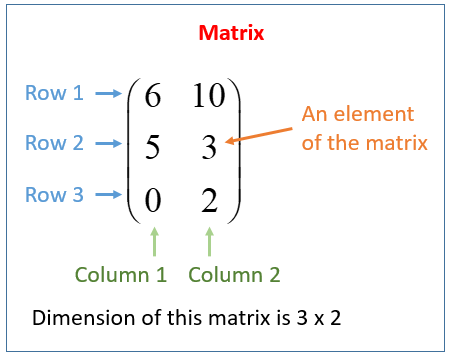
A matrix is a rectangular arrangement of numbers, symbols, or expressions organized in rows and columns. Matrices are one of the most important structures in mathematics and play a crucial role in algebra, engineering, physics, statistics, computer science, economics, and data science.

Matrices are particularly useful when dealing with large sets of numbers, solving systems of linear equations, performing transformations in geometry, and modeling real-world problems.

The plural of matrix is matrices.

Matrices were first introduced in the 19th century by mathematicians such as Arthur Cayley, who developed matrix algebra. Since then, matrices have become a fundamental component of linear algebra, which is widely used in scientific and technological applications.

For example, consider a simple table representing students’ marks:

MathScienceEnglish
857890
888291

This table can be represented as a matrix:

A =
[ 85 78 90 ]
[ 88 82 91 ]

Each number in a matrix is called an element or entry.


2. Structure of a Matrix

A matrix is defined by:

  • Rows
  • Columns

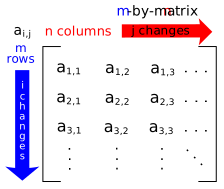
If a matrix has m rows and n columns, it is called an m × n matrix.

Example:

A =
[ 1 2 3 ]
[ 4 5 6 ]

This matrix has:

Rows = 2
Columns = 3

So it is called a 2 × 3 matrix.


General Form of a Matrix

A matrix is usually written as:

A = [aᵢⱼ]

Where:

  • i represents row number
  • j represents column number

Example:

A =
[ a11 a12 a13 ]
[ a21 a22 a23 ]

Here:

a21 means element in 2nd row and 1st column.


3. Representation of Matrices

Matrices are represented using capital letters.

Examples:

A, B, C, M, X

Example matrix:

A =
[ 2 5 ]
[ 3 7 ]

The elements are:

a11 = 2
a12 = 5
a21 = 3
a22 = 7


4. Order of a Matrix

The order of a matrix describes its size.

Order = rows × columns

Examples:

MatrixOrder
[1 2]1 × 2
[3 4; 5 6]2 × 2
[1 2 3; 4 5 6; 7 8 9]3 × 3

5. Types of Matrices

Matrices can be classified into several types based on their structure.


Row Matrix

A matrix with only one row.

Example:

A = [ 2 4 6 8 ]

Order:

1 × 4


Column Matrix

A matrix with only one column.

Example:

A =
[3]
[5]
[7]

Order:

3 × 1


Rectangular Matrix

If rows ≠ columns.

Example:

2 × 3 matrix

A =
[1 2 3]
[4 5 6]


Square Matrix

A matrix with equal rows and columns.

Example:

A =
[1 2]
[3 4]

Order:

2 × 2

Square matrices are very important because many operations like determinants and inverses are defined for them.


Zero Matrix

A matrix whose elements are all zero.

Example:

A =
[0 0]
[0 0]


Diagonal Matrix

A square matrix where all elements except the diagonal are zero.

Example:

A =
[5 0 0]
[0 3 0]
[0 0 7]


Identity Matrix

A square matrix where diagonal elements are 1 and others are 0.

Example:

I =
[1 0 0]
[0 1 0]
[0 0 1]

Identity matrix behaves like number 1 in multiplication.


Scalar Matrix

A diagonal matrix with equal diagonal elements.

Example:

A =
[4 0 0]
[0 4 0]
[0 0 4]


Upper Triangular Matrix

Elements below the diagonal are zero.

Example:

A =
[2 4 6]
[0 5 7]
[0 0 9]


Lower Triangular Matrix

Elements above the diagonal are zero.

Example:

A =
[3 0 0]
[5 6 0]
[7 8 9]


6. Equality of Matrices

Two matrices are equal if:

  1. Their orders are equal
  2. Corresponding elements are equal

Example:

A =
[1 2]
[3 4]

B =
[1 2]
[3 4]

Therefore:

A = B


7. Addition of Matrices

Matrices can be added if they have the same order.

Example:

A =
[1 2]
[3 4]

B =
[5 6]
[7 8]

A + B =

[1+5 2+6]
[3+7 4+8]

Result:

[6 8]
[10 12]


Properties of Matrix Addition

  1. Commutative Property

A + B = B + A

  1. Associative Property

(A + B) + C = A + (B + C)

  1. Additive Identity

A + 0 = A

  1. Additive Inverse

A + (-A) = 0


8. Subtraction of Matrices

Matrix subtraction is defined as:

A − B = A + (−B)

Example:

A =
[8 6]
[4 2]

B =
[3 1]
[5 2]

A − B =

[5 5]
[-1 0]


9. Scalar Multiplication

Multiplying a matrix by a number.

Example:

A =
[2 4]
[6 8]

3A =

[6 12]
[18 24]


10. Matrix Multiplication

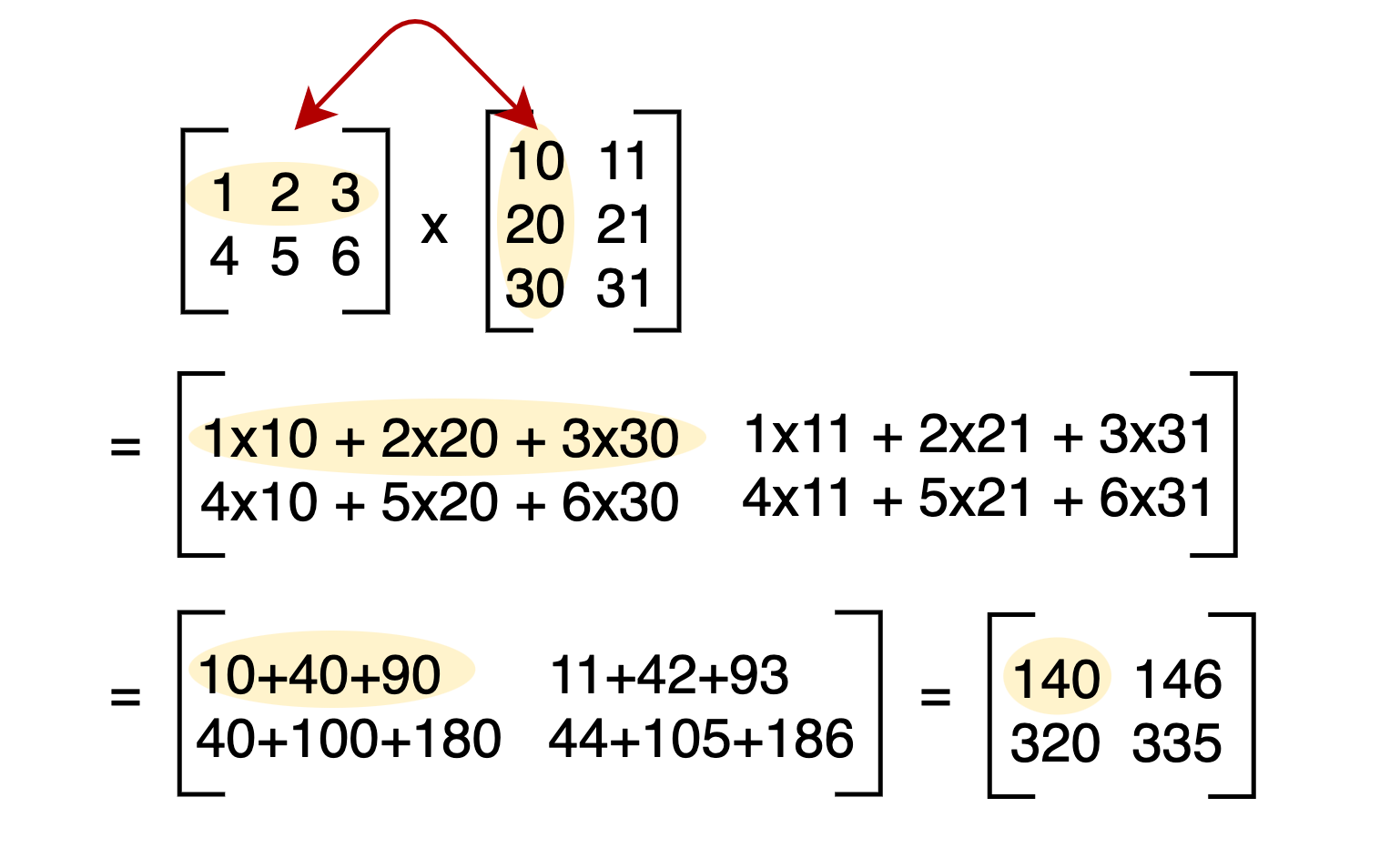
Matrix multiplication is different from ordinary multiplication.

Condition:

Columns of first matrix = rows of second matrix

If

A = m × n
B = n × p

Then:

AB = m × p


Example:

A =
[1 2]
[3 4]

B =
[5 6]
[7 8]

AB =

[1×5 + 2×7 1×6 + 2×8]
[3×5 + 4×7 3×6 + 4×8]

Result:

[19 22]
[43 50]


Properties of Matrix Multiplication

  1. Not commutative

AB ≠ BA

  1. Associative

(A B)C = A(B C)

  1. Distributive

A(B + C) = AB + AC


11. Transpose of a Matrix

The transpose of a matrix is obtained by interchanging rows and columns.

If A is matrix:

Aᵀ is transpose.

Example:

A =
[1 2 3]
[4 5 6]

Aᵀ =

[1 4]
[2 5]
[3 6]


12. Determinant of a Matrix

Determinants are defined only for square matrices.

For a 2×2 matrix

A =
[ a b ]
[ c d ]

Determinant:

|A| = ad − bc

Example:

| 2 3 |
| 4 5 |

= (2×5) − (3×4)
= 10 − 12
= −2


13. Inverse of a Matrix

A matrix inverse is similar to reciprocal.

If:

A⁻¹ exists then

A × A⁻¹ = I

Where I is identity matrix.

For 2×2 matrix:

A =
[ a b ]
[ c d ]

Inverse:

1/(ad − bc)

[ d −b ]
[ −c a ]


14. Rank of a Matrix

The rank of a matrix is the maximum number of independent rows or columns.

Rank tells:

  • how many independent equations exist
  • whether system has solution

15. Elementary Operations on Matrices

Three basic operations:

  1. Row swapping
  2. Row multiplication
  3. Row addition

Used in solving equations.


16. Systems of Linear Equations Using Matrices

Example system:

2x + y = 5
x + 3y = 7

Matrix form:

AX = B

A = coefficient matrix
X = variable matrix
B = constant matrix

Using inverse:

X = A⁻¹B


17. Applications of Matrices

Matrices are used in many fields.


Computer Graphics

Matrices perform transformations:

  • Rotation
  • Scaling
  • Translation

Used in video games and animation.


Physics

Matrices describe:

  • Quantum mechanics
  • Electromagnetism
  • Mechanics

Engineering

Used in:

  • Structural analysis
  • Electrical circuits
  • Robotics

Economics

Matrices help analyze:

  • Input-output models
  • Economic forecasting

Statistics

Matrices represent datasets and perform calculations like:

  • covariance
  • regression
  • machine learning algorithms

Cryptography

Matrices are used in encryption methods like the Hill cipher.


Artificial Intelligence

Matrices represent:

  • neural networks
  • machine learning data
  • deep learning models

18. Matrices in Computer Science

Matrices play a major role in:

  • Image processing
  • Data compression
  • Graph theory
  • Machine learning

Example:

Images are stored as pixel matrices.


19. Eigenvalues and Eigenvectors

For a matrix A:

Av = λv

Where:

λ = eigenvalue
v = eigenvector

These concepts are used in:

  • vibration analysis
  • facial recognition
  • Google PageRank

20. Importance of Matrices

Matrices simplify complex mathematical problems.

They help in:

  • solving simultaneous equations
  • modeling systems
  • handling large datasets
  • performing transformations

Matrices are essential tools in modern science and technology.


Conclusion

Matrices are powerful mathematical tools that organize numbers into structured arrays. They play a central role in linear algebra and are widely used in mathematics, engineering, physics, computer science, economics, and artificial intelligence. By representing complex data and relationships in a compact form, matrices make it easier to perform calculations, solve equations, and analyze systems.

Matrix operations such as addition, multiplication, transpose, determinants, and inverses allow mathematicians and scientists to model real-world problems effectively. Applications of matrices extend to computer graphics, machine learning, quantum physics, robotics, and cryptography.

Understanding matrices provides a foundation for advanced mathematical concepts and modern technological developments.


Tags

Algebra in Mathematics: A Comprehensive Guide

Introduction to Algebra

Algebra is one of the central branches of mathematics that deals with symbols and the rules for manipulating those symbols. Unlike arithmetic, which focuses on specific numerical values, algebra introduces variables—letters that represent numbers—to express general relationships and patterns. Through algebra, mathematicians can formulate equations, model real-world problems, and explore abstract structures.

The word “algebra” originates from the Arabic term al-jabr, from the title of a 9th-century book written by the Persian mathematician Muhammad ibn Musa al-Khwarizmi. His work laid the foundation for systematic equation solving and influenced mathematical development in Europe and beyond.

Algebra is not merely about solving for “x”; it is a powerful language that describes patterns, relationships, structures, and transformations. It serves as the gateway to higher mathematics such as calculus, linear algebra, abstract algebra, number theory, and mathematical modeling.


Historical Development of Algebra

Algebra evolved gradually across civilizations.

Ancient Civilizations

  • Babylonians solved quadratic-type problems using geometric reasoning.
  • Egyptians used algebraic thinking in solving practical problems involving trade and land measurement.
  • Greeks, especially Diophantus of Alexandria, introduced symbolic representations and solved indeterminate equations.

Indian Contributions

Indian mathematicians like Brahmagupta made significant contributions to quadratic equations and introduced rules involving zero and negative numbers.

Islamic Golden Age

The most significant breakthrough came with Muhammad ibn Musa al-Khwarizmi, whose systematic methods for solving linear and quadratic equations formalized algebra as a discipline.

European Renaissance

Mathematicians such as Gerolamo Cardano and François Viète advanced symbolic algebra and solved cubic and quartic equations.

Modern Era

The 19th century saw the development of abstract algebra, led by mathematicians like Évariste Galois, who connected algebra to group theory.


Basic Concepts of Algebra

1. Variables

Variables are symbols, usually letters like x, y, or z, that represent unknown or changing values.

Example:
x + 5 = 10

Here, x is a variable.


2. Constants

Constants are fixed numerical values.

Example:
In 3x + 7, the numbers 3 and 7 are constants.


3. Expressions

An algebraic expression is a combination of variables, numbers, and operations.

Examples:

  • 2x + 3
  • 4a² − 5a + 6

Expressions do not contain equality signs.


4. Equations

An equation states that two expressions are equal.

Example:
2x + 3 = 7

Solving an equation means finding the value of the variable that makes the equation true.


5. Inequalities

Inequalities compare expressions using symbols such as:

  • (greater than)
  • < (less than)
  • ≥ (greater than or equal to)
  • ≤ (less than or equal to)

Example:
x + 2 > 5


Algebraic Operations

Algebra involves operations similar to arithmetic but applied to variables.

Addition and Subtraction

Like terms (terms with the same variables and exponents) can be combined.

Example:
3x + 2x = 5x


Multiplication

Multiplication distributes over addition:

a(b + c) = ab + ac

Example:
2(x + 3) = 2x + 6


Division

Division can simplify expressions:

6x ÷ 3 = 2x


Laws of Exponents

Algebra uses exponent rules:

  • a^m × a^n = a^(m+n)
  • (a^m)^n = a^(mn)
  • a^0 = 1
  • a^−n = 1 / a^n

These rules simplify complex expressions.


Linear Equations

A linear equation has degree 1.

Example:
2x + 5 = 11

Solution:
2x = 6
x = 3

Linear equations can have:

  • One solution
  • No solution
  • Infinitely many solutions

Systems of Linear Equations

A system contains two or more equations.

Example:
x + y = 5
x − y = 1

Methods of solving:

  • Substitution
  • Elimination
  • Graphing

Quadratic Equations

A quadratic equation has degree 2.

Standard form:
ax² + bx + c = 0

Methods of solving:

  1. Factoring
  2. Completing the square
  3. Quadratic formula:

x = (-b ± √(b² − 4ac)) / 2a

The expression b² − 4ac is called the discriminant.


Polynomials

A polynomial is an expression consisting of variables and coefficients.

Examples:

  • 3x² + 2x + 1
  • 5a³ − 4a + 7

Degree of a polynomial: highest exponent.

Operations with polynomials:

  • Addition
  • Subtraction
  • Multiplication
  • Division (long division or synthetic division)

Factoring

Factoring breaks expressions into products.

Examples:
x² − 9 = (x − 3)(x + 3)

Factoring techniques:

  • Common factors
  • Difference of squares
  • Trinomials
  • Grouping

Rational Expressions

Rational expressions are fractions containing polynomials.

Example:
(x + 1)/(x − 2)

They follow fraction rules:

  • Multiply numerators and denominators
  • Find common denominators for addition

Restrictions apply where denominator ≠ 0.


Radical Expressions

Radicals involve roots.

Example:
√(x²) = x (with restrictions)

Simplifying radicals involves factoring perfect squares.


Functions in Algebra

A function relates one input to one output.

Notation:
f(x) = 2x + 3

If x = 4:
f(4) = 11

Types of functions:

  • Linear
  • Quadratic
  • Polynomial
  • Rational
  • Exponential

Graphing in Algebra

Graphing shows relationships visually.

A linear equation:
y = 2x + 1

Has slope (2) and y-intercept (1).

Graphing helps:

  • Visualize solutions
  • Analyze trends
  • Understand functions

Exponential and Logarithmic Functions

Exponential function:
y = a^x

Logarithmic function:
log_a(x)

They are inverses.

Applications:

  • Population growth
  • Radioactive decay
  • Finance (compound interest)

Matrices and Determinants

Matrices organize numbers in rows and columns.

Example:
[ 1 2 ]
[ 3 4 ]

Used in:

  • Solving systems
  • Transformations
  • Computer graphics

Abstract Algebra

Abstract algebra studies algebraic structures:

  • Groups
  • Rings
  • Fields

Group theory studies symmetry and transformations.


Algebraic Identities

Common identities:

(a + b)² = a² + 2ab + b²
(a − b)² = a² − 2ab + b²
a² − b² = (a − b)(a + b)


Word Problems

Algebra translates real-world problems into equations.

Example:
If a number increased by 5 equals 12, find the number.

Let x = number
x + 5 = 12
x = 7


Applications of Algebra

Algebra is used in:

  1. Engineering
  2. Physics
  3. Computer Science
  4. Economics
  5. Cryptography
  6. Data Science
  7. Architecture

Importance of Algebra

  • Develops logical reasoning.
  • Enhances problem-solving.
  • Builds foundation for calculus.
  • Essential for scientific research.
  • Critical in technology development.

Common Mistakes in Algebra

  • Misapplying exponent rules
  • Sign errors
  • Incorrect distribution
  • Ignoring restrictions in rational expressions

Algebra in Modern Education

Algebra is taught progressively:

  • Pre-algebra
  • Elementary algebra
  • Intermediate algebra
  • Advanced algebra

It prepares students for STEM fields.


Relationship Between Algebra and Other Fields

  • Algebra + Geometry = Coordinate Geometry
  • Algebra + Calculus = Advanced mathematical modeling
  • Algebra + Statistics = Data analysis

Conclusion

Algebra is a powerful and essential branch of mathematics that extends arithmetic into the realm of generalization and abstraction. It introduces variables to represent unknowns and relationships, enabling the formulation of equations and mathematical models.

From solving simple linear equations to exploring abstract algebraic structures, algebra forms the backbone of advanced mathematics and scientific research. It is indispensable in engineering, physics, economics, computing, and many other disciplines.

The development of algebra through centuries—from ancient Babylonian methods to modern abstract theory—demonstrates its evolving and dynamic nature. Mastering algebra equips individuals with analytical skills, logical reasoning, and the ability to model and solve real-world problems.

Algebra is not just about symbols and equations; it is a language that describes patterns, relationships, and structures across the universe.


Tags

Algebra, Mathematics, Variables, Equations, Linear Equations, Quadratic Equations, Polynomials, Factoring, Functions, Inequalities, Exponents, Logarithms, Matrices, Abstract Algebra, Group Theory, Rational Expressions, Radical Expressions, Mathematical Modeling, STEM Education, Mathematical Structures